

Long before screen time turned our evenings into isolated doomscrolling events, the living room coffee table was the gathering place of choice. Throughout the mid-to-late 20th century, families turned to board games as a wholesome bonding ritual where parents and children alike could share laughs, test their mettle, and build memories. Television commercials of the era capitalized on this, showing beaming families sitting around brightly colored game boards and delighting in every single move.
If you participated in family game nights, you know the reality is a little more nuanced than the truth. Below the classics that still dot store shelves, you have a graveyard of borderline experimental, trend-cashing, or even downright cruel board games. Forgotten titles often promised lighthearted fun, but bogged players down in rules, flawed game design, or by exploiting social dynamics that threatened arguments and tears. Today, we’re taking a closer look at those forgotten board games that probably should stay on the cutting room floor of game night.
Go For Broke

Games built around economics, like Monopoly, are infamous for ruining friendships and relationships alike through the pursuit of the almighty, albeit fictional, dollar. The 1980s took a spin on the formula that attempted to flip the capitalist formula of Monopoly on its head. Go For Broke tasked players with a simple premise: be the first person to go completely bankrupt and spend a million dollars.
The game board featured a chaotic arrangement of stock markets, casinos, bookies, and luxury land purchases. On paper, losing money seems like an easy task, allowing just about any player to win the game. In practice, the flaws of this board game’s design came to the fore. Players had to navigate several economic events that constantly handed money back to their accounts.
Psychologically, you could see the toll this took on families. Instead of a jovial, fun time, there was a sense of dread that permeated through each session of Go For Broke. You never knew if a roll of the dice would lead to you winning big at the casino. If you fell behind, which was easy enough to do, you were rolling in riches. Game nights would grind to a halt, as each player entered a war of attrition to get rid of millions of fake dollars.
Which Witch?
Well before the advent of digital components, board game designers relied on elaborate plastic assemblies to create hazards on the board. One of the most prominent examples of this is Which Witch?, a haunted house game where players need to navigate a multi-room mansion and reach the top floor.
The central mechanic relies on a massive plastic chimney placed in the middle of the board. With each turn, players needed to spin a wheel or draw a card that could trigger a drop down the chimney. Dropping a steel marble often had the chimney rattling unpredictably, sending it shooting out of 4 random secret chutes and knocking over any game pieces in its path.
While initially thrilling, the game quickly turned into a session of anxiety-inducing events for younger players. The degree of mechanical randomness meant that players could spend a half hour carefully getting in place before the steel marble dashed their progress to the floor. Each move was deliberately tense, which probably aided in the horror theming around the game. That said, you were more likely to flip the game board over in frustration rather than go through the whole process of getting back in place once again.
Perfection
©Matěj "Dědek" Baťha / Creative Commons Attribution-Share Alike 4.0 International license – Original / License
While the first few board games we’ve covered take their toll in raw mechanical flaws, Perfection taxes players through pure sensory overload. Perfection didn’t have dice, boards, or even strategy, relying instead on a mechanical tray with a spring underneath and a ticking timer. The objective is relatively simple, as players are meant to place 25 distinct yellow plastic pieces in their corresponding slot.
If you didn’t accomplish this in 60 seconds, the pieces shot up and out, scattering everywhere. In theory, this should be a relatively simple game, as matching shapes with slots is something even preschoolers can do. That said, in practice, it was a far different matter. The timer is noisy, meaning you’re constantly dealing with that looming threat over your head as you place pieces down as fast as you can.
For a family game night, this is one board game where skill disparities were quickly seen. Older kids and adults could handle the pressure, but younger kids would struggle. Instead of being a relaxing bonding experience, Perfection was a stress-inducing nightmare that was perfectly tailored to get those cortisol levels elevated. Curiously, the board game still enjoys an audience even today, although it doesn’t have quite the same level of popularity or notoriety as it did back in the 1970s and 1980s.
Pitfall!
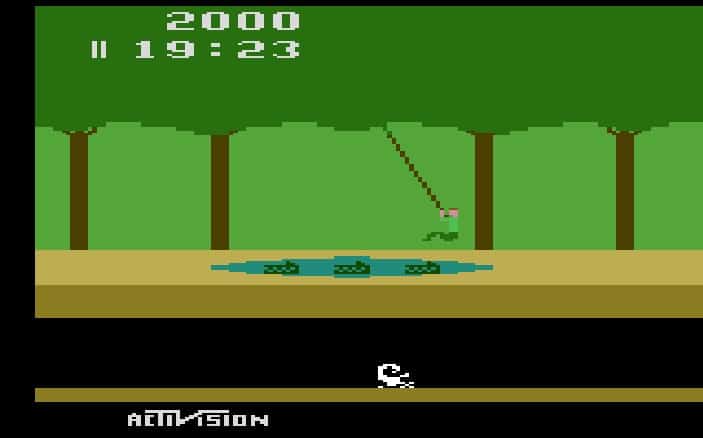
Licensed board games seem like something of a relic of a bygone era these days. However, during the 1970s and 1980s, you had your pick of the litter when it came to board games based off of popular properties. This extended to Activision’s hit for the Atari 2600, Pitfall, with a board game adaptation meant to call to mind the fast-paced jungle exploration of the hit video game.
Players navigated their own explorer through a hazardous map filled with wild animals, rolling logs, and traps. Superficially, this heavily resembles the basic tenets of the hit game. However, where Pitfall diverges from its video game forebear is with the inclusion of decidedly cruel mechanics. Players had the choice to set hidden traps, which became the default method of gameplay. It was often more effective to hedge your bets on a sibling triggering a trap and sabotaging their every effort rather than focusing on easily navigating the board.
This created a thick atmosphere of paranoia, something even the video game was devoid of. Parents trying to play gently with their kids were often caught in the traps set by competitive kids, while younger siblings often fell victim to these hazards. Getting caught in a trap wasn’t a momentary setback either, as it often saw you skipping multiple turns in one go. Construction of the board game was notoriously flimsy as well, with complex cardboard dials that failed, plastic sliders that broke, and more. As such, it wasn’t uncommon for this board game to be met with groans and tears.
Dark Tower
©Margarita Gorskaya/Shutterstock.com
Our final board game is arguably the most ambitious on the surface. Milton Bradley’s Dark Tower is a fantasy game with a giant, motorized tower at its center. This was state of the art for the time, featuring lights, digital displays, and sound effects that acted as something of a game master when tabletop games like Dungeons & Dragons were still relatively niche.
While the game might have been technologically advanced for its time, it had more than its share of mechanical flaws when it came to playing it. Resources were scarce, and player elimination was harsh. As you traversed the board, it wasn’t uncommon to come across random events that saw you just knocked out of the game completely. A single unlucky roll could see you sitting out the entire game for hours on end.
Eliminated players had to sit and watch as the remaining players played arguably a long-form game. The technologically advanced tower was prone to damage, thanks in part to some sensitive key electronics. Bulbs would go out, or batteries would drain, meaning the game came to an unceremonious stop. With typical gameplay taking up to 2 hours on the short end, you’ve got a recipe for utter disaster.
Conclusion
Players are spoiled for choice in 2026 when it comes to board games, with a recent influx of smartly designed titles that are catered towards enjoyable play. The latter half of the 20th century saw them as something of a Wild West, with games being engineered without a thought or care to the lasting mechanics. There’s a reason many of these games are forgotten, and it isn’t just down to the march of time.
The image featured at the top of this post is ©AAlves/Shutterstock.com