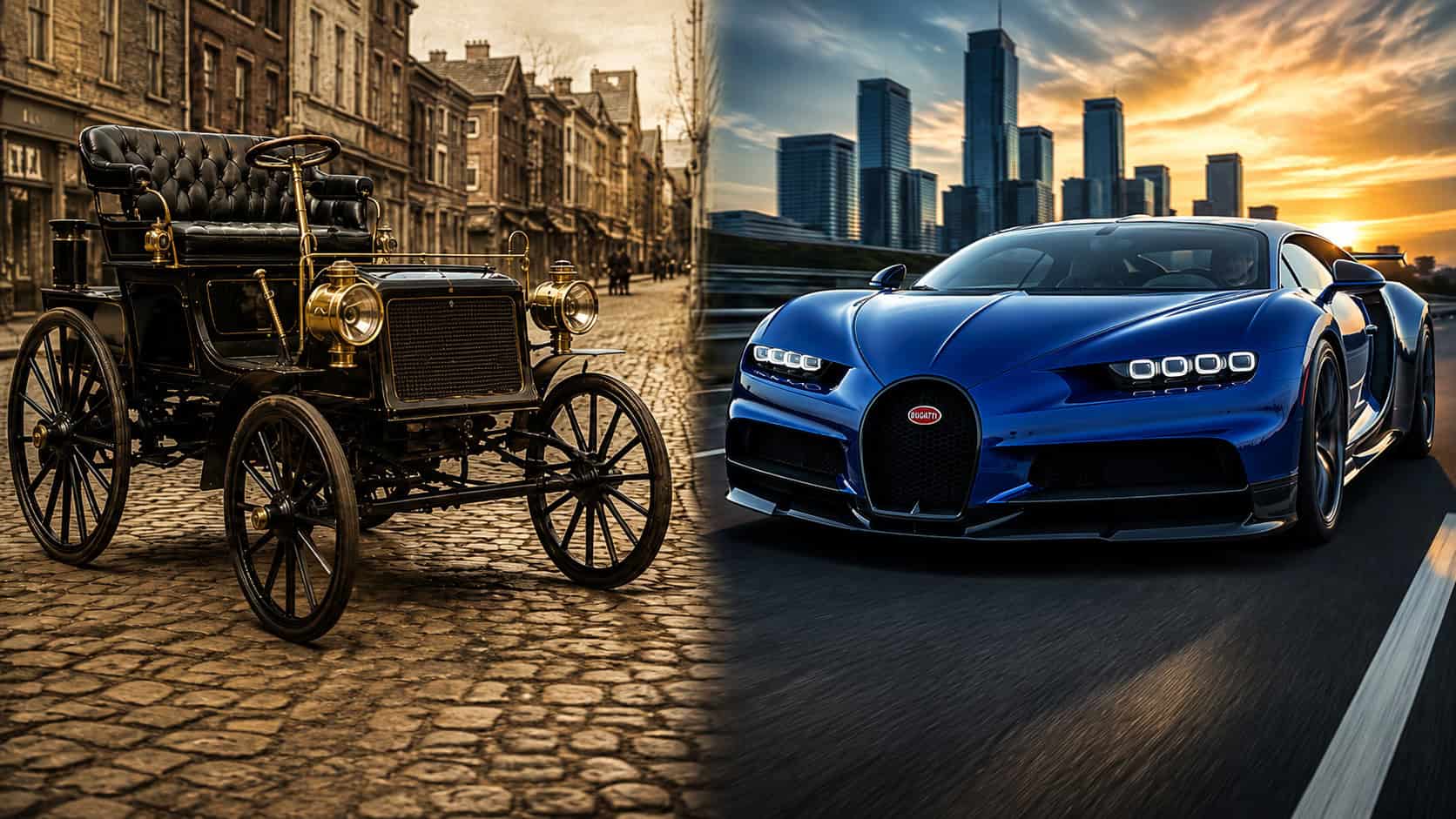

It took decades of engineering, experimentation, and more than a few wrong turns to build the cars we drive today. In fact, the history of the automobile is far messier than the polished machines sitting in modern showrooms might suggest. Early inventors were working without a proven blueprint, and some of their ideas changed transportation forever while others ended in spectacular failure. False starts, product flops, questionable business decisions, and even outright fraud all played a part in shaping an industry that would eventually transform everyday life around the world.
Along the way, engineers had to solve problems involving power, speed, safety, manufacturing, fuel, reliability, and affordability. Some breakthroughs arrived at exactly the right moment, while others nearly disappeared before anyone realized their potential. Even developments we now consider essential were not always obvious successes.
From primitive self-propelled vehicles to mass production, modern safety systems, and increasingly sophisticated automotive technology, the road to the modern car was anything but smooth. Here’s a timeline of some of the biggest advances in the history of the automobile, along with the surprising setbacks, failures, and controversies that nearly derailed them.
1912: The Electric Starter
Henry Leland, the founder and key engineering mastermind behind Cadillac, wanted a self-starting car for a personal reason: his friend Byron Carter died from injuries suffered while hand-cranking a stalled engine.
Charles Kettering, an engineer who’d built his early reputation on cash register motors, took on the job. He had to build a motor small enough to fit under the hood but strong enough to turn a cold engine. He realized that it only needed that strength for a few seconds, not continuously.
The finished system was stranger than it looks in hindsight: four 6-volt batteries wired together for 24 volts, housed in a box bolted to the running board. It worked well enough for Cadillac to order12,000 units.
Hand-cranking effectively excluded most women and older drivers from car ownership, so Kettering’s starter was instrumental in opening the driver’s seat to the wider public.
1932: Ford’s Flathead V8 Brings Performance to the Masses
©National Automobile Museum
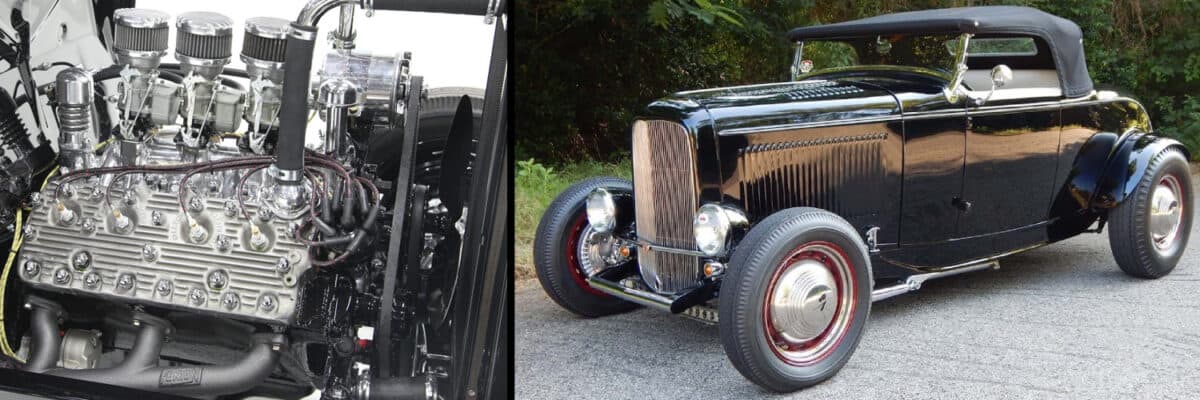
For most early drivers, a car was transportation first and excitement second. That changed in 1932, when Ford introduced its flathead V8 in the Model 18. V8 engines were not new, but Ford put that kind of power within reach of regular buyers and helped make performance part of everyday car culture.
The engine was strong, relatively simple and easy for mechanics and hot-rodders to modify for more speed. Before long, hopped-up flathead Fords were showing up in racing and custom builds. The V8 helped change what people expected from a car. It could still haul the family around, but now it could also be loud, fast and genuinely exciting, setting the stage for hot rods, muscle cars, and America’s lasting obsession with horsepower.
1940: The Automatic Transmission
The Hydra-Matic was General Motors’ first successful attempt to eliminate clutch pedals from cars.
In 1937, Buick and Oldsmobile, two of General Motors’ brands, released a semi-automatic transmission called the Automatic Safety Transmission. Buick’s version had a tight torque-tube driveshaft that shifted so roughly that people hated it, and it failed within a year. Oldsmobile’s version, built on an open driveshaft, shifted smoothly enough for engineers to believe the idea was viable.
That near-failure fed directly into the Hydra-Matic, which arrived as a $57 option on 1940 model-year cars. The transmission offered four forward speeds, no clutch pedal, and no manual shifting once the car was moving. It sold modestly at first, but by 1949 more than a million cars carried it. Rivals with no automatic of their own, including Hudson and Kaiser, were buying Hydra-Matics wholesale from General Motors just to keep pace. Rolls-Royce also licensed the design and used it in Bentleys until the mid-1960s.
1958: Cruise Control
©Edmunds.com
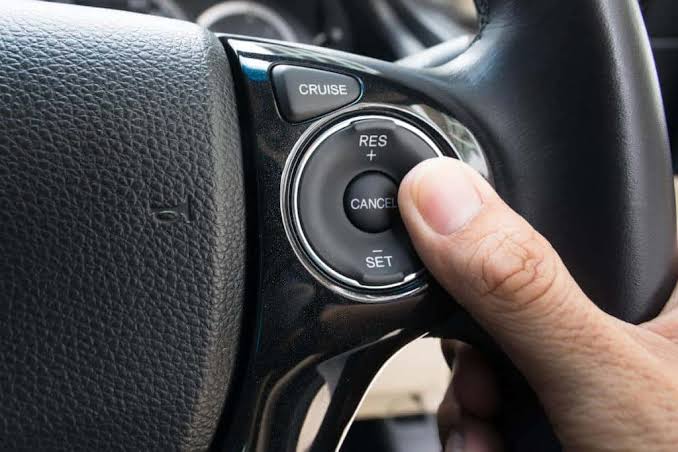
Ralph Teetor, a mechanical engineer at the Indiana auto parts company Perfect Circle, invented cruise control to solve a specific annoyance. Safety wasn’t on his mind initially.
When riding with his lawyer, Teetor noticed that he would speed up while talking and slow down while listening, and the rocking pace bothered him enough to start working on the design and to file his first patent in 1948. Teetor kept refining the device for another decade. The earliest working model, built in 1949, had a glaring hole: it couldn’t hold a set speed on its own since there was no way to lock it in. Teetor added that feature later, worried that without it, drivers might nod off trusting a system that wasn’t really driving for them.
Teetor called his invention the Speedostat. Chrysler branded it Auto-Pilot and introduced it on its 1958 Imperial luxury car. Cadillac came out the following year with its own name for the same idea, Cruise Control, and that’s the one that stuck.
The most interesting fact behind the innovation is that Teetor himself was blind. He never once saw a road while designing a device meant to make driving easier.
1959: The Three-Point Seatbelt

©New Africa/Shutterstock.com
Before Volvo hired Nils Bohlin as its first dedicated safety engineer in 1958, seatbelts were two-point lap straps. A lot of people don’t know that these early seatbelts could cause more harm than good in a crash, possibly leading to serious internal injuries.
Bohlin, who had previously designed ejection seats for fighter jets, spent about a year adapting that aviation logic to a car seat. The V-shaped three-point belt was introduced on the Volvo Amazon and PV544 in 1959, and it worked right away. A study by Bohlin in 1967 analyzed 28,000 accidents and found no fatalities among belted occupants below 60 mph.
Despite its efficacy, the rollout of the three-point seatbelt wasn’t smooth. Automakers worried safety features implied their cars were dangerous; people resisted this too, out of an actual fear of being stuck inside an automobile that had caught fire and/or sunk underwater. Volvo gave away its patents for free. It’s one of the rare safety inventions that became a global standard specifically because its creator refused to profit from withholding it.
1974: The Airbag
©Caito/Shutterstock.com
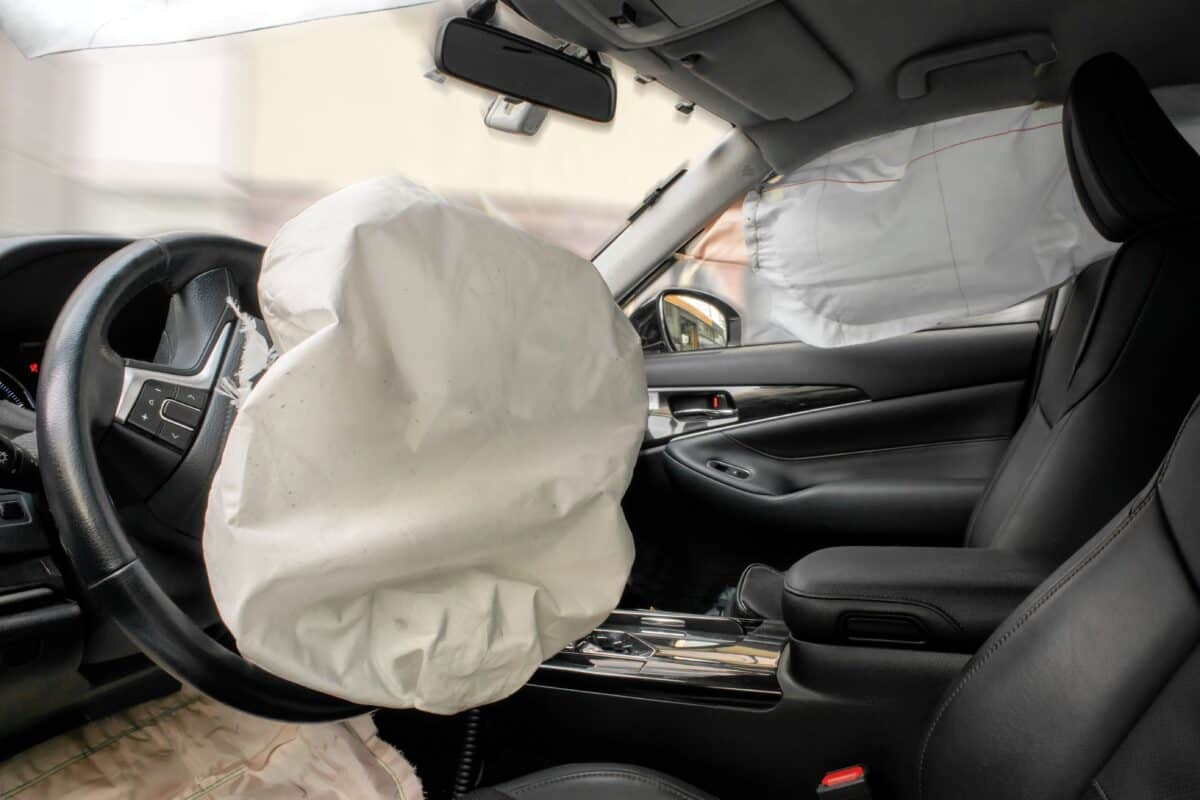
General Motors tested airbags first in a fleet of 1,000 government-owned 1973 Chevrolet Impalas that the public never had a chance to buy. The real commercial debut came a year later with the 1974 Oldsmobile Toronado, which offered airbags as a paid option called the Air Cushion Restraint System, or ACRS. But things didn’t go smoothly, as ACRS didn’t really reach production until late November 1973, nearly two months after the 1974 model year had already started.
Buyers were also very hesitant to buy an extra feature that was only relevant if there was an accident. This led General Motors to drop ACRS from its lineup by 1977. The airbag disappeared from American showrooms for years until Mercedes-Benz revived the idea in its 1981 S-Class and made it stick.
1978: Anti-Lock Brakes
Bosch patented the basic concept of an anti-lock brake in 1936, but the electronics needed to make it work reliably didn’t exist yet. Mercedes-Benz and Bosch spent decades trying to find a workable version, including a fully analog system introduced in 1970. The analog system was discontinued, as it was too unreliable for mass production.
The fix, when it finally came, was digital: a computer that could read wheel-speed sensors and adjust brake pressure in real time. It was unveiled in August 1978 and offered as a paid option on the Mercedes S-Class.
This was the first mass-market car feature to run on a digital computer. This detail tends to get buried under the safety story, but it’s arguably the more consequential one. Every driver-assist and infotainment system traces its origins back to this option box.
Bonus: When Cars Ran on Stranger Things
Not every automotive fuel idea aged well, and a couple never left the workshop.
1826: The Vapor Engine
Before gasoline became common, American inventor Samuel Morey patented a “gas or vapor engine” that ran on turpentine vapor, a close cousin to the ether-based fuels that early tinkerers experimented with. He mounted it to a wagon and climbed aboard to test it. The moment he cranked the engine, it threw him to the ground, and the riderless wagon puttered off down the street and into a ditch. Morey couldn’t find a single buyer for the idea.
1980s to 1996: The Water Fuel Cell
Stanley Meyer claimed his “water fuel cell” could split water molecules to produce hydrogen and oxygen with less energy than it takes to generate those gases, so that cars could run entirely on water. That, however, would contradict the first law of thermodynamics, which is a polite way of saying it couldn’t have worked. Meyer sold dealership rights to the technology to investors, but in 1996, an Ohio court ruled that he’d committed “gross and egregious fraud.” He died in 1998, and conspiracy theories about his death still circulate online.