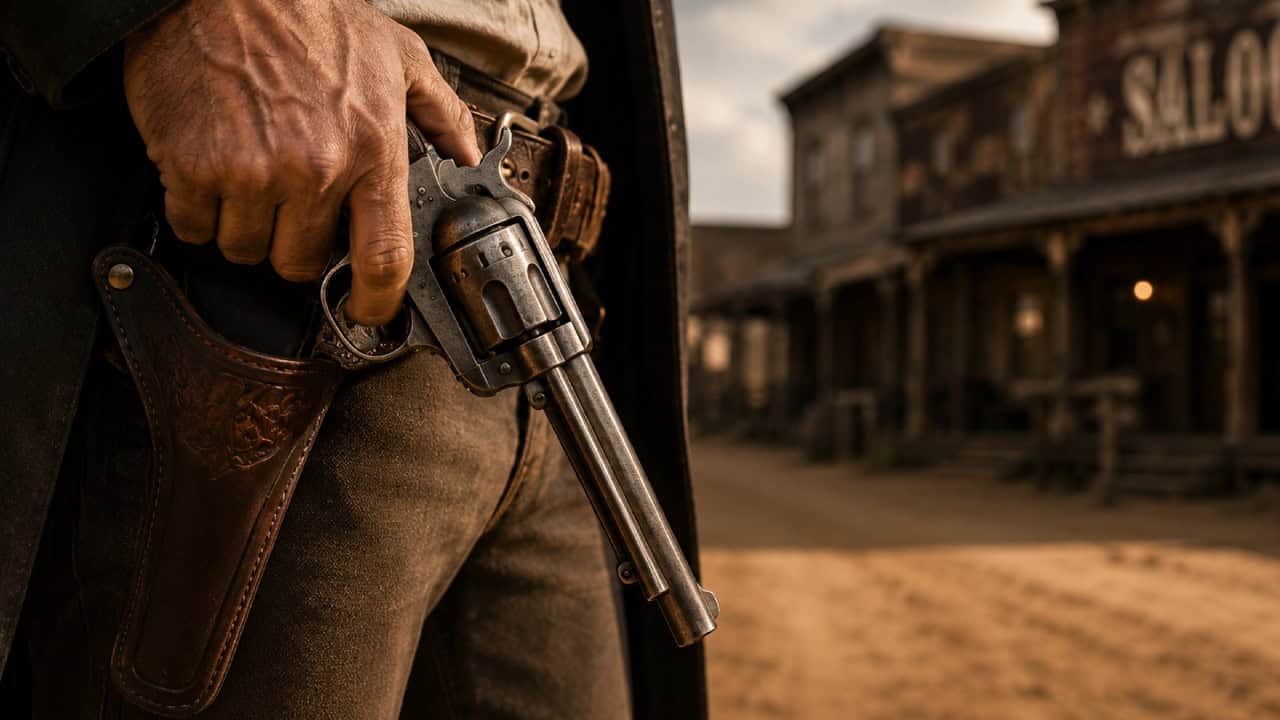

The Old West has been elevated into a legendary era of high noon showdowns and quick draw matches. Dime novels set the scene, and Hollywood did the rest. But the weapons that defined the frontier weren’t props. Some were extremely deadly, and even lethal in ways that had nothing to do with aim or skill. Some were even dangerous to the person holding them.
These are 10 weapons from the Old West that were far more deadly than their reputation suggests.
The Bowie Knife
The Bowie knife is remembered as the utility knife of the frontiersman. It was a long blade, used for skinning game and clearing brush. The fighting version was closer to a short sword than a knife. It had blades ranging from 9 to 15 inches long and the back edge was usually clipped and sharpened into a false edge.
The Sandbar Fight of 1827, on the Mississippi River near Natchez, is where the Bowie knife earned its notoriety. Jim Bowie came as a second for a duel, which turned into a melee. He was shot, pierced by a sword cane, and hit by a pistol blow strong enough to drive him to his knees. Nevertheless, having received several bullets and numerous stab wounds, he managed to kill one man and wound another seriously before the fight was over.
Knife fights in that era were prolonged and brutal. The wounds they left killed plenty of men who had initially walked away from the fight.
The Derringer
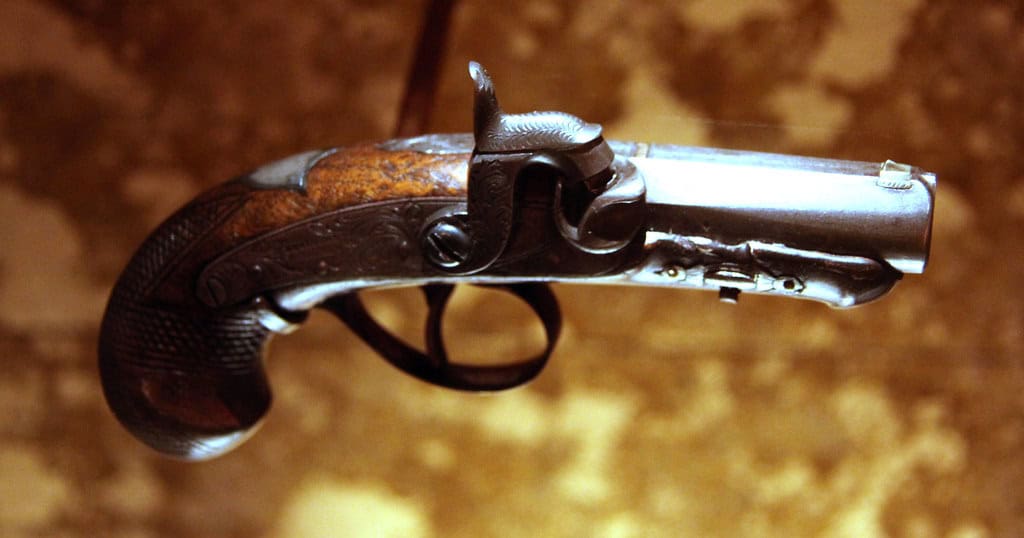
©"John Wilkes Booth derringer used to kill Abraham Lincoln 02 – Fords Theatre – 2012-05-20" by Tim Evanson is licensed under BY-SA 2.0. – Original / License
The Remington Double Derringer doesn’t have the best reputation among gun owners. It’s a small, single-shot weapon that’s easy to conceal in your palm and chambered in modest calibers. It looks like an emergency backup for someone who couldn’t manage a real firearm. This reputation doesn’t do it justice. The derringer was created with one purpose: shooting someone nearby who has no idea you’re carrying. It sent the bullet moving at around 425 fps, slow enough that it could actually be seen during the shot, but lethal at the distances it was built for and especially handy at card tables and saloon bars.
The Derringer was made famous on April 14, 1865, when John Wilkes Booth entered Ford’s Theatre armed with one that was small enough to get past a guard and shoot Abraham Lincoln, the President of the USA. A weapon no one took seriously enough to search for was used to change the course of American history.
The Sawed-Off Shotgun
The sawed-off shotgun is the fallback weapon used in Hollywood by those who have exhausted all other alternatives. In the Old West, it was the other way around. The sawed-off shotgun was possibly the most efficient weapon in the frontier West when it came to ambushes and stagecoach defense. When loaded with 00 buckshot from a 12-gauge shotgun at close range, the wounds created are similar in severity to high-velocity rifle shots, but with multiple simultaneous wound tracks instead of one.
Stagecoach guards, known as express messengers, used the sawed-off shotgun loaded with buckshot as their main weapon simply because one well-aimed shot could stop a mounted attack. The shotgun messenger became his own job category at Wells Fargo. It was no fallback weapon at all.
The Colt Walker Revolver
Most people think the Peacemaker was the definitive Old West handgun. But that title belongs to the Colt Walker Revolver. In 1847, the gun held 60 grains of black powder per chamber, which is twice as much as conventional revolvers did, and until 1935, when the .357 Magnum came to market, it was the most powerful commercially produced handgun ever made.
This risk went both ways, though. The Walker could also kill the person holding it. The 60 grains of powder put a lot of strain on the cylinders, which were not always able to take the strain. Of the original 1,000 military-issue Walkers, nearly 300 came back with ruptured cylinders. Soldiers would fill the mouth of the chamber with lard before firing the weapon to avoid one spark setting off all six chambers at once. Captain Samuel Walker, the Texas Ranger who co-designed the gun, died during the Battle of Huamantla on October 9, 1847, allegedly carrying two of his own revolvers.
The Lasso
©Tanison Pachtanom/Shutterstock.com
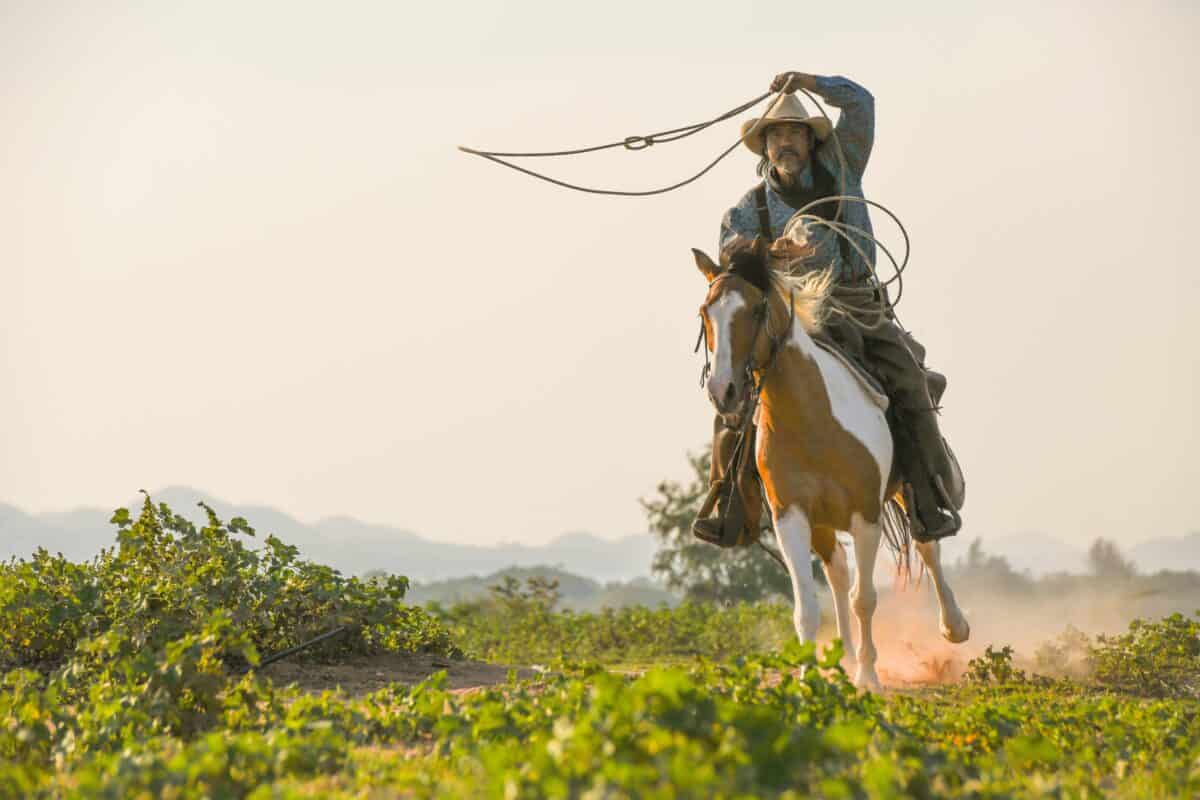
Nobody sees the lasso as a weapon, and that’s exactly why it was such a dangerous tool. The rawhide riata carried by the vaqueros and cowboys was ubiquitous in the Old West, as natural as the saddle itself and completely unregulated. A town that insisted on pistol check-in at the saloon didn’t say anything about the coil of rope found on every rancher’s saddle horn.
It would be thrown at full gallop with the precision that came with years of handling cattle, effectively dropping a person as easily as a steer. Ropes were used for dragging people behind horses and conducting summary hangings from horseback and convenient tree branches in range wars and frontier justice cases. The accounts of range war violence speak about the lasso as if it were any purpose-built weapon. It did its job silently and was a weapon of choice for many on the range.
The Winchester Model 1873
The Winchester was known as a symbol. The phrase “The Gun That Won the West” appeared on the receiver itself. What is often ignored is what it actually meant to face one in a fight.
A Winchester held 15 rounds of .44-40 without reloading, in contrast to the single shots or six shots of most opponents. The fullest demonstration of that gap came at the Battle of Little Bighorn, fought in June of 1876. Sioux and Cheyenne warriors equipped with Henrys and Winchesters outnumbered and outgunned Custer’s 7th Cavalry, but their single-shot Springfield Model 1873 rifles fired copper cartridges that expanded under heat and were prone to jamming the weapon. Soldiers who ran out of ammunition had to use their knives to remove the stuck cases, while their opponents cycled through 15-round magazines.
The Tomahawk
©Rawpixel.com/Shutterstock.com
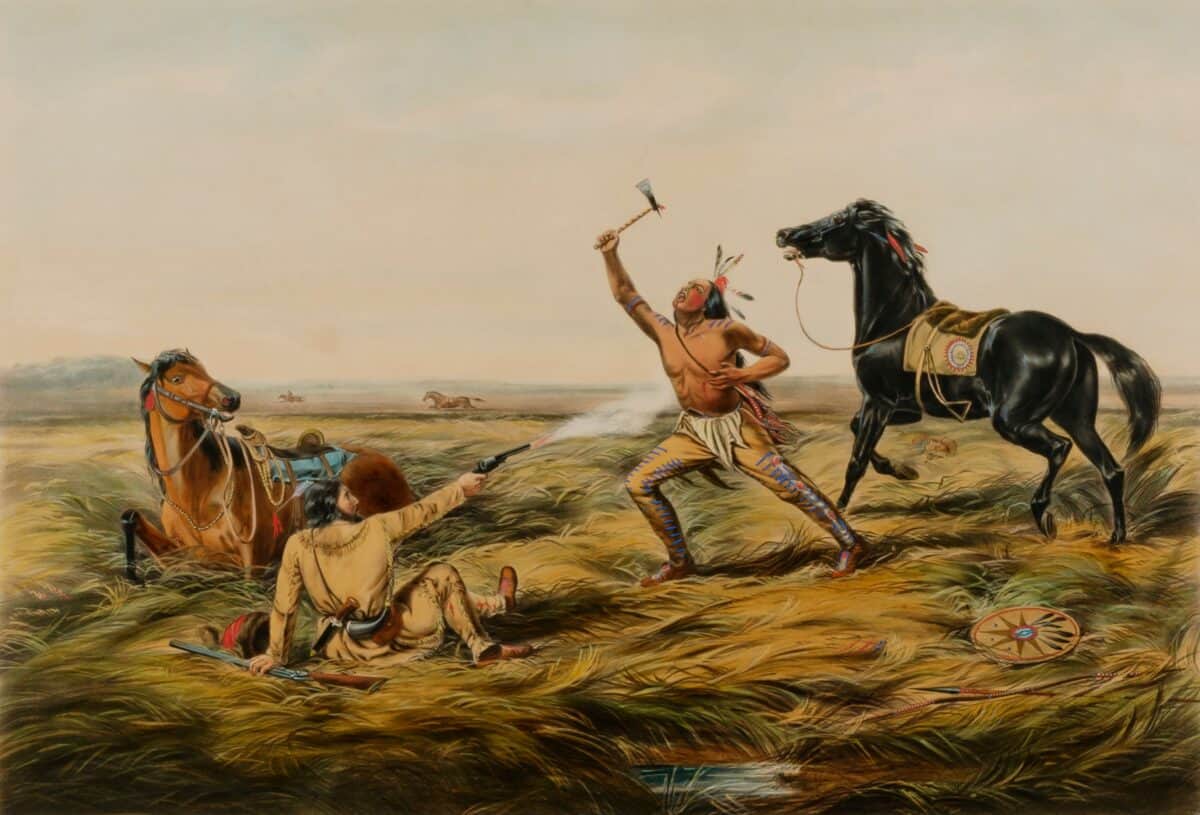
The film and television portrayal of the tomahawk as a throw weapon has been firmly entrenched in the public consciousness. The high arc through the air, followed by the satisfying thunk into the wooden post, is iconic. Expert throwers could accurately strike targets at 20 to 30 feet, with disabling force. But that was the exception, not the primary use.
Close-in fighting saw the tomahawk used as a quick, light hatchet. Quicker and lighter than an axe and far more maneuverable than a long gun at arm’s length, it was brutally effective in the wild melee common to frontier warfare. Once the charge brought combatants within reach of each other, it was more dangerous than a pistol to anyone who had already fired.
Period accounts from frontier soldiers and trappers describe surviving gunshot wounds in the same battle where tomahawk wounds were fatal. The Plains Indians used it and the frontier scouts learned to use it as well. It remained in constant use precisely because nothing else did the same job at the same range.
The Pepperbox Revolver
This gun looks like a piece of folk art, not a weapon. It has several stubby barrels arranged in a ring around an axis, which turns to align each barrel with the hammer. Some 200,000 to 300,000 units were produced from 1830 to 1860, and the gun could be lethal both to targets and to whoever was holding it.
The percussion caps in the pepperbox were located side-by-side without any separation between them. Chain-fire, where one shot ignited the surrounding chambers at once, was known to happen. The result was a small explosion in the shooter’s hand.
In an account from the 1849 California Gold Rush, one can read about George Dornin, a 19-year-old who arrived in San Francisco with an Allen pepperbox and threw it away, considering it “more dangerous to the shooter than to the shot-at.”
The Black Powder Flask
©Dariusz Wojtaluk / iStock via Getty Images
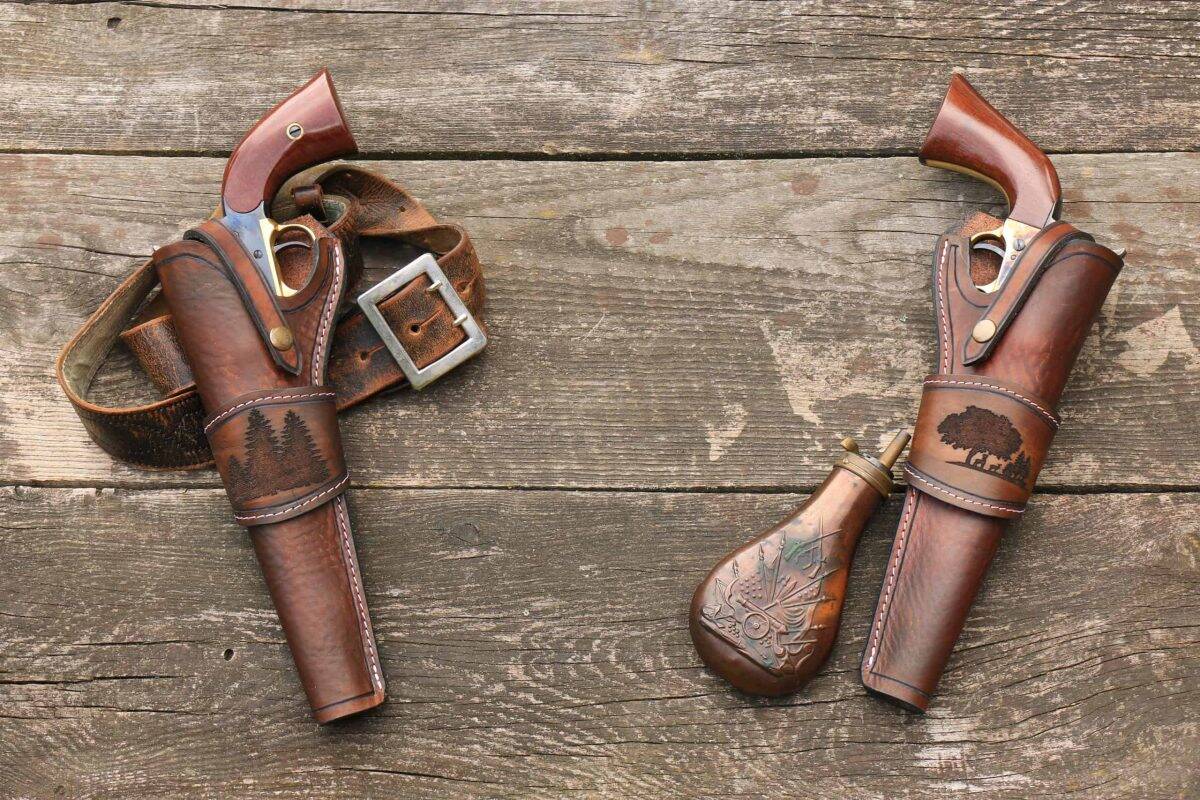
During the first half of the frontier era, when metallic cartridges had yet to become common, every frontiersman would carry loose black powder in a flask or a horn. While it was not strictly a firearm in a traditional sense, it was the fuel for every firearm that the frontiersman owned, and one of the most reliably dangerous objects on the frontier.
Black powder has an ignition temperature of about 572 degrees Fahrenheit (300 degrees Celsius). If there was a spark from a failed shot or from a campfire close to an open flask, it was no minor accident. Several fatalities in the pre-war and early frontier era resulted from loose powder explosions. The slow replacement of loose powder with self-contained metallic cartridges in the 1860s and 1870s took place because loose powder was killing people who weren’t fighting.
Men died from their own ammunition before they ever raised a weapon. The flask itself was never seen as a weapon but it sure killed like one.
The Spencer Repeating Carbine
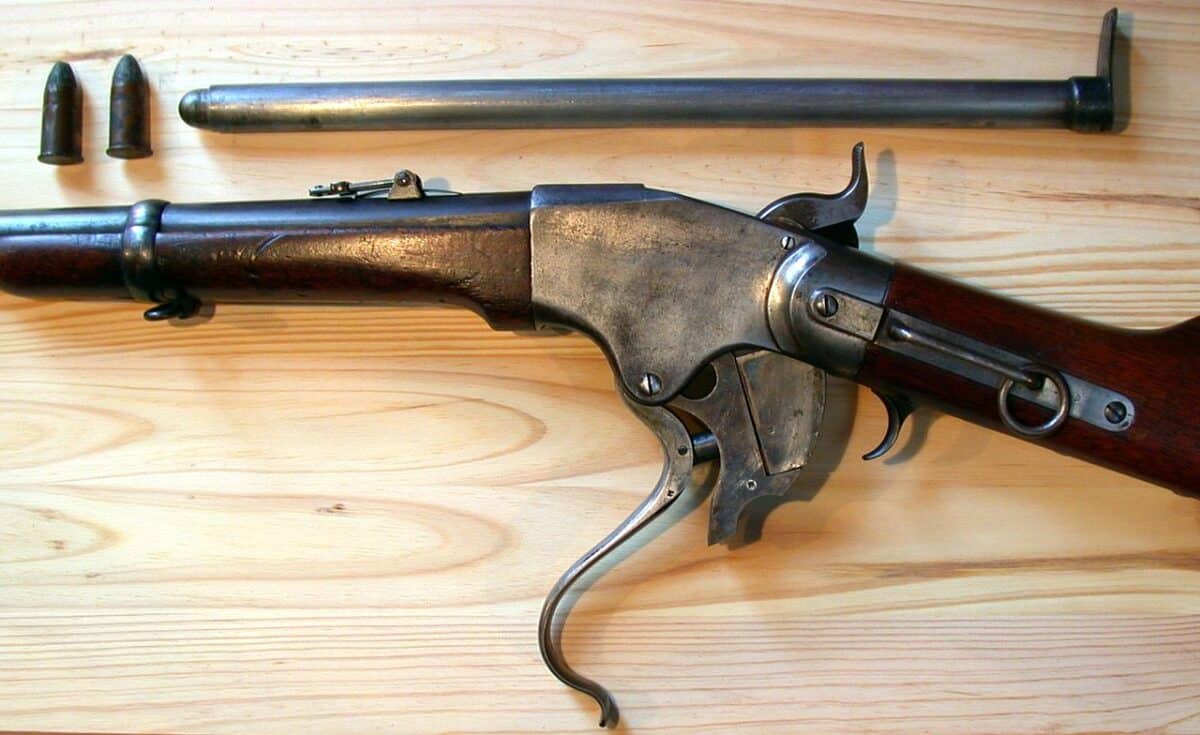
In the decade between the end of the Civil War and the rise of the Winchester, the Spencer Repeating Carbine was the deadliest shoulder arm in the Wild West, and those who met it had no idea what they were up against.
The Spencer held seven shots in a tubular magazine located in the butt stock, at a time when the standard military arm was a single-shot muzzle loader. Confederates met this weapon in action during the Civil War and called it a gun that could be loaded on Sunday and fired all week long. After the Civil War ended, surplus Spencers flooded west at low prices, putting a seven-shot repeater in the hands of frontiersmen, outlaws and scouts who understood exactly what they had.
In the Battle of Beecher Island in September 1868, Major George Forsyth and his troop of only fifty scouts, all armed with Spencer repeating rifles, managed to resist the attack of a Cheyenne force roughly twenty times their size for nine days.