























15 “American” Inventions That Actually Came From Somewhere Else
America has always been a land known for taking in people from all over the world. People bring their traditions along with them. Some foodstuff is brought to America by immigrants, some technology travels across the ocean in someone's suitcase, and some sport finds its formal codification on American soil thanks to the immigrant who grew up playing it somewhere else. And within one generation, it has become part of the national psyche in such a way that its foreign roots fade away.
No one is lying, exactly. The U.S. did refine many of these things. They were commercialized and scaled up, and in some cases, improved. But refinement is not invention, and in this case, the two have been quietly swapped for a long time.
Here's a list of 15 inventions that Americans think they invented, but didn't. Some of them are thoroughly documented but ignored. Some of them have been buried under decades of branding. A few will feel like a mistake. They're not.
Blue Jeans
What could be more American than good ol’ blue jeans? The truth is that the most American garment you can think of actually came from Europe. The word "denim" comes from the French town of Nîmes and originally referred to a strong cotton twill known as "serge de Nîmes." "Denim" is an Anglicized version of "de Nîmes." It’s also worth noting that, in the 16th century, there were durable cotton work trousers worn in Genoa, Italy, and "jeans" probably comes from the French word for Genoa: "Gênes."
Levi Strauss, who is considered the inventor of the blue jean in 1873, was actually born in Bavaria. His fellow inventor Jacob Davis, whom he patented the invention with, came from Latvia. The riveted denim trousers were created in the United States by immigrants from French fabric. The origin story is about as American as the name "Levi."
The Hamburger
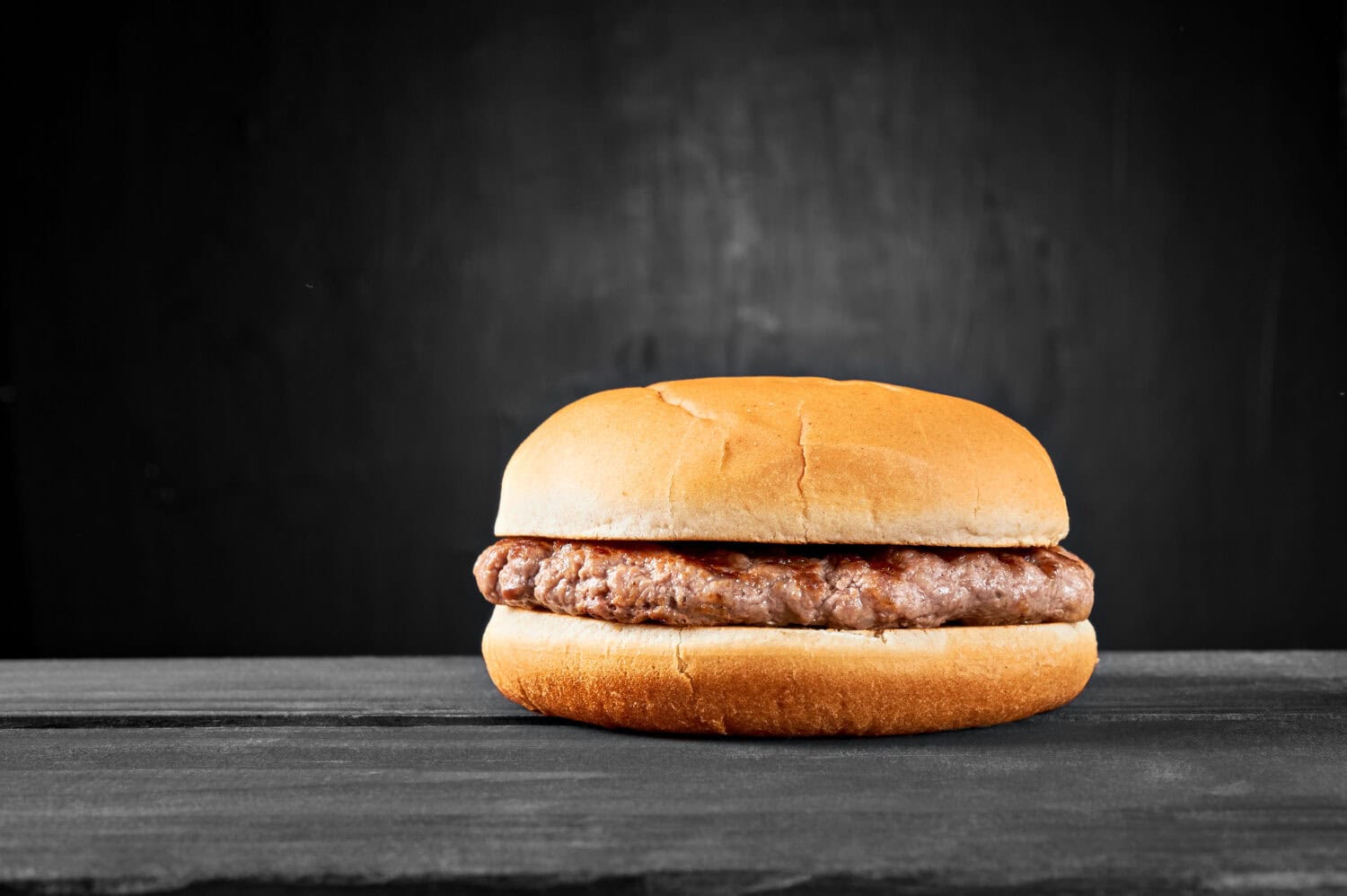
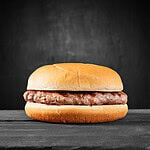
The hamburger was a common food for German sailors and working-class immigrants during the 19th century. Minced beef, sometimes smoked or salted, shaped into a patty and eaten as a cheap, filling meal. German immigrants brought it to America, where it would later encounter a bun and the griddle. The name was never subtle about where it came from: Hamburger comes from Hamburg, Germany, where it was known as the Hamburg steak.
America made the Hamburg steak into an industry worth hundreds of billions of dollars. McDonald's, Burger King, and Wendy's are true American institutions. The thing they built their empires on is not.
The Hot Dog
Frankfurt claims it. Vienna claims it. Both cities' claims are valid, and their disagreement has been going on long enough to become a historical footnote. But one thing is for sure: the sausage traveled to the United States along with the German immigrants in the nineteenth century. "Frankfurter" and "wiener" are hardly ambiguous about the geography. Americans added the bun and that’s about it.
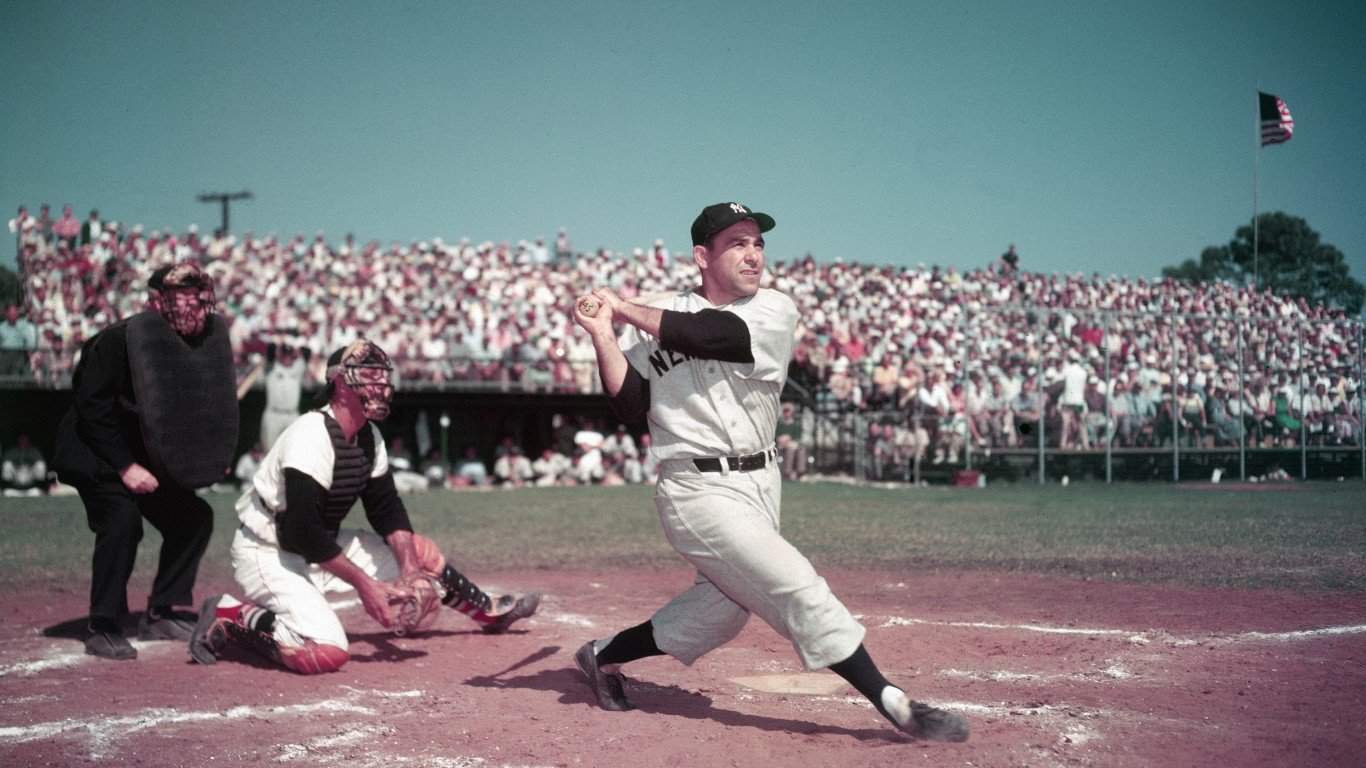
Baseball
Legend has it that baseball was invented by Abner Doubleday in Cooperstown, New York, in 1839. This myth was made up by a committee in 1905, and even the committee's own research didn't really support it. Historians found out that baseball can be traced back to English stick-and-ball games, most notably rounders, which were popular throughout England and first written about in 1744. The rules were formalized and codified in America, which is why the myth took hold.
The National Baseball Hall of Fame is located in Cooperstown. The game's actual birthplace is somewhere in the English countryside, several centuries earlier.
The Fax Machine
The fax machine is generally thought of as a creation that originated from American offices in the 1980s. But the idea behind it was patented by Alexander Bain of Scotland in 1843, which makes it older than even the telephone. Arthur Korn of Germany invented the first working system in 1902 by transmitting photos over telephone lines across Europe before it reached American shores. When the fax machine finally conquered the American office environment, it had already been a European invention for nearly a century.
The Credit Card
What’s more American than being able to buy something you can’t afford with credit? The credit card is such an American institution that its foreign roots are hardly ever mentioned. The idea of the charge card was invented by the British banker John Biggins in 1946, and intended for use by clients of his Brooklyn bank for making purchases from local merchants. Diners Club adopted the idea in 1950 and made a consumer product out of it.
America industrialized consumer credit and spread it across the world. The idea of buying now and paying later was born in the mind of a British banker in Brooklyn.
The Automobile
Henry Ford and his association with the automobile have become synonymous with each other in America, and it’s no wonder. In 1908, he developed the famous Model T, which made cars available to ordinary people and revolutionized the transportation industry. However, Ford did not invent the car itself. Carl Benz in Germany patented the first true internal combustion automobile in 1886, more than two decades before the Model T appeared. Gottlieb Daimler and Wilhelm Maybach built their own engine and fitted it to a carriage in 1885, a year before Benz filed his patent.
While Ford didn’t invent the automobile, he did perfect the assembly line and brought the price down, making it available to the middle class.
Television
Philo Farnsworth is the name associated with television in America, and his contribution was real, but the foundational work took place elsewhere. Boris Rosing, a Russian engineer, used a cathode ray tube for transmitting images as early as 1907. John Logie Baird, a Scottish inventor, publicly demonstrated moving television pictures in London in 1926. Both men were building the technology that Farnsworth and others in the U.S. would later develop into a commercial product. American companies industrialized television. The foundational work came from Russia and Scotland.
The Lightbulb
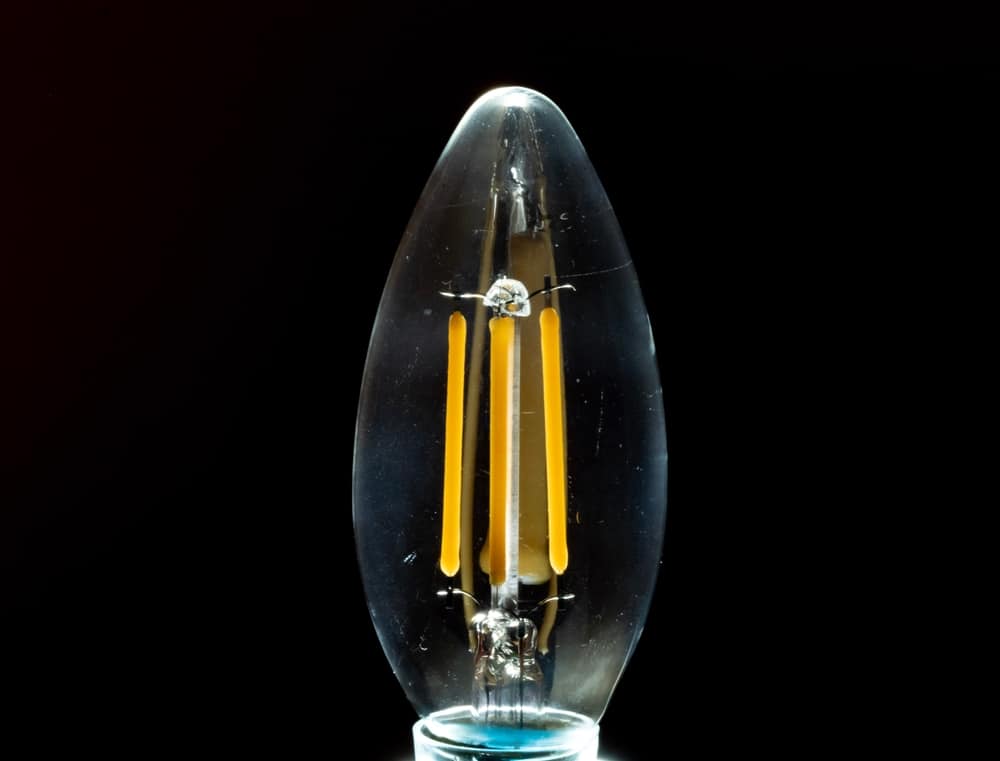
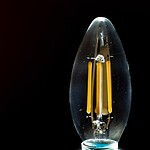
The patent for the incandescent light bulb in America was filed by Thomas Edison in 1879, and his is the name that comes to mind immediately when one asks about its inventor. But in February 1879 Joseph Swan, a British inventor working in Newcastle, had already demonstrated the incandescent bulb using a carbon filament, several months prior to Edison's public demonstration. Swan had the British patent. Edison had the American patent. Edison and Swan finally merged their companies in 1883 to avoid prolonged litigation.
Edison's invention proved to be more durable and commercially practical, and that’s a real and significant achievement. But Swan got there first, and he did it in England.
The Assembly Line
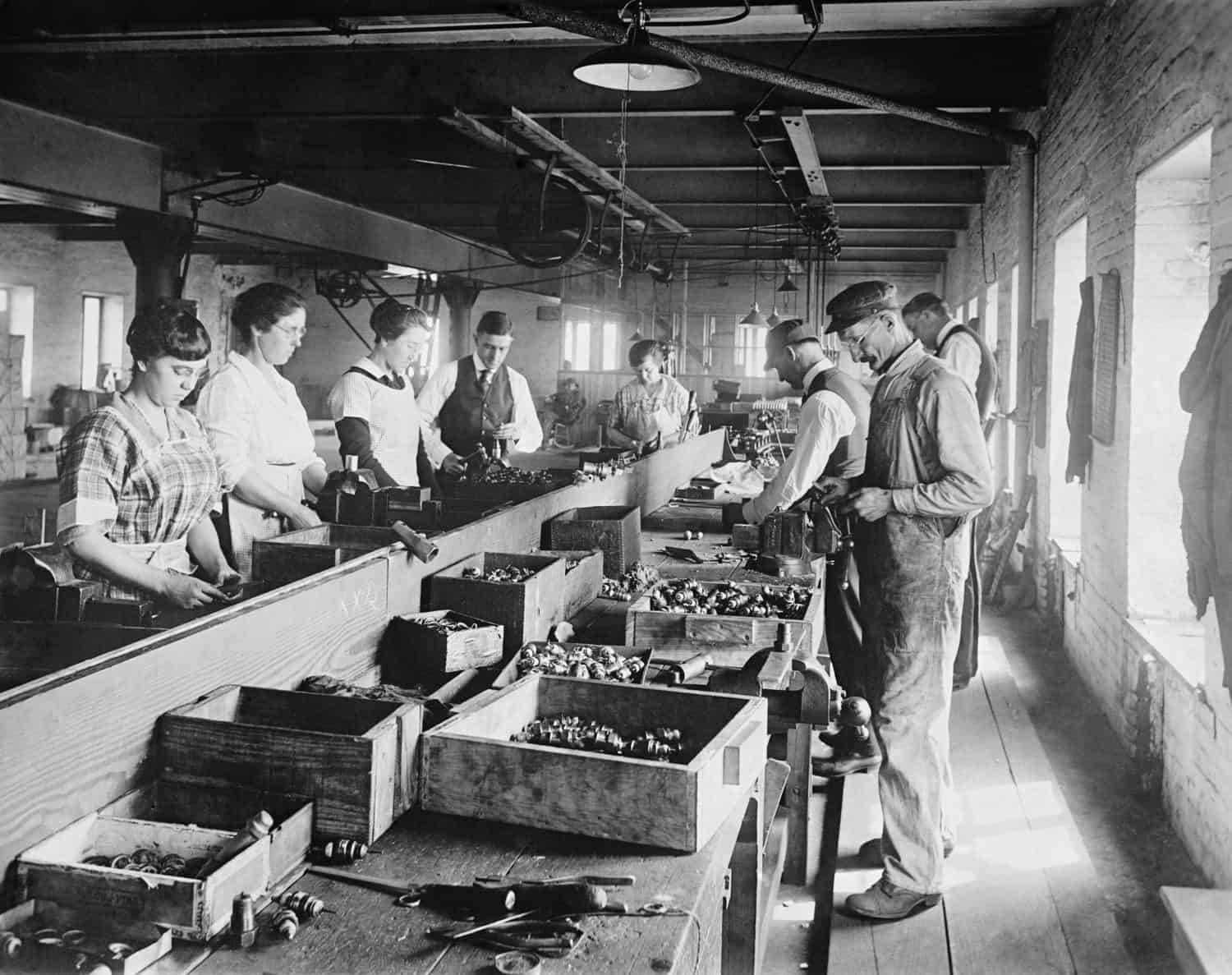
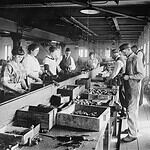
Henry Ford’s Highland Park plant adopted the full assembly line production process in 1913. But the idea of sequential production, in which each employee does one operation as the item progresses along the line, goes back more than a century before Ford. The Portsmouth Block Mills of England, constructed in 1801-1803 by engineer Marc Brunel, made use of the process, employing special machines and the sequential approach to manufacture pulley blocks for the Royal Navy. It is the first documented example of industrial production line manufacturing.
Ford scaled it and adapted it to consumer products. He didn’t think of it first. He was beaten by a British naval engineer by 110 years.
Decaffeinated Coffee
Decaf is so thoroughly embedded in American office and diner culture that it barely registers as something that could be invented outside of the U.S. Ludwig Roselius, a German businessman and inventor, created the first commercial decaffeination process in 1903. After becoming convinced that caffeine had contributed to the death of his father, he patented the process and sold decaf coffee under the brand Kaffee HAG in Europe and later Sanka in the United States.
The product is German. The name Sanka is a contraction of "sans caféine" in French. The American diner staple has a European birth certificate.
Apple Pie
We all love saying "as American as apple pie," but there doesn't seem to be any attempt at verifying the accuracy behind the statement. The oldest recorded apple pie recipe came about in England in 1381. When the apple pie was introduced in the American colonies by European settlers, it had been a staple of English and Dutch cuisine for centuries.
As for the apple itself, its ancestor comes from Central Asia, in the region of modern Kazakhstan, where it grows wild. And it was known in Europe long before it reached North America. America made apple pie ubiquitous. It didn’t make apple pie.
Democracy
Americans often think about democracy as something that could have only been invented in America. It’s often thought as an invention of the Founding Fathers that came to them in 1787 in Philadelphia. The Greeks would like a word. The reforms carried out by Cleisthenes of Athens in 508 B.C. created the first known democratic constitution, where the people had the right to vote. The Romans took the idea further, developing their republican system, while Enlightenment thinkers in Britain and France theorized the modern form. The Founders were well-read students of all of it.
The American Constitution is indeed an extraordinary document. However, it did not invent the principle that lies behind it. That happened roughly 2,300 years before that and considerably further to the east.
The World Wide Web
While the Internet itself, referring to the network technology, has true American origins in ARPANET, the Defense Department's project in the late 1960s, the World Wide Web is different. It was the British scientist Tim Berners-Lee who proposed the web in 1989 when he was working at CERN in Switzerland and implemented the first web browser and web server in 1990. He invented the hyperlink structure, URLs, and HTTP, which is the architecture that makes the web work.
When most people say "the internet," they mean the web. It is a British invention implemented in Switzerland on top of American infrastructure.
The image featured at the top of this post is ©Getty Images / Getty Images