
























12 Everyday Objects That Are Way Older Than You Think
Everyone has an approximate timeline of inventions in their heads. Sunglasses? Probably the 1920s. Vending machines? Sometime in the middle of the twentieth century. Condoms? Maybe the Victorian era. Toilets? Obviously very recent.
Almost all of these timelines are wrong by thousands of years. That’s because history only takes notice when an object is named or sold, but not when it was actually manufactured for the first time. Everything that happens previously tends to be forgotten.
Today, we’re having a look at twelve inventions people believe in as being modern, but whose story started way back.
Sunglasses
The very first commercial sunglasses were made by Sam Foster and sold in Atlantic City in 1929. And that is what everyone remembers about them.
However, the earliest examples actually date back to the first century AD. They belonged to indigenous peoples of the Iñuit ethnicity inhabiting areas in Arctic Russia, Alaska, Canada, and Greenland. They had to deal with snow blindness and used the materials that were at hand in their environment, like walrus ivory, whalebone, bark, or even driftwood, with slits narrowing down the amount of light hitting the eye.
Function-wise, the purpose of the primitive eyewear was no different from that of contemporary polarized glasses. They were made in order to reduce glare, protect eyesight, and ensure that you can actually see under the bright sun.
Breath Mints
Altoids were invented in the 1780s, while Tic Tacs first hit the market in 1969. But the concept of breath mints is far older than either.
In ancient Egypt, about 3,500 years ago, the locals were dealing with bacterial decay and rotting teeth, so they invented a recipe for breath mints that included a mixture of spices and aromatics such as frankincense and cinnamon boiled in honey. These recipes can be found in Ebers Papyrus, one of the oldest medical documents known in history, dated back to 16th Century BC.
It makes sense that Egyptians would be the ones to invent mints. Their flour had so much sand ground into it by their stone mills that tooth decay was rampant. The mints masked the problem, but their teeth were still rotting from chewing on literal sand.
Vending Machines
Vending machines feel like a product of 20th-century convenience culture. Fluorescent-lit, metal boxes dispensing chips and soda at airports and office lobbies. But the concept is far older than it looks. The first vending machine dates back to ancient Greece. It was invented by Heron of Alexandria, an ancient Greek mathematician and engineer active around the 1st or 2nd century AD.
Heron's machine dispensed holy water in Egyptian temples. A user inserted a coin into a slot at the top. The coin landed on a lever inside, its weight tilting it and lifting a plug that was blocking an opening. Water poured out until the coin slid off the lever and the plug dropped back into place.
Nearly two thousand years separate Heron's coin-operated holy water dispenser from the vending machines we get our snacks from, and the crazy thing is that they operate in a fairly similar way.
Alarm Clocks
The first mechanical alarm clock is generally credited to American inventor Levi Hutchins, who built his version of the device in 1787. Hutchins’ alarm clock could only ring at 4 AM, so it didn’t really work as intended, unless you were willing to commit to a whole new routine. Turns out that the ancient Greeks had already come up with something more practical.
The original alarm clock traces back to ancient Greece. Around 400 BC, Plato owned a large water clock designed to emit a sound at a set time. It used to wake students for early morning lectures.
An engineer called Ctesibius, working around 285 to 222 BC, went a step further, designing a water clock with a dial and pointer to display the time, and a sophisticated alarm system that used pebbles dropping onto a gong.
The principle, to use a timed mechanism to trigger an audible alert, is unchanged. What changed over two millennia is the energy source (water to springs to electricity) and the snooze button, which ancient Greeks would almost certainly have also invented if given enough time.
Door Locks
It is believed that the pin tumbler lock which is at the core of almost all door locks today was invented by the American inventor Linus Yale Jr. The first patent for such a lock was taken out by him in 1861, and the model he came up with formed the basis for the locks used in most front doors today.
However, the underlying mechanism for said lock was first described six thousand years ago in Egypt. The Egyptian pin tumbler lock was created out of wood. It consisted of a horizontal bolt of the door which could be unlocked by raising the pins using a wooden key. It was a long instrument, consisting of multiform pins, and using a unique key for each lock.
Linus Yale Jr. didn’t invent this locking method; he just scaled it down and mechanized it.
High Heels
High heels have become so ingrained as women's footwear that they cannot even be conceived as anything else. Stiletto, kitten, or block high heels all feel like they belong nowhere else than in a woman's wardrobe. But they didn't start that way.
Originally functional in nature, Persian cavalrymen needed heeled boots because high heels helped them stay locked into the stirrups when they were riding. When Persian ambassadors appeared in Europe at the beginning of the 17th century, European nobility borrowed the trend but only used it for decorative rather than equestrian purposes. The man who wears heels does not do physical labor and can afford expensive footwear.
The evolution took place slowly during the 18th century when masculine fashion began to take a low heel shape, and high heels became a symbol of feminine footwear.
Condoms
Traditional accounts place the history of the condom during the sixteenth century in Europe, when sheaths made out of linen were recommended as protection against syphilis, which had spread across the whole of Europe at that time. The modern rubber condom came even later, with the development of rubber production in the nineteenth century. But the origins of the original condom go much further back than either.
One of the items found during the opening of Tutankhamun's tomb in 1922 was an unusual one: the young king's condom. It consisted of a linen sheath lubricated with olive oil and connected to a string used for attaching it to the body. Its age is estimated as around 1350 BC.
The condom appeared thousands of years before the rubber version we know today. Technology evolved, but its purpose remained the same.
The Toothbrush
When we think about the toothbrush, with its plastic handle and nylon bristles, it seems entirely contemporary. The first version to be mass-produced was made at the end of the 18th century, and animal hairs were substituted with nylon bristles only in 1938.
The miswak came much earlier. Also known as the frayed-twig toothbrush, it was made from Salvadora Persica twigs and invented by the Babylonians some 5,500 years ago. It was later adopted by the Medieval Arabic world due to frequent usage.
The function of the toothbrush, cleaning teeth with bristles on a handle, has not changed in any essential manner since ancient Babylonians started rubbing twigs against their teeth. Only the materials changed, and that’s probably a good thing.
Chewing Gum
The name Wrigley is synonymous with chewing gum. The company launched its first gum called Juicy Fruit in 1893. It has remained dominant in the market since then. The gum stick packaged in foil seems to be a product of the modern food industry, but they’ve been around for thousands of years.
In ancient times, the Greeks chewed mastic, a substance made by tapping a resin from a tree native to the Greek island of Chios. The Mayans used to chew chicle, another latex substance, which came from the sapodilla tree. But it still goes back further.
Finnish researchers discovered birch bark tar with bite marks in it, dating back almost 10,000 years. It’s the earliest chewable products ever found. It's safe to say that before Wrigley ever came up with the commercial gum, humans had already been chewing for thousands of years.
The Umbrella
The name Wrigley is synonymous with chewing gum. The company launched its first gum called Juicy Fruit in 1893. It has remained dominant in the market since then. The gum stick packaged in foil seems to be a product of the modern food industry, but they’ve been around for thousands of years.
In ancient times, the Greeks chewed mastic, a substance made by tapping a resin from a tree native to the Greek island of Chios. The Mayans used to chew chicle, another latex substance, which came from the sapodilla tree. But it still goes back further.
Finnish researchers discovered birch bark tar with bite marks in it, dating back almost 10,000 years. It’s the earliest chewable product in history. It's safe to say that before Wrigley ever came up with the commercial gum, humans had already been chewing for thousands of years.
The Battery
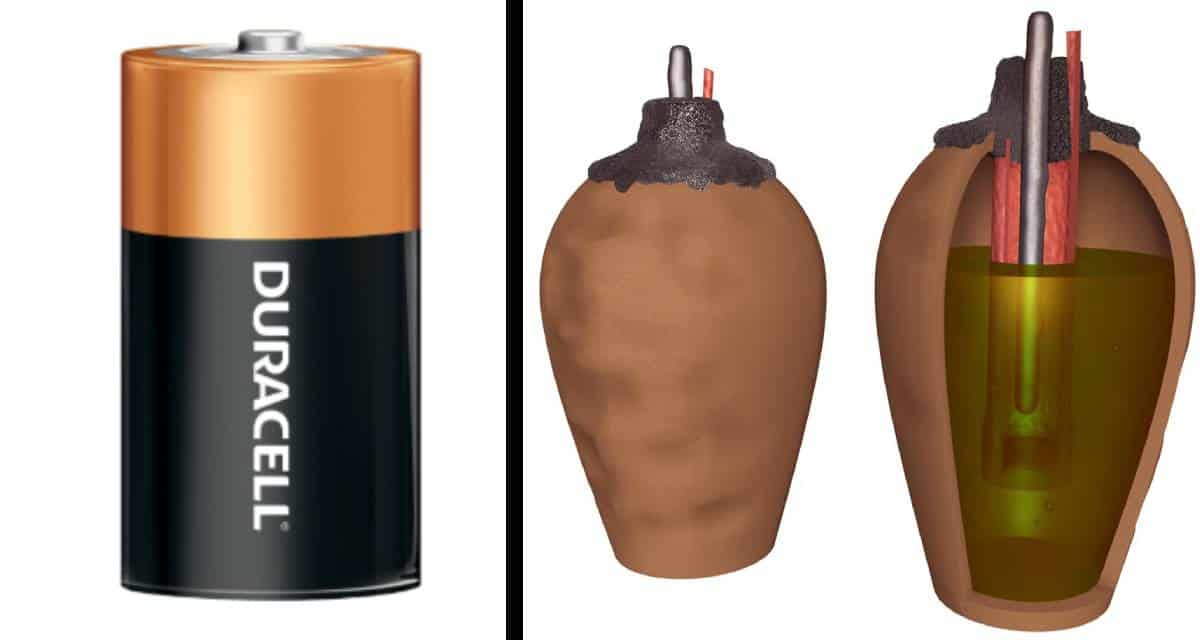
The battery is almost always linked to Alessandro Volta, who invented the voltaic pile in 1800. That isn't too far off since the voltaic pile was the first man-made electrical battery, which paved the way for the electrical age that followed.
However, the history of the battery before Volta is stranger than most people realize. In 1938, a German archaeologist called Wilhelm König unearthed a ceramic pot in Baghdad dating back to around 200 BC. Inside was an iron rod, a copper cylinder, and traces of an acidic substance. When replicas were filled with vinegar or lemon juice, they produced a small electric charge.
Not everyone agrees on what it was used for. Some archaeologists think it stored religious texts. If that electric charge was its purpose, someone in ancient Mesopotamia was doing electrochemistry 2,000 years before Volta.
The Flush Toilet
The flush toilet is regularly attributed to Thomas Crapper, which is a great story, but mostly wrong. The more accurate credit goes to the inventor John Harington, who built one for Queen Elizabeth I in 1596.
The invention of the toilet goes further back. Excavations in Mohenjo-daro and Harappa, cities in what is now Pakistan, have uncovered drainage and sewage systems dating to around 2500 BC. Individual houses had brick latrines connected to covered drains running beneath the streets. The infrastructure displays a complexity that didn't reappear in European cities for roughly four thousand years.
The Romans had extensive sewage systems well before the birth of Christ. To think that sanitation only developed through 19th-century plumbing is an extremely Eurocentric reading of history. People have been flushing since the Bronze Age.