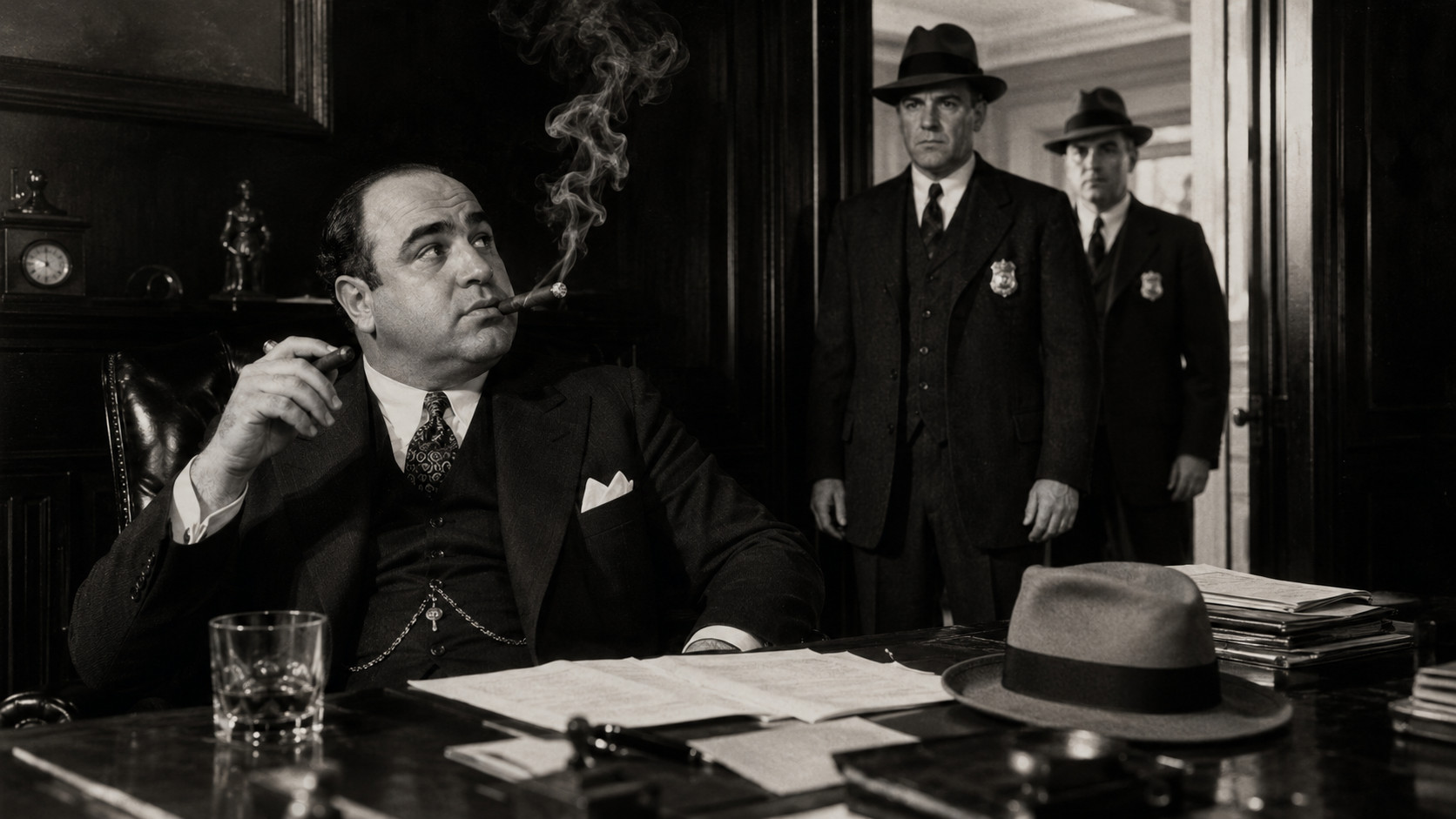

There’s something a lot of America’s most notorious crime bosses have in common. Gangsters who seemed completely untouchable, men who had survived bloody gang wars, countless witnesses, government inquiries, betrayals, and everything else that came with life in organized crime for years, sometimes decades, suddenly vanished from power. Gone. Not after a long, drawn-out decline, but in an instant. A single day, a single arrest, a single betrayal, or even a single bullet was all it took to bring their reigns to an abrupt end.
The reasons were rarely the same. Sometimes it was a disgruntled accountant with the books. Other times it was an underboss who decided to save himself by turning government witness. In other cases, coordinated federal raids hit multiple cities at once, leaving entire criminal organizations reeling, or a lone gunman stepped from the shadows to settle a score. The one thing these stories all share is how quickly everything unraveled. Criminal empires built over years, fueled by fear, loyalty, and violence, could collapse in a matter of hours, proving that even the most powerful mob bosses were never as invincible as they believed.
Dutch Schultz
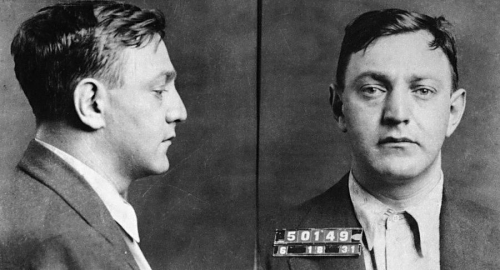
In the 1930s, Dutch Schultz conducted racketeering and bootlegging operations in New York. But when prosecutor Thomas Dewey came after him for tax evasion, he pulled off an unbelievable maneuver. He moved to a small town upstate, made himself a local fixture, gave money to churches, and ended up being acquitted by a friendly jury. It was an audacious tactic, and one of the more interesting legal maneuvers in organized crime history. The most interesting thing about it is that it worked.
His reaction to Dewey’s next move was his downfall. Schultz went to the Mafia’s ruling Commission and asked for approval to kill Dewey. They refused and decided that killing a prominent public official would bring too much heat. He ignored their decision and started planning anyway, so they took him down instead. On October 23, 1935, two hitmen walked into the Palace Chop House in Newark and shot him then and there. He died the next day. The man who beat a federal prosecution was eliminated by his own allies.
Angelo Bruno
Angelo Bruno led the Philadelphia crime family for 21 years with such restraint that he stood out from others. He chose negotiation rather than violence and avoided headline-grabbing bloodshed. He was called the Gentle Don. By the late ’70s, the young members of the crime family resented his refusal to get into narcotics, watching how much money was being made by other families.
On March 21, 1980, Bruno went for dinner at his favorite restaurant in South Philadelphia, after which he returned home with one of the members of his family. While Bruno was sitting in his car outside his rowhouse, smoking a cigarette, a gunman approached him and fired a shotgun blast into the back of his head.
His consigliere had ordered the hit without Commission approval, assuming that the other families would accept and even appreciate the result. They didn’t. The Philadelphia family spent the next decade tearing itself apart.
Al Capone
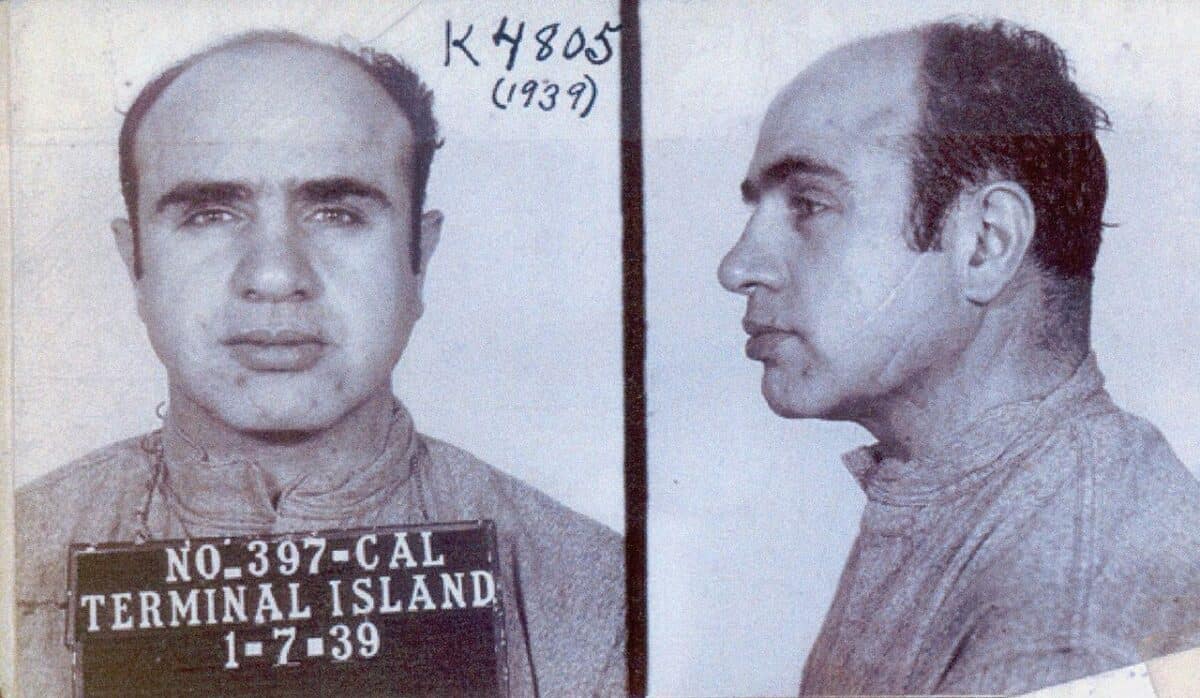
©U.S. Federal Prison Officials / Public Domain – Original / License
Al Capone had taken over Chicago by the end of the 1920s. He had the bootlegging business in the city under his control, openly corrupted judges and aldermen, gave orders to carry out the St. Valentine’s Day Massacre, knowing that no jury would try him, and was earning between $60 and $100 million per year during the peak of Prohibition. In 1930, the Chicago Crime Commission made him Public Enemy No. 1.
The government finally got him in 1931 for tax evasion charges. Not murder, not racketeering. Tax evasion. He never filed a tax return in his life. His tax debt amounted to $215,000, and the government sent him to federal prison for eleven years. Capone entered Alcatraz in 1934 with neurosyphilis symptoms and never recovered his faculties. One of the most infamous mob bosses in the U.S. was taken down by the IRS.
Carmine Galante
Galante operated through much of the 1970s as the boss of bosses in the American Mafia, having used his Sicilian contacts to control heroin trafficking into the country, making enemies at every level of organized crime in the process. His small stature, standing just 5’5″, did not make him any less powerful. He was known for his cruelty and he was feared by many, including other Mafia bosses.
Galante ate lunch on July 12, 1979, at Joe and Mary’s Restaurant in Brooklyn’s Bushwick. He stepped out to smoke a cigar after his meal and was shot on the spot by three assassins. A photo of his body shows him still clutching the cigar. This hit had been approved by the Commission itself, which decided that he was more trouble than he was worth.
Paul Castellano
Paul Castellano led the Gambino family in the late ’70s and early ’80s. He conducted his criminal activities through legitimate business fronts and stayed away from the street-level violence common to his predecessors. He made the family rich. But he made many enemies. The younger members of the family hated the way he managed business and his ban on drugs, a rule he enforced unevenly and that cost him the loyalty of many across the organization.
On December 16, 1985, Paul Castellano was shot dead on the sidewalk on his way to the Sparks Steak House in Midtown Manhattan. He went there for a meeting, along with his underboss, Thomas Bilotti. John Gotti, who planned and organized his murder, watched from a car across the street. Castellano was facing charges in the federal court. He never made it to the courtroom.
John Gotti
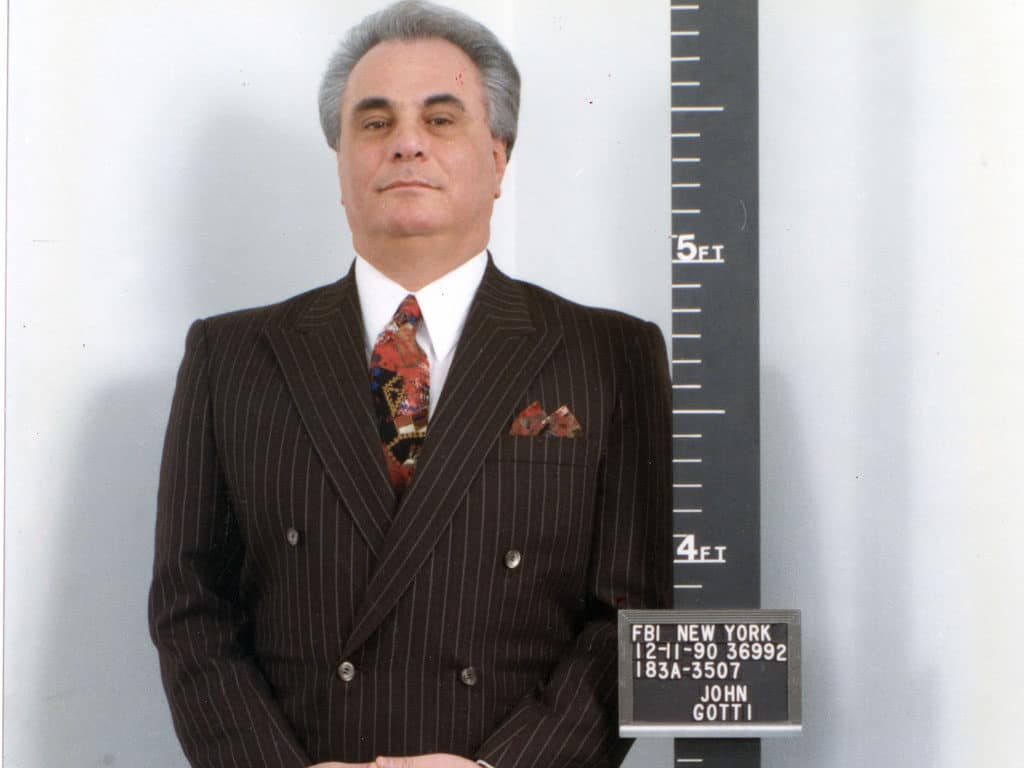
John Gotti was the most notorious mobster in the country for seven years straight and he seemed to be the most protected too. He managed to escape incarceration in three separate trials. Tabloids nicknamed him Teflon Don as charges didn’t appear to stick. He arrived at the court dressed in $2,000 suits and walked out with a smile on his face. John Gotti played the media game as no mobster had before. It worked right up until it didn’t.
The fourth prosecution, in 1992, was different. His underboss, Salvatore “Sammy the Bull” Gravano, flipped and testified against him, describing nineteen murders in vivid detail. Gotti was found guilty on all charges and got a life sentence. He died in 2002 in federal prison. The press cultivation strategy that helped John Gotti stay untouchable during all those years also put a giant bullseye on his back.
Rayful Edmond III
Rayful Edmond III was just 22 years old when he established himself as the primary drug supplier in Washington D.C., establishing a crack cocaine empire in the mid-1980s and flooding this city with drugs. He was one of the major reasons why D.C. was dubbed “the murder capital of the United States.” Edmond maintained direct connections with Colombian cartel suppliers and moved an estimated $300 million worth of cocaine per year. He was labeled by the federal officials as the most notorious drug trafficker in the history of D.C.
Edmond was arrested at 24 years old after a federal investigation. He was convicted in 1990 and was given life without parole. The speed of both his ascent and fall became a case study for DEA training programs. Edmond later assisted federal authorities in their prosecution efforts and, by some accounts, he paid for it dearly both socially and physically for the rest of his incarceration.
Albert Anastasia
©New York Police Department / Public domain – Original / License
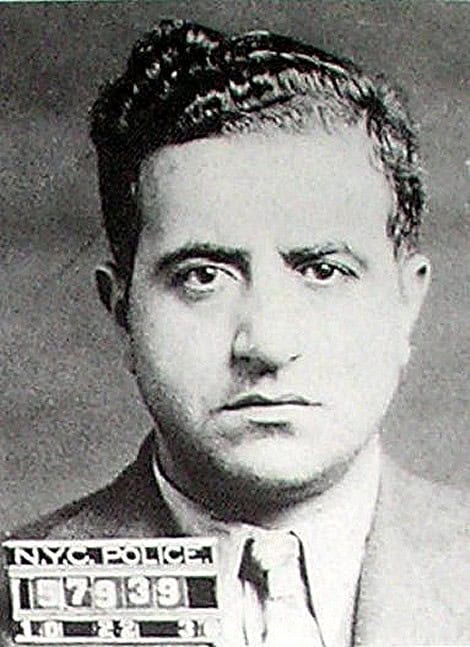
Albert Anastasia headed Murder, Inc., the enforcement arm of the national crime syndicate, through the 1930s and into the 1940s. He later took charge of the gang that would eventually be known as the Gambino family. His reputation for putting out hits on almost no provocation at all gave rise to the nickname “Lord High Executioner.” The FBI estimated that during the 1930s and 1940s, his gang was responsible for hundreds of murders.
On October 25, 1957, Anastasia sat in a barber’s chair of the Park Sheraton Hotel in Midtown Manhattan for a shave when two men with scarves covering their faces came in and shot his bodyguard and opened fire on Anastasia. While the bodyguard survived, Albert Anastasia died on the barbershop floor. No one was ever charged for the murder. His reign ended in under two minutes, mid-haircut.
Felix Mitchell
Felix Mitchell controlled the supply of heroin in a large portion of Oakland, California, throughout the 1970s and well into the 1980s, operating a street organization so well-run that law enforcement analysts likened its structure to a corporation. He went by the local nickname of Felix the Cat. His earnings per week were estimated to be $800,000. His gang used street-level dealers as well as supply chain managers. Thanks to his organizational structure and the use of enforcers, his rule over certain areas of Oakland was absolute.
In 1985, Mitchell was convicted of federal drug charges and given a life sentence with no parole. He had been Oakland’s kingpin for more than a decade at this point. Just less than one year later, in August 1986, he was stabbed to death in prison by another inmate. Thousands attended his funeral in Oakland, where he was laid to rest in a horse-drawn carriage. The organization he built went down with him.
Demetrius “Big Meech” Flenory
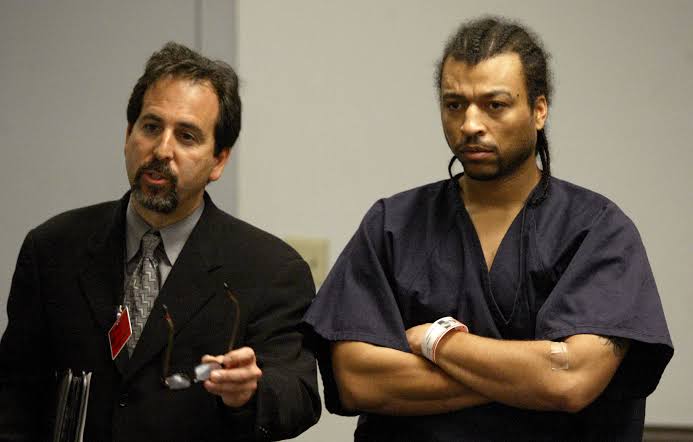
Big Meech and his brother Terry founded the Black Mafia Family in Detroit in the latter part of the 1980s and transformed it into a nationwide cocaine trafficking ring worth about $270 million and operating in over a dozen cities by the early 2000s. Big Meech didn’t try to keep a low profile. He had parties and wore flashy jewelry. He also associated himself with hip-hop stars and operated a promotional company named BMF Entertainment. His music-related endeavors gave the organization a semi-legitimate public face. It was one of the most flamboyant criminal organizations in American history.
The DEA broke up the whole organization in 2005, arresting 30 members in coordinated raids. More than 150 members were eventually charged. Big Meech received a 30-year sentence in federal prison in 2008. The speed of the takedown was a result of years of embedded investigation. The organization had been infiltrated long before the actual raids took place. An empire built over nearly two decades collapsed in a single morning.