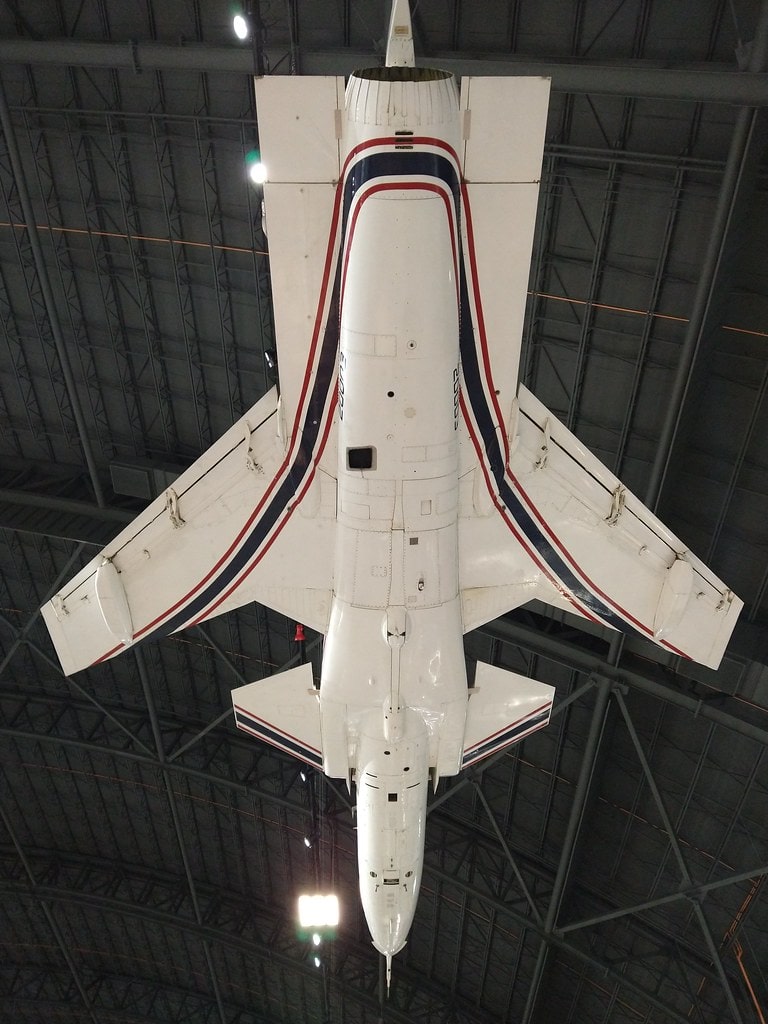

Military aircraft design has long been a crucible for innovation and radical thinking. Strategic stakes often hinged on the prolonged existence of nations, especially when looking at eras like the Second World War. Engineers given blank checks and a clear slate can conjure up many bizarre ideas, which range from inspired to downright ridiculous. With that in mind, let’s look at some of the most unusual military aircraft to take flight.
Northrop XP-79B
©United States Air Force / Public Domain – Original / License
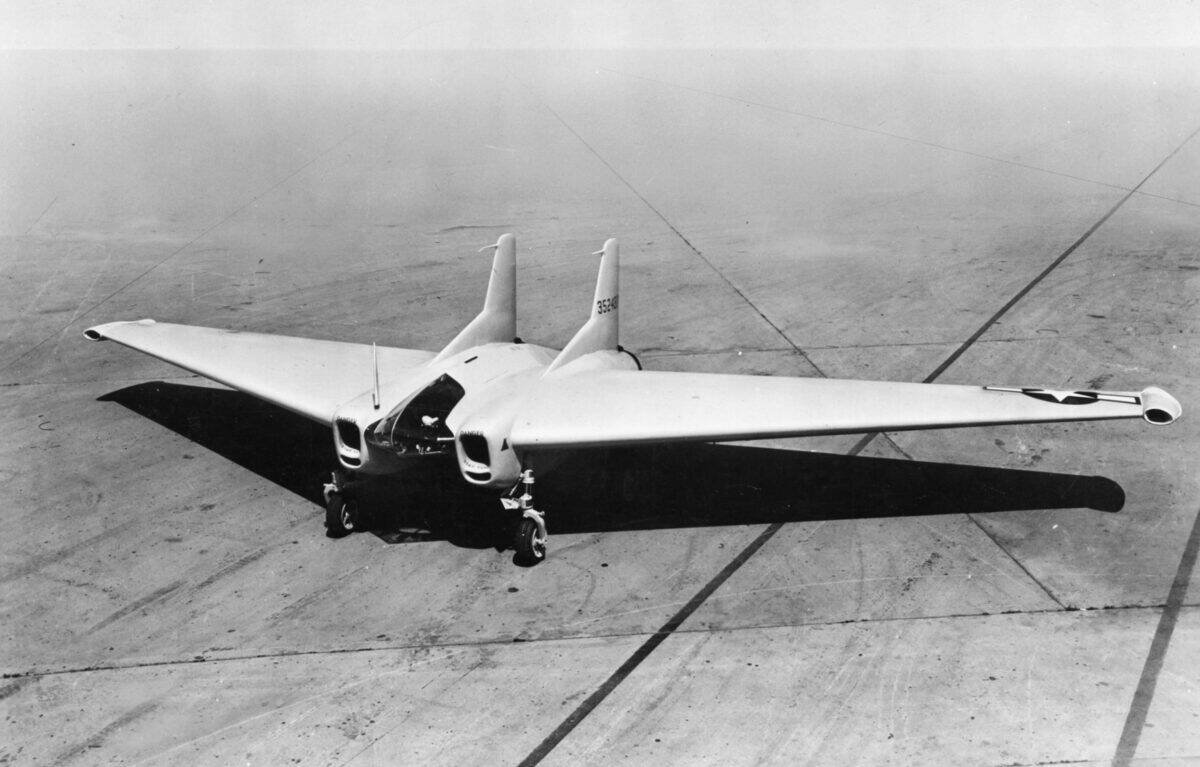
The Northrop XP-79B is one of the most bizarre military aircraft you’ll find, combining so many unconventional ideas that almost defies expectations. Conceived in 1942, the XP-79 was envisioned as a rocket-powered flying-wing fighter. Pilots laid face-down in a prone position, allowing for greater overall resistance to g-forces during violent turns, an idea that wasn’t adopted because pilots still need to see where they’re going.
The original rocket engine proved unworkable, so revisions saw the addition of a pair of Westinghouse 19B small jet engines. Each could produce 1,150 pounds of thrust. The airframe itself was unusual in terms of overall construction, at least for the era. Engineers fashioned a welded magnesium monocoque structure instead of the more typical riveted aluminum. The most bizarre aspect of this military aircraft was its overall aim. The XP-79B’s express intent was to serve as a battering ram, an unusual deployment even during the wilder era of the Second World War.
The XP-79B took its sole flight on September 12, 1945, as the Second World War wound down. 15 minutes into its maiden voyage, the XP-79B’s test pilot, Harry Crosby, lost complete control of the vehicle. The aircraft began a spiraling descent from around 10,000 feet up. Crosby punched out, but was struck by a piece of the aircraft and killed. What remained of the aircraft crashed into the desert sands, with the project being cancelled immediately afterwards.
McDonnell XF-85
©"McDonnell XF-85 Goblin" by twm1340 is licensed under BY-SA 2.0. – Original / License
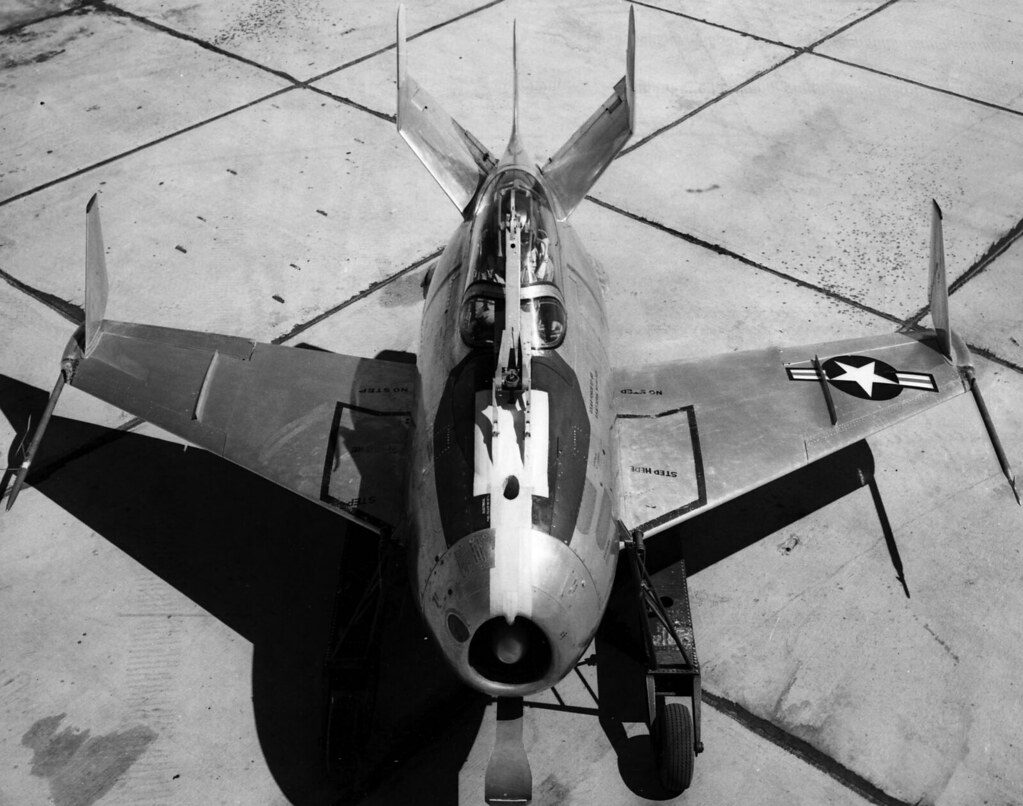
When Cold War bombers, particularly the B-36, were flying faster and longer than any potential fighter escort, the XF-85 was brainstormed. The XF-85 was a jet-propelled fighter meant to launch from a bomber, rather than from an aircraft carrier or landing strip. The Goblin, as it came to be known, was an unusual military aircraft. There was no fixed landing gear. Instead, it used a retractable hook for recovery and a ventral skid for emergency landings.
The hook was the central conceit for this aircraft, as the pilot was expected to fly interference for the bomber, then return to snag a trapeze dangling from the bomb bay. As you might expect, hitting the trapeze proved too difficult, as the XF-85 was susceptible to the likes of turbulence. A pair of Goblins were flown 7 times, with a total flight time of just over 2 hours. Only three flights ended with a successful hooking on the trapeze.
The program was cancelled in 1949 following bigger strides in aerial refueling technology. Developing dedicated fighter aircraft that didn’t compromise capabilities to escort a bomber was the better choice, and the entire concept of the Goblin was rendered obsolete. Nowadays, the XF-85 is a museum piece, a relic of a bygone era of military aviation.
Convair XFY-1 Pogo

©"John Knebel in front of the Convair XFY-1 Pogo," by Jack Snell – Thanks for over 26 Million Views is licensed under BY-ND 2.0. – Original / License
The early years of the Cold War saw American paranoia, particularly at the military level, running rampant. A prevailing fear washed over military planners as they worried about Soviet aggression in destroying air assets like landing strips and carriers. For the United States Navy in particular, this was the seat of their air power, and losing any carrier compromised the efficacy of its strike times. The proposal was relatively simple: develop an aircraft that didn’t need a carrier or runway to take off.
The XFY-1 Pogo is an oddity, a VTOL, or vertical take-off and lift, aircraft from the earliest years of the Cold War. On paper, it was intended to be a high-performance fighter, capable of operating from even the smallest of the American Navy’s warships. The Pogo was a tail sitter, rather than functioning like the later A-7B Harrier or V-22 Osprey. It rested on a launch pad, much like a rocket, and took off vertically before orienting itself like a conventional aircraft.
The pilot’s seat swiveled to accommodate this. Flying was just fine in the XFY-1, landing is where things got tricky. Pilots would have to land on the tail of this unusual military aircraft, requiring them to look behind them as they backed the plane onto a landing pad. Ultimately, it tested well, but was shelved as jets became the predominant force in the naval air wing.
Vought V-173
©"Frontiers of Flight Museum December 2015 070 (Vought V-173 'Flying Pancake')" by Michael Barera is licensed under BY-SA 4.0. – Original / License
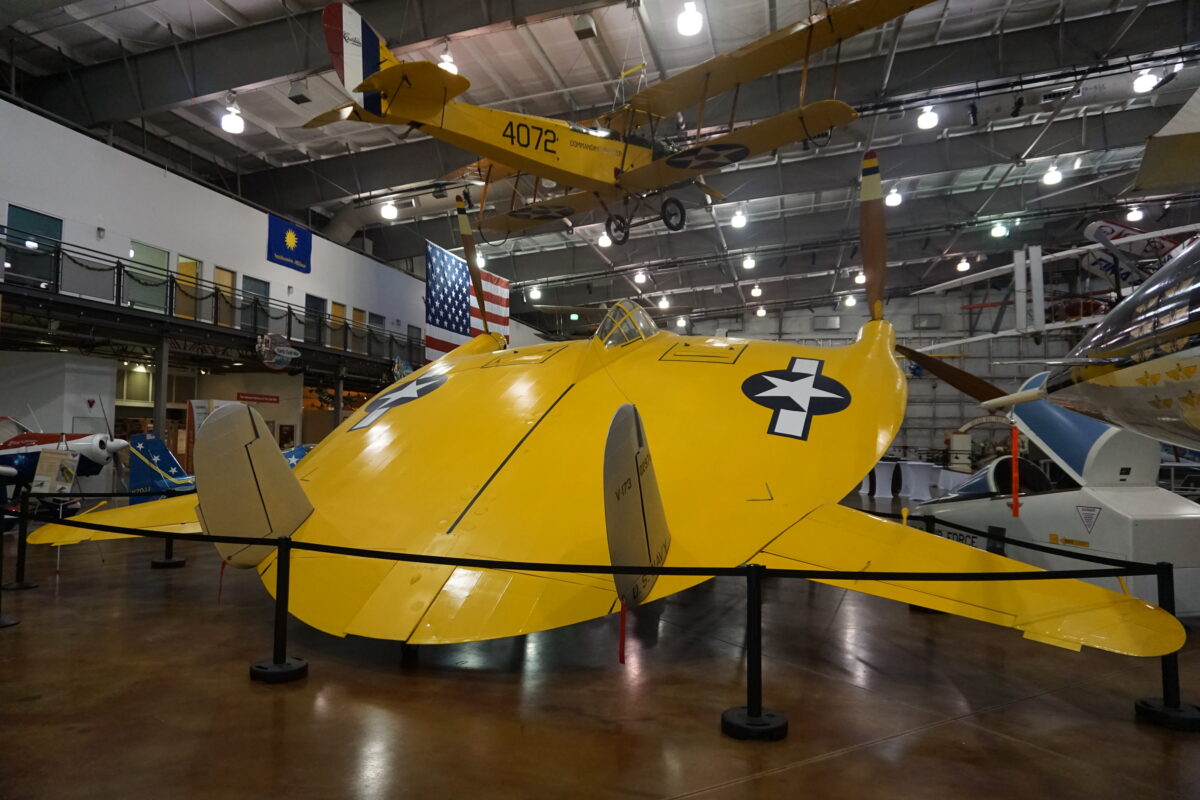
With a nickname like the Flying Pancake, you know you’re getting something bizarre with the V-173. Devised originally in 1942, the Vought V-173 was an experimental fighter aircraft with a fairly distinctive disc-shape airframe. The unconventional shape had some noted benefits, like improved lift and low stall speeds.
It was developed primarily as a proof-of-concept and saw many successful test flights. Ideally, the V-173 would’ve been a fit for carrier-based operations, as the low-stall speed and agility of the craft made for an unusual but adept fighter for World War 2 combat operations. Testing racked up around 130 hours of airtime, a significant amount for any test craft during the war.
That said, the V-173 was the victim of technological advancements, as successful jet engines made the piston-powered aircraft of the Second World War obsolete overnight. The intended full-scale successor, the XF5U-1, never reached full development, and the program was cancelled as the United States transitioned to solely jets for its fighter wings.
Grumman X-29
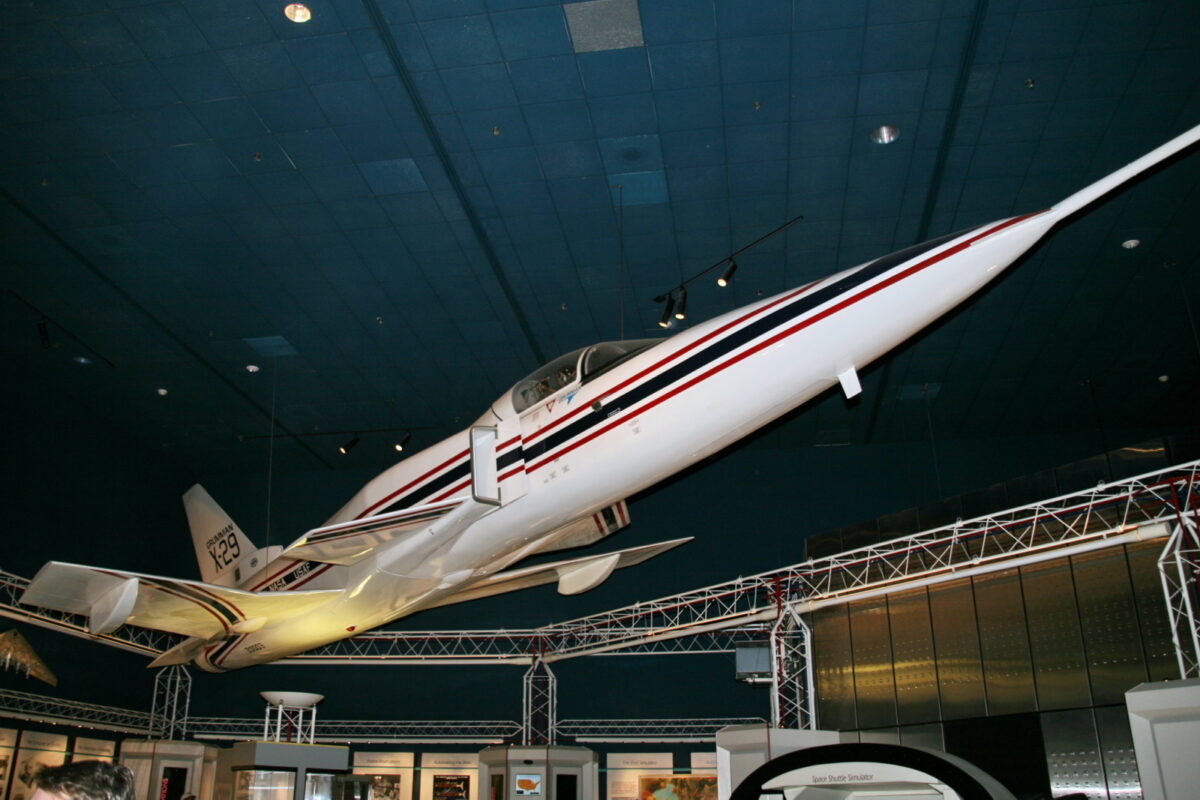
©"Grumman X-29 model at Smithsonian" by Cliff is licensed under BY 2.0. – Original / License
The previous entries were born from the same sort of feverish thinking and plentiful funding that saw many of the great innovations of the Second World War and early Cold War era. There was a sense of urgency for the era, an experimentation was relatively cheap all things considered. The 1984 Grumman X-29 showed that such a flair for unusual military aircraft hadn’t diminished in the years since the end of the Second World War.
Boasting forward-swept wings and canards to test atypical aerodynamic configurations, the X-29 was a test bed if there ever was one. That said, the physics of the aircraft made it highly unstable, requiring fly-by-wire controls to maintain any sort of control. This wasn’t a flaw by any measure, as the X-29 could approach from high angles of attack while the computerized controls made dozens of corrections per second. Quite a few test flights for the X-29 were conducted throughout the 1980s and 1990s before the project was shelved.
Grumman would go defunct in 1994, leaving this as little more than a curiosity in their storied history. However, it provided DARPA with invaluable test data, something that would serve fifth-generation fighters like the F-22 and F-35 well.
Avro Canada VZ-9 Avrocar
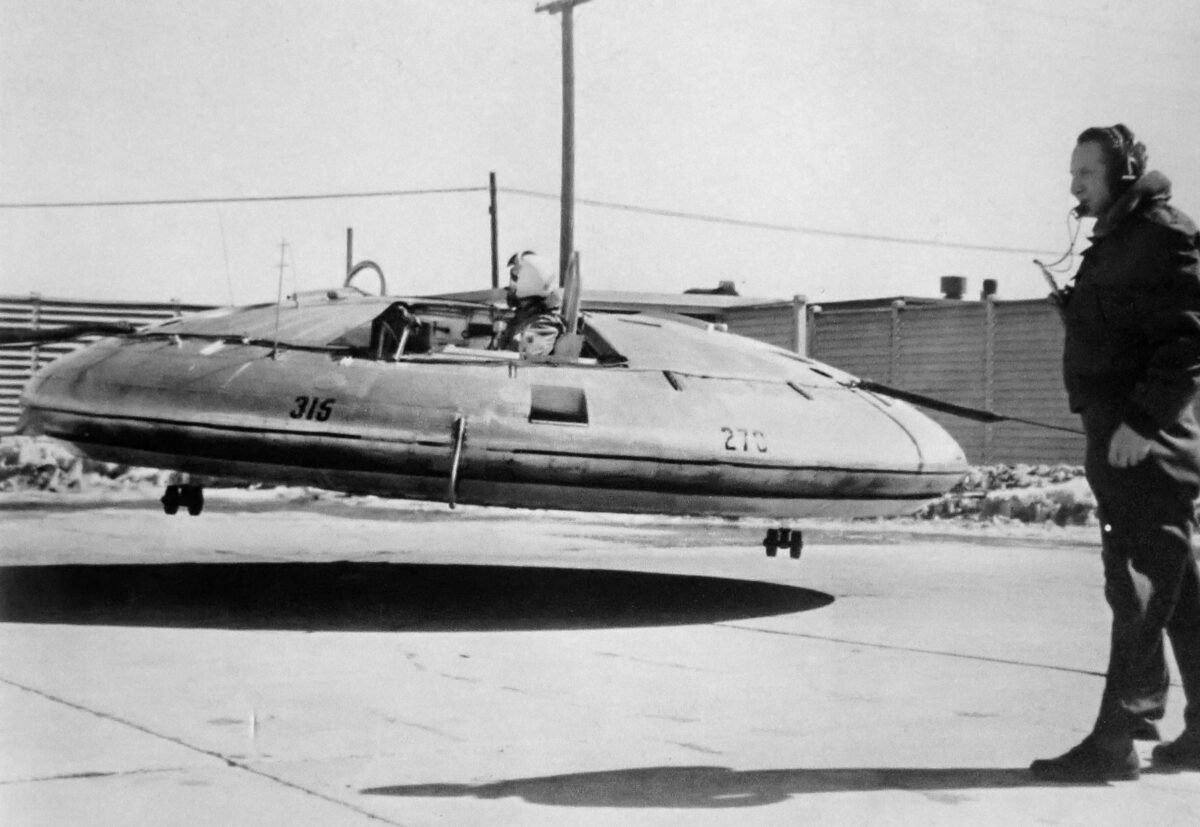
©"Avro Canada VZ-9AV Avrocar 2 (53993437252)" by James St. John is licensed under BY 2.0. – Original / License
No list of unusual military aircraft would be complete without mentioning this oddity. The Avrocar is right out of a 1960s sci-fi film and looks like it shouldn’t function in the slightest. Another VTOL aircraft, this saucer-shaped fighter seemed to carry forward the same sort of creative madness that the earlier V-173 brought to mind.
The Avrocar was intended to fly at high speeds and extreme altitudes, but faced numerous setbacks as the project continued. The United States Air Force was after an aircraft that could tactically strike before the enemy could respond, but eventually abandoned the project. Physics weren’t on the Avrocar’s side, and the flight envelope gave it performance more akin to a helicopter than a fighter jet.
Development was eventually picked up by the United States Army, resulting in additional funding. The Army envisioned it as something like a high-performance attack helicopter, but flight testing revealed numerous issues with thrust and stability. Eventually, the Avrocar was cancelled for good in 1961. It was a blistering couple of years of development and showed the same sort of creative zeal that marked the early Cold War.
Conclusion
There’s a bit of connective tissue you can observe with any of these unusual military aircraft, namely when looking at the unconventional thinking behind their designs. These crafts were ultimately failures, soaking up millions in funding before being left to gather dust in museums. That said, there were some notable gains, as things like fly-by-wire are common on modern fighters.
The image featured at the top of this post is ©"Grumman x 29 National Museum of the US Air Force" by amanderson2 is licensed under BY 2.0. – License / Original