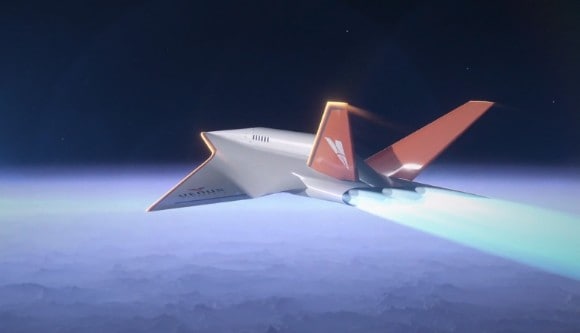

Over the last 122 years of flight, there certainly hasn’t been a lack of innovation. Engineers, designers, and pilots all seek to push the envelope, pushing well ahead of what contemporary technological progress might dictate. At times, this can lead to significant breakthroughs, as seen with designs like the F-117A Nighthawk or B-2 Spirit. However, at other times, it can lead to some rather ambitious projects that fall short of the finish line. Whatever the case may be, there is certainly no arguing about the experimental aircraft we’re taking a look at today.
Northrop YB-49
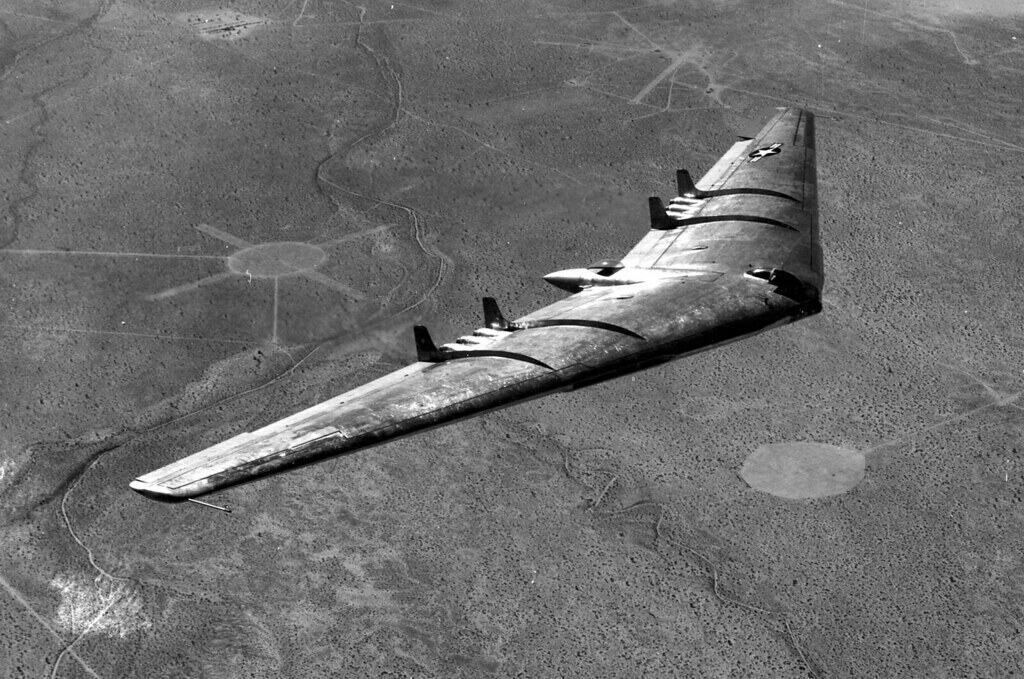
©"Northrop YB-49" by twm1340 is licensed under PDM 1.0. – Original / License
The Northrop Corporation’s YB-49 was a look forward to what could be. The strategic bomber’s silhouette isn’t too dissimilar to the likes of the previously mentioned B-2 Spirit. It made use of a series of turbojets for propulsion, one of the first purpose-built strategic bombers to make use of the newly discovered jet engine. In theory, the striking minimalist design was a surefire way of reducing radar signatures and maximizing lift efficiency.
There was only one problem: the YB-49 was designed in 1947. The YB-49 was notoriously touchy, something that many test pilots would attest to as the plane was trialed. It was decades out from fly-by-wire, something that would make the YB-49’s ambitions a reality. Ultimately, this resulted in a promising concept that was hindered by the technological achievements of the time.
The YB-49 would ultimately be shelved in 1953, with the flying wing concept moved to the back burner for decades. The lessons learned would be instrumental in the development of the B-2 Spirit, which had the necessary level of technological progress to finally be realized.
Bell X-1 and X-1A

©Maximin Stock/Shutterstock.com
A mere year after the introduction of the first true jet engine, engineers were already hard at work to surpass the limits. The Bell X-1 holds the distinction of being the first jet-powered aircraft to exceed the sound barrier, something accomplished by Chuck Yeager in 1947. While the plane and its variants, like the X-1A, were superb at getting to speed, they left something to be desired when it came to any other sort of performance. The X-1A and Yeager would also push the limits once again in 1953, achieving a speed of Mach 2.44, something unthinkable a mere ten years before.
After Yeager broke the speed record, he attempted to pull the X-1A down to a more manageable speed. It was thrown into an uncontrollable tumble, something known as inertial roll coupling. No pilot had experienced this at the same level of speed, with Yeager only coming away from the incident through sheer luck and a touch of skill. The X-1 and X-1A would later show that planes needed far more stability than was thought.
As it sits, the Bell X-1 stands as a testament to the passion surrounding avionics in the immediate aftermath of the Second World War. It might not have been the way forward in some regards, especially when looking at the overall design of the aircraft. However, the lessons learned from these record-breaking flights would go on to influence third and fourth-generation military aircraft in the future.
Ryan X-13

©"54-1619 Ryan X-13 Vertijet KSEE 30-0118" by kitmasterbloke is licensed under BY 2.0. – Original / License
When looking at something like an aircraft carrier, space is at a premium. You have limited room to accommodate the needs of the aircraft, pilots, and crew. A mere decade after World War 2 ended, the engineers at Ryan Aeronautical were hard at work to solve this problem. Vertical takeoff and landing, or VTOL, was little more than a pipe dream in the years before the X-13’s first test flight. Engineers had gotten around the issue of designing a VTOL-capable aircraft that didn’t rely on complex mechanisms to take off and land. It did so in a rather striking manner as well.
The X-13 was oriented on its tail on the deck of any carrier or strip, taking off more like a rocket than any sort of military jet. Once in the air, it would transition to more traditional flight handling, functioning as you might expect for any of these earlier jets. Upon landing, pilots would orient it vertically once again, making use of a suspended catch platform to arrest all movement of the aircraft.
In tests, the X-13 worked splendidly. However, the technology simply wasn’t there just yet for it to make sense. The rigors of combat meant that relying on the suspended catch platform was another massive concern in an already large list of checklists and workloads to keep track of while operating the plane. You start factoring in things like weapons payloads, incoming enemy aircraft, and so forth, and relying on jet engines with thrust lag starts to seem like a bit of a nightmare. Only two of these aircraft were built, with the project shelved in 1957.
Convair XFY-1 Pogo

©"John Knebel in front of the Convair XFY-1 Pogo," by Jack Snell – Thanks for over 26 Million Views is licensed under BY-ND 2.0. – Original / License
A quick glance over aviation history will show that VTOL aircraft were seen as the next true barrier to break, although not many militaries are making use of them exclusively. The XFY-1 Pogo from Convair first took flight in 1954 and made use of a rather unusual design. The Pogo sat on its tail, just like the X-13, but made use of a piston-driven engine for propulsion rather than any sort of jets. Tests were promising, with the aircraft handling admirably when looking at vertical and horizontal maneuvers.
Issues arose quickly when it came time to land the aircraft, however. Landing the Pogo was a bit like landing a helicopter for some pilots, but it forced them to glance behind their shoulders and descend slowly onto a small pad. In ideal conditions, this might not have been an issue. However, for many naval aircraft, you’d be lucky to get ideal conditions on even a routine combat patrol. Ultimately, the Pogo was deemed to be too dangerous to operators for its intended role.
Like the X-13, the Pogo served as something of a look forward to what could be achieved with the right sort of engineering. It didn’t pave the way for the likes of the A7-B Harrier or F-35B, but it certainly showed the concept was possible.
Lockheed X-7

A few years after aviation had broken the sound barrier and gone supersonic, engineers from Lockheed were looking at how to break the next barrier. Hypersonic flight is characterized as exceeding Mach 5, something necessitating a little more power than a mere turbojet could provide. Lockheed’s X-7 wasn’t intended as a testbed for manned operation, but rather a study in ramjets, thermal protection, and aerodynamics. It never achieved hypersonic flight, although it came quite close with a maximum speed of Mach 4.3, or 2,910 miles per hour, a flight no other aircraft of the era had achieved.
The X-7, being unmanned, opened up possibilities that allowed Lockheed to push limits in a way that no manned test flights could achieve. That said, the X-7 was a resounding success, often exceeding any sort of expectations from Lockheed. The aircraft were often recoverable, provided that tracking systems could keep an eye on them. Multiple X-7 airframes were simply lost by going too fast for the pursuing aircraft and tracking systems to follow.
As far as its legacy goes, the X-7 is the direct ancestor to missiles like the AIM-7 Sparrow and AIM-97. Further, the data gathered during the 9 years of testing of the X-7 would be invaluable for progressing toward hypersonic flight. The X-7 simply wasn’t just ahead of its time; it was pushing forward aviation research that wouldn’t be fully realized for decades to come.
Boeing X-20

Boeing’s X-20 would never take flight, despite running from 1957 to 1963. The ambitious project was started during the halcyon years of the space age, with the X-20 being a reusable spaceplane intended to be attached to a rocket, launched into space, stay in orbit, and eventually return to Earth unharmed. It predates the later Space Shuttle by decades, showing that there was some novel thinking at work at the time.
Boeing’s test program would assemble a group of some of the most notable pilots of the time, including Neil Armstrong. However, shifting priorities and a simple lack of funding led to the project being shelved after six years. Further, there is no guarantee that the X-20 would have been a viable platform, as materials science of the time likely wouldn’t have been adequate for reentry requirements.
Still, you have to admire what the X-20 stood for. It was looking to the future, and it was just a few decades shy of being a tenable concept. Boeing has revisited this concept in recent years, if the X-40 and X-37B are anything to go by.
Rockwell X-30

Rockwell’s X-30, or the National Aero-Space Plane, was an ambitious attempt to design an aircraft that could function as a passenger space liner. The design was a single-stage-to-orbit craft, capable of taking off from a runway and entering low Earth orbit without the need of any sort of external boosters. If everything aligned as intended, it would have been capable of speeds approaching Mach 25 thanks to the use of an array of scramjets.
As work started on the aircraft in 1986, the engineers at Rockwell quickly ran into issues. The proposed speed of Mach 25 simply didn’t align with the available materials of the time, with engineers suggesting a speed of Mach 8 instead. Mach 20 was feasible, but would require significant engineering to allow passing hydrogen to reduce the heat generated by adiabatic compression. Computer technology of the era simply wasn’t there to accommodate the needs of the X-30.
No test flights took place for the X-30 during the 7 years the project was operational. As the Cold War came to an end, projects like the X-30 were seen as relics of a bygone era. It simply ran afoul of the very real physical and technological limitations of the time.
Conclusion
If there’s anything we can take away from the aircraft highlighted today, there is something of a recurring truth. The concepts that power the aircraft tomorrow are often fundamentally feasible long before the technological means become available. Whether it is material restrictions, computational limitations, geopolitical unrest, or unstable aerodynamics, many of these aircraft were influential toward the development of the aircraft of today. Innovation in flight is inherently risky, as every design that is a resounding success has multiple failures that are contemporary to it. If anything, the aircraft we covered didn’t fly too close to the future as the title of this piece states, but rather, they brought the future that much closer to the world.