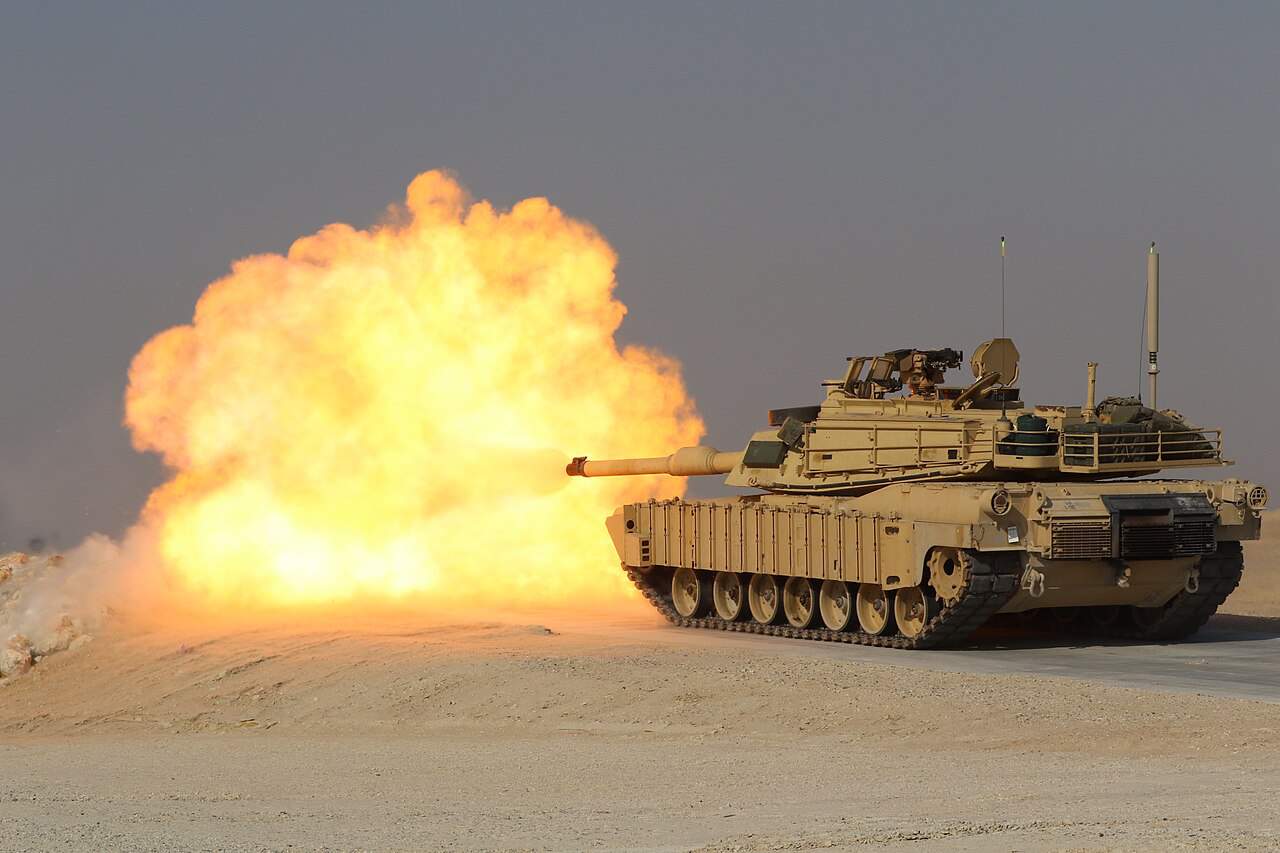

The history of armored designs in modern warfare is intended to answer the question of how to protect a crew, project force, and move across a battlefield without compromising any of those capacities. There have been numerous designs over the last century that have pushed the envelope forward, dating back to the Great War in 1916. Not all of the innovations we see across armored vehicles are successes, as some are resounding failures. However, the important thing to note is that the notes and lessons learned from these designs would go on to be highly influential. That said, let’s dive in and see what has shaped the nature of armored warfare over the last century.
Mark I
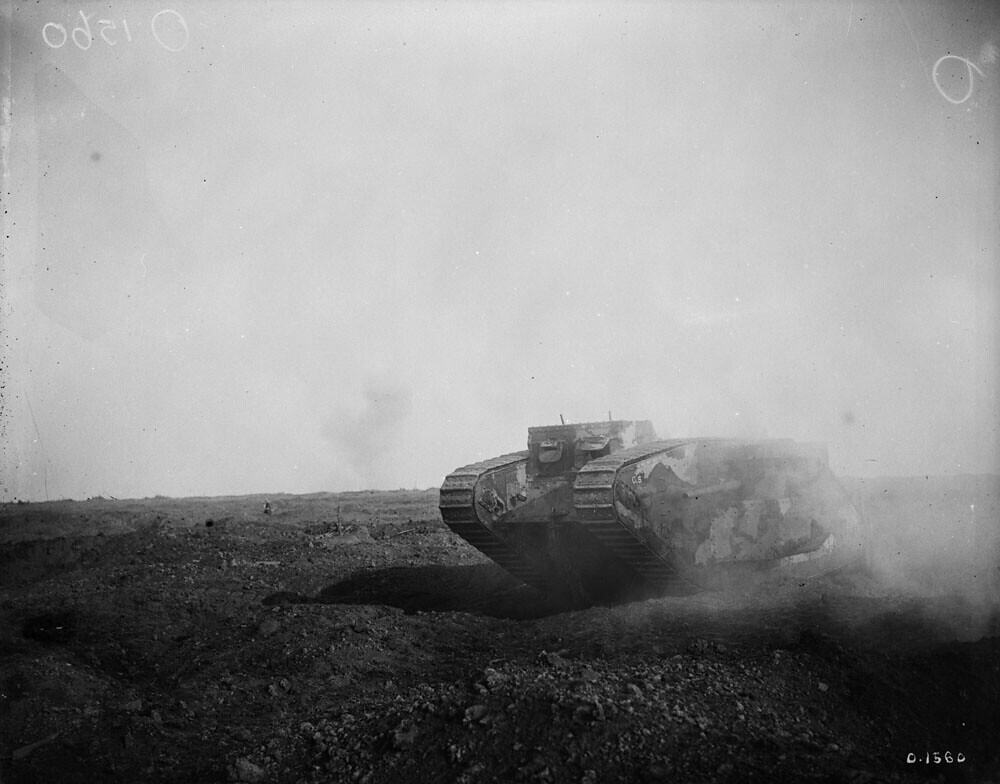
©"A Mark I tank in action, July 1917 / Un char Mark I en marche, en juillet 1917" by BiblioArchives / LibraryArchives is licensed under BY 2.0. – Original / License
When talking about any armored design, you might as well start at the very top. The Mark I had no true predecessors, especially in 1916 when it debuted on the battlefield. There was no precursor for the battle tank, as it represents the first true paradigm shift in industrialized warfare. Before the First World War, transport and assaults were largely conducted on horseback. The internal combustion engine was still in its relative infancy at the turn of the 20th century. The battle tank was devised to break the stalemate found across the Western Front in Europe. Static trench lines, sweeping sectors of fire through machine guns, and barrages of highly accurate artillery fire made going on horseback a fool’s errand.
The Mark I was the first true battle tank and acted as the purest distillation of what would dictate armored designs across the next century. Caterpillar treads gave it mobility and traction across the muddy battlefields, the rhomboid armored hull could deflect most gunfire, and it was explicitly designed for crews to bridge whole trenches and assault positions. These were fickle vehicles to maintain, as tank design was relatively new. However, their efficacy cannot be understated. Land warfare would change overnight, and the die was cast in what the next war would look like.
T-34
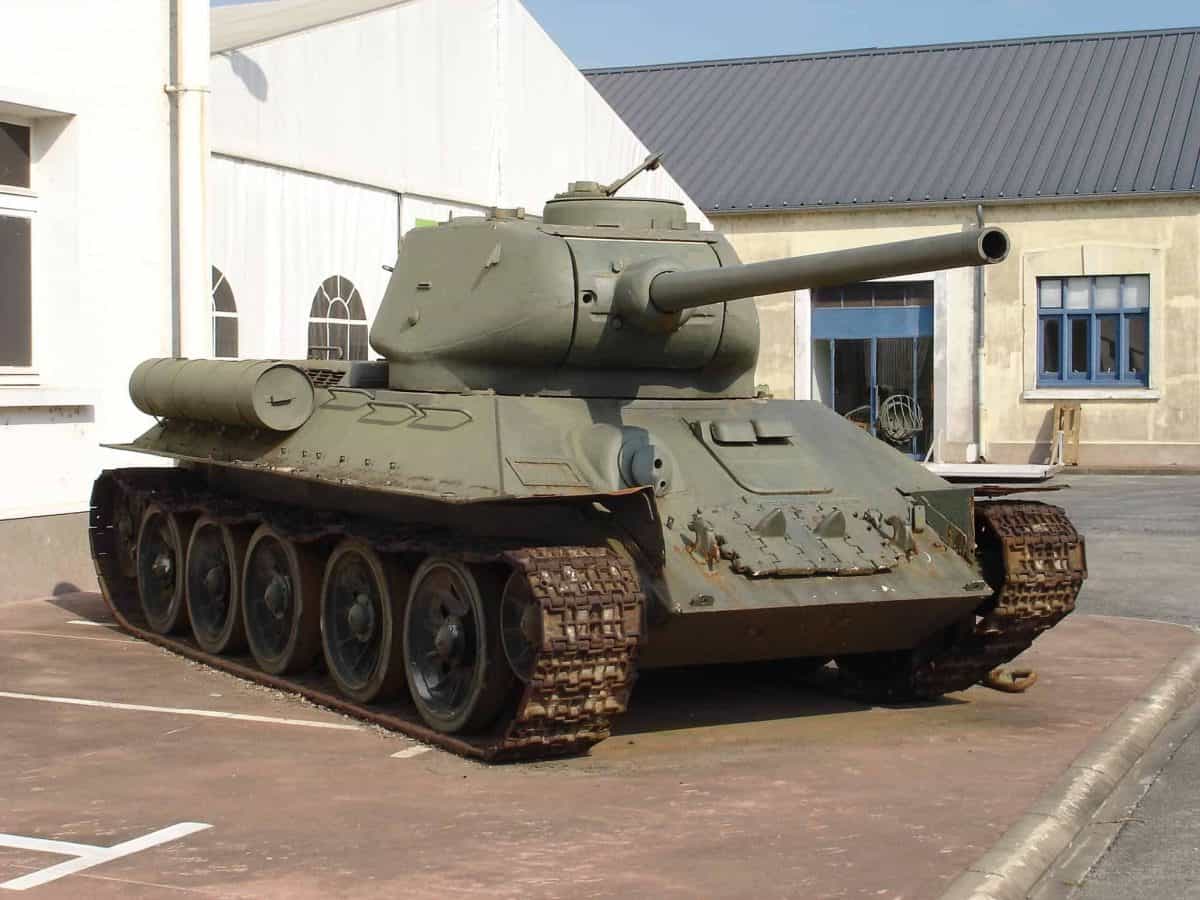
©Char T-34 by Antonov14 / BY-SA 2.5 (https://creativecommons.org/licenses/by-sa/2.5/) – Original / License
The most influential battle tank design of the 20th century could be any number of vehicles. When you get down to it, the most prolific design of the Second World War and the early Cold War period is going to be the T-34. Built at the Kharkiv Locomotive Factory in the Soviet Union, the T-34 is a masterstroke in design, not because of any cutting-edge features, but because of how it builds on its concepts. It carried a sloped hull, giving far more protection than just thick, vertical plates of steel. This made for a nimble tank, which can’t be said of competing designs across the Eastern Front of World War 2.
The wide track of the T-34 distributed its weight efficiently, enabling it to cross the muddy ground that arose after the brutal Soviet winters. It carried a diesel engine, which carried less risk of combustion compared to gasoline-powered contemporaries. When the T-34 met with German tanks in the summer of 1941, as Operation Barbarossa began to stall, they were met with a tank that deflected its standard shells and required a complete shift in German armor doctrine.
Panzer V
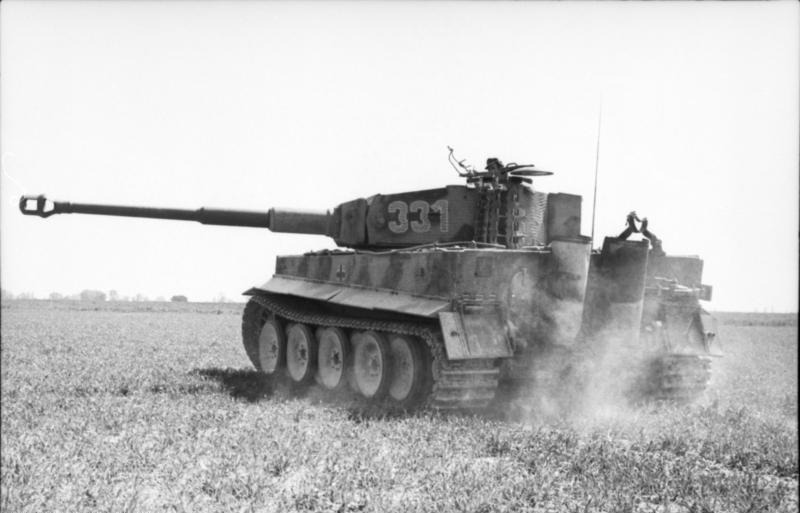
Speaking of that shift in armored doctrine, the Panzer V, or Panther, was a total response to the efficacy of the T-34. Early models were a disaster in terms of reliability, as standardization wasn’t a common practice during wartime production of tanks in Nazi Germany. However, these early teething problems detracted from a thoroughly modern design. The design featured highly sloped frontal armor, a high-velocity 75mm gun that could achieve vehicle kills on any Allied tank of the time.
On paper, it is the finest tank of the Second World War. That said, the chronic mechanical failures and dwindling supplies of quality steel and gasoline meant it never truly realized its potential. The post-war period would show just how effective the Panzer V was seen in the lineage of NATO’s tanks across Western Europe during the early Cold War. Every new design would feature sloped armor, high-velocity guns, and a torsion-bar suspension, all elements seen in the Panther.
M1 Abrams
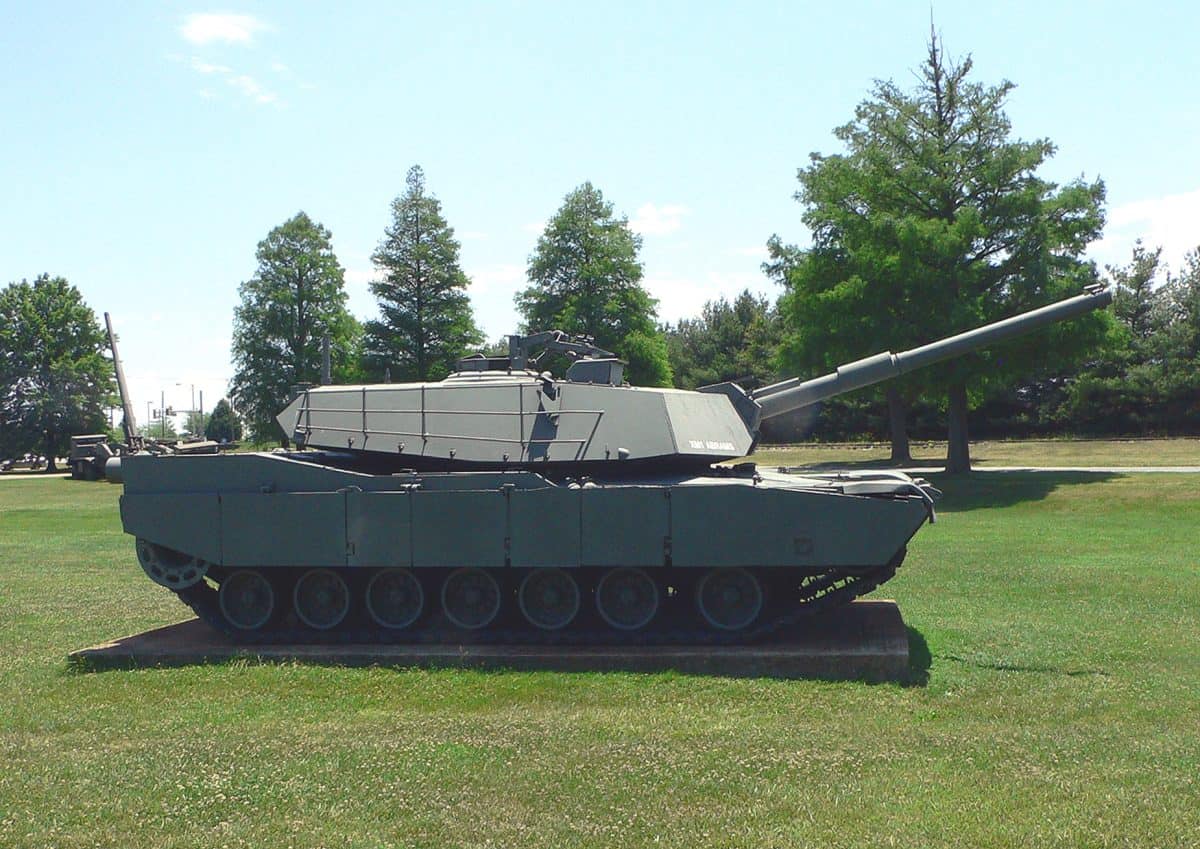
©"M1 Abrams 1" by Mark Pellegrini is licensed under BY-SA 2.5. – Original / License
The most profound innovation of the M1 Abrams doesn’t come from the outward elements of the armored design itself, but rather advances in metallurgy. It is one of the first true tanks to make use of the Chobham composite armor, developed throughout the 1960s and 1970s in the United Kingdom. The layered ceramic tiles and steel/polymer matrix readily defeated shaped charge projectiles and kinetic penetrators. This was due to the ceramic shattering projectiles on impact, dispersing the energy evenly rather than allowing for a crew kill.
The Abrams debuted in 1980, but wouldn’t make a true showing until 1991 during Operation Desert Storm. Iraqi T-72s paled in comparison to the Abrams, and the American tanks were readily achieving vehicle kills at distances that should have been mutual kill zones with surprisingly few casualties. Composite armor is the norm for any modern tank these days, thanks in part to the work done in the UK and just how unkillable the modern M1 Abrams variants can be.
Merkava
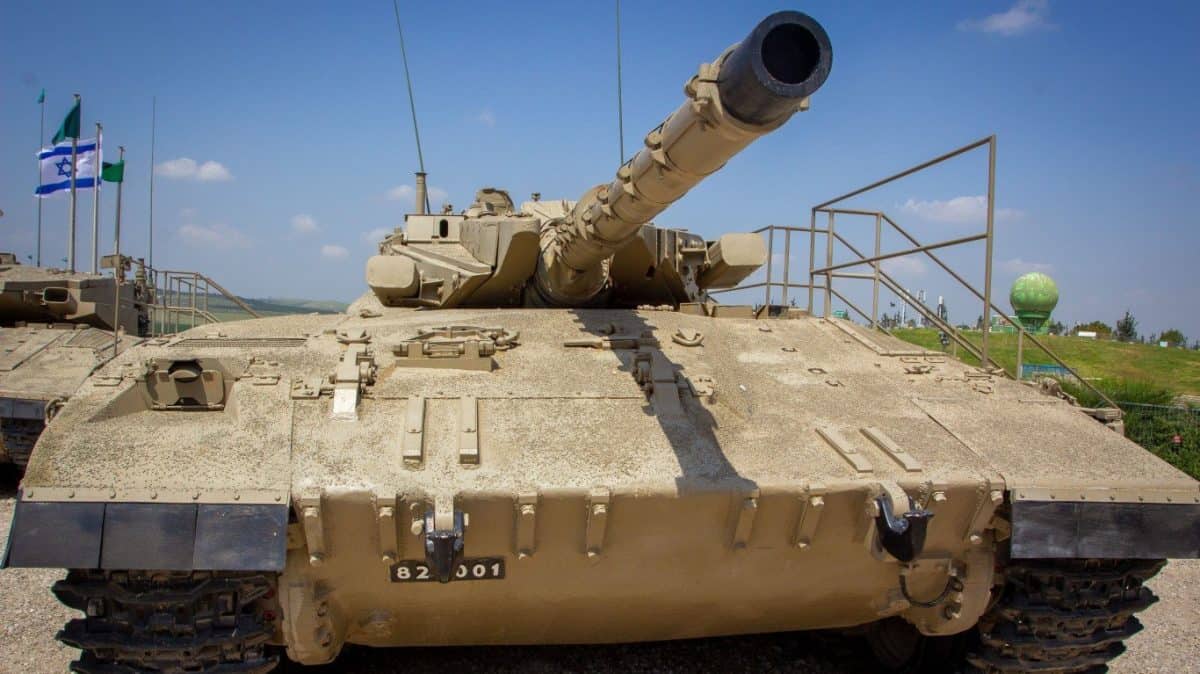
©Wirestock / iStock Editorial via Getty Images
The Israeli Merkava goes against all conventions when it comes to traditional armored designs. Most vehicles place the engine in the rear compartment, which is intended to allow the fighting compartment for the crew to sit at the center-front of the vehicle. The Merkava moved it forward, which served as additional protection for the crew. This hasn’t been influential on the whole, but it presents an interesting shift in the thinking behind battle tanks. The front-mounted engine allows for more protection for the crew, as frontal kills become more difficult.
It serves double duty as an infantry fighting vehicle, capable of transporting infantry elements to the battlefield while acting as support. The latest variant, the Merkava IV, integrates the Trophy active protection system as standard equipment. Given the efficacy of modern anti-tank weapons, the Trophy system is a must for defeating these weapons before the crew is placed at risk.
Bradley IFV
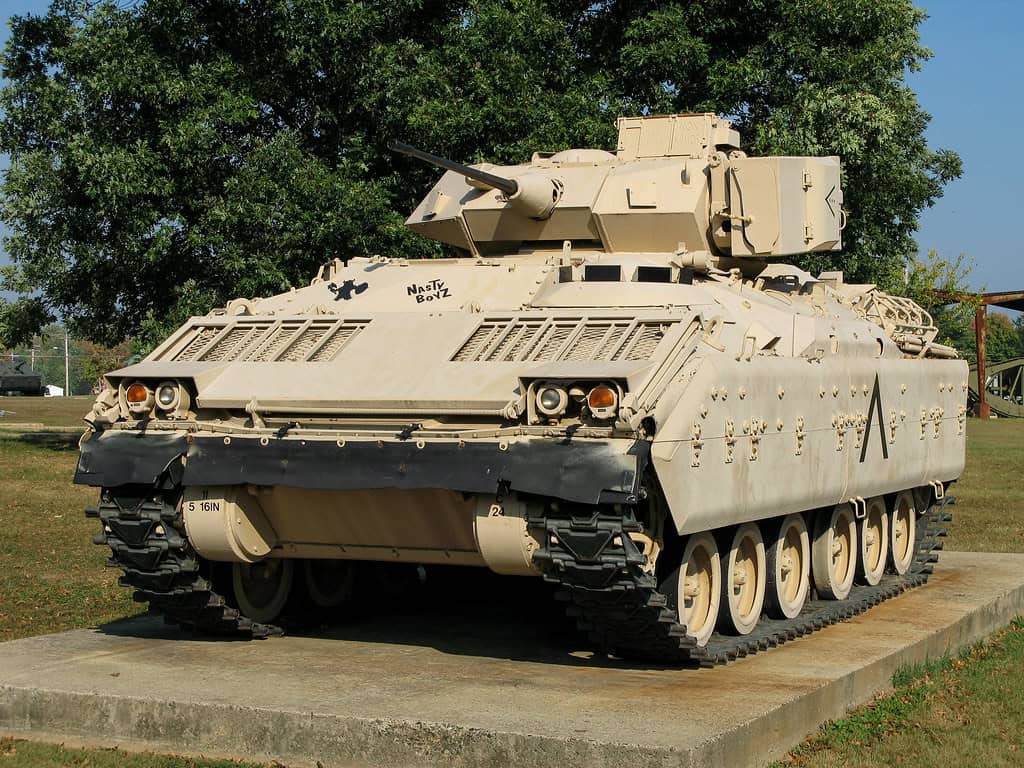
©"M2 Bradley" by 270862 is licensed under BY-ND 2.0. – Original / License
The M2 Bradley represents a shift in the thinking behind most armored designs, especially when considering armored personnel carriers. Historically, most APCs were light-skinned vehicles, transporting infantry to the battlefield and hanging back until the engagement was finished. The M2 Bradley could carry an infantry squad while providing a withering base of fire to support soldiers in the field. A lot of this comes down to the armament, like the 25mm Bushmaster chain gun and the TOW anti-tank missiles.
The Bradley was embroiled in a massive amount of controversy during its development. The thinking at the time was that it was too lightly armored to contend with tanks, while being too large to readily conceal from enemy air assets. Those criticisms certainly do have merit, and the Bradley is in a rather odd niche when compared to contemporary IFVs. That said, combined arms is the rule of the day, and the Bradley has distinguished itself quite ably in combat. The design has been so influential that we can see its lineage in vehicles like the Marder and CV90.
Conclusion
The most influential armored designs of the future aren’t focusing on things like armor and weaponry, but rather a shift in philosophy. Anti-tank weapons are highly potent in the modern era, especially when considering top-attack missiles and drones. As such, the shift goes from passive protection, like sloped armor, to active protection, like the previously mentioned Trophy system.
What this means for armored vehicles going forward is rife with possibilities, as it might mean lighter hulls being preferred over the likes of heavier vehicles carrying massive 120mm main guns. Whatever it means, we certainly aren’t done seeing the evolution of armor going forward.
The image featured at the top of this post is ©Sgt. Joaquin Vasquez-Duran, Public domain, via Wikimedia Commons – License / Original