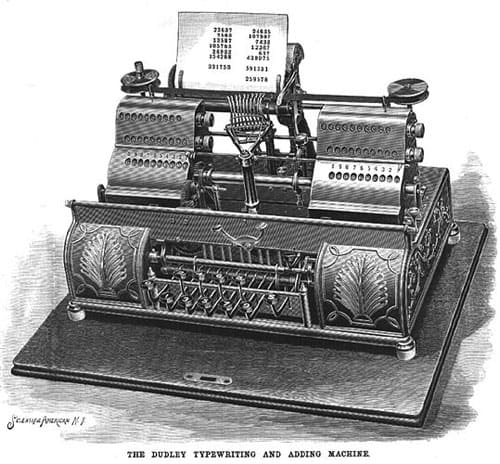

In this section will be presented some simple calculating devices, which are not so clever, to be presented in other sections of the site, but still clever enough, to be interesting as principle or to had market success. During the second half of 19th and first half of 20th centuriy, a large number of relatively inexpensive machines were marketed to businesses and others for use in performing simple addition and subtraction. In principle, these adders and other devices could also be used for multiplication by repetitive addition and for division by repetitive subtraction. Numbers were typically entered by using a stylus to move a dial or slide. Most of the handheld devices are cheap, sold for $5 to $25. Some devices of this type have already been examined in other sections of this site, for instance devices of Perrault, Caze, Kummer, etc. There are a lot of inventors, especially in 19th century, who invented such devices, for example Samuel S. Young of Eaton, Ohio, USA, who patented three simple calculating rules: for adding figures (US patent No 6602 from 1849), for calculation of interest (pat. 8329, 1851) and arithmetical proof-rule (pat. 21921 from 1858). None of this devices however doesn't contain any clever principle or has been actually manufactured and sold, so they are not presented here.
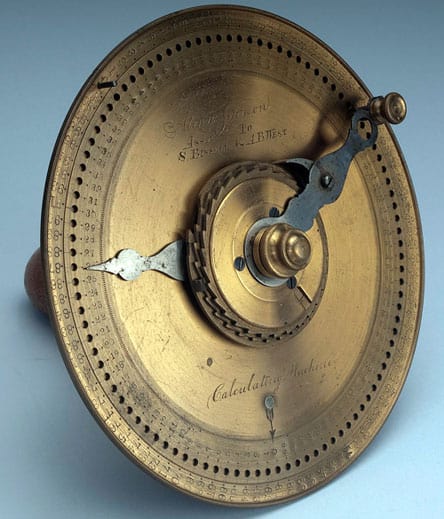
| Charles Cotterell( 1667) | George Brown (1699) |
| Nystrom's Calculator (1848) | Hatfield's Adder (1854) |
| Fowler's Adding Machine (1863) | Webb's Adders (1868 and 1886) |
| Groesbeck's Adding Machine (1870) | Stephenson Adding Machine (1873) |
| Spalding Adding Machine (1874) | Calculators of Chambon (1876) |
| Hart's Mercantile Computer (1878) | Calculators of Louis Troncet (1889) |
| Centigraph Adding Machine (1891) | Landin Computer (1891) |
| Locke Adder (1901) | Calcumeter (1901) |
| Golden Gem adding machine (1901) | Adix adding machine (1901) |
| Adder (1902) | BriCal Calculator (1905) |
| Computometer (1907) | Bassett Adder (1909) |
| Add-A-Mite (1950) |