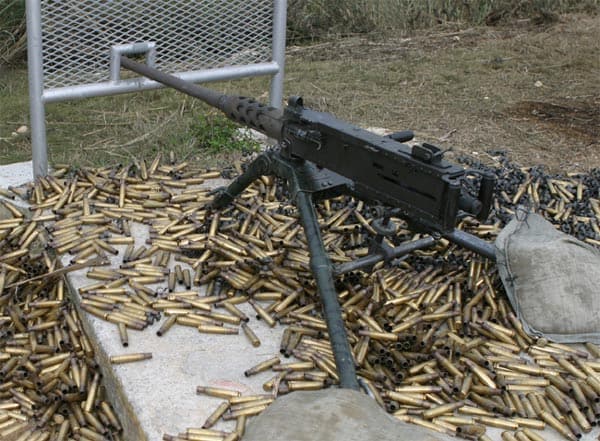

Some firearms just last well past their expected shelf life. Try as they might, many militaries dream of finding the sort of immortal firearms that last for decades. Wars draw to a close, borders dividing nations shift, and generations of soldiers might see the same weapons in use. These sorts of legendary firearms are the sorts that sit in arsenals, built to last for years to come. That said, there isn’t some magical secret that keeps certain weapons more relevant over decades and centuries, but rather effective designs. Today, we’re looking at some truly long-serving guns.
Colt 1911
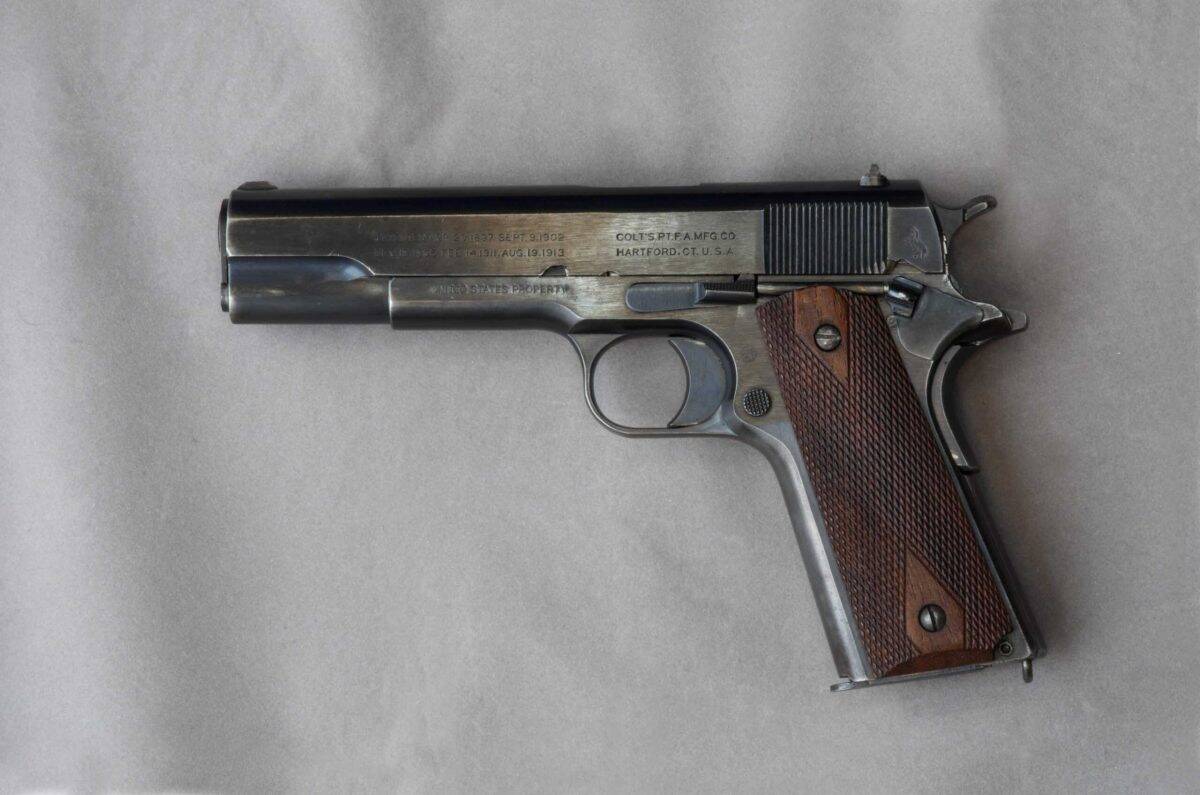
©Colt 1911 .45 246524 L DSC 3330 by Judson Guns / BY-SA 3.0 (https://creativecommons.org/licenses/by-sa/3.0/) – Original / License
The 1911 debuted in the same year as its name implies, being one of the most enduring handguns from famed designer John Browning. At the time, you can’t help but think if Browning knew that his pistol would still be serving in some capacity over a century later. The 1911 was developed as a direct response to the Philippine-American War, with concerns over the .38 Long Colt lacking adequate stopping power and penetration to put down determined attackers. The United States Army needed something more potent, and the 1911 and its newly developed .45 ACP were just the right weapon for the job.
The 1911 would serve across both World Wars, the Korean War, the Vietnam War, and numerous other conflicts before its official replacement with the Beretta M9 in 1985. That said, despite its official replacement in inventories across the armed forces, it continued in use. SOCOM units retained the pistol, along with elements of Force Recon in the United States Marine Corps. Given its ubiquity in the armed forces, it also became a popular firearm on the civilian market. At the time of this writing, nearly every major pistol manufacturer, save Glock, has a 1911 of some sort.
A large part of this is down to just how good the design is. It’s easy to shoot, with an ergonomic design built for comfort, control, and good body mechanics while putting in some trigger time. This isn’t solely about sentimentality or American exceptionalism, either, but merely a design that was so ahead of its time in mechanical refinement that there wasn’t much to improve the pistol. You can argue against the use of guide rods or not. The simple truth is that Browning’s design needed little improvement over the last 125 years.
AK-47

©"AK-47 Assault Rifle // Avtomat Kalashnikova 1947" by brian.ch is licensed under BY 2.0. – Original / License
The story goes that Mikhail Kalashnikov’s most legendary firearm was designed as he recovered from wounds sustained on the Eastern Front. Some claim that he was inspired by the StG 44 in use by German forces throughout the later years of the Second World War. Whatever the case may be, you can’t get around how popular the AK-47 is. A lot of this is down to streamlined mechanical design. As one of the first truly mass-adopted assault rifles, the AK-47 and its derivatives needed to be easy to operate while functioning reliably across a wide variety of adverse conditions. These weren’t weapons to pamper, but intended to fight in theaters of combat around the world, and it has succeeded beyond what anyone could imagine.
The sheer number of Kalashnikov rifles in circulation defies belief, with total production numbers hovering between 75 and 100 million for officially licensed AK-pattern rifles. It’s been copied, reverse-engineered, and modified by dozens of countries, with some, like Mozambique, even championing it on their national flag. Just about every major conflict over the last half of the 20th century, and into the present day, has seen the AK somewhere.
Part of what makes this a legendary design isn’t necessarily some secret sauce. Much like the 1911, the AK-47 is as pure as you get when it comes to a closed-bolt assault rifle. Tolerances were kept loose, as Soviet doctrine of the time wasn’t focused on accuracy and precision, but rather volume of fire. This also meant that debris and fouling wouldn’t seize up the action in a combat scenario. Further, it’s a design so simple you can field-strip it and reassemble it in a matter of seconds. A complete novice to the shooting arts could learn to use it in less than an hour. For many nations around the world, the AK-47 isn’t just a legendary firearm, but the most defining small arm produced over the last century.
M2 Browning
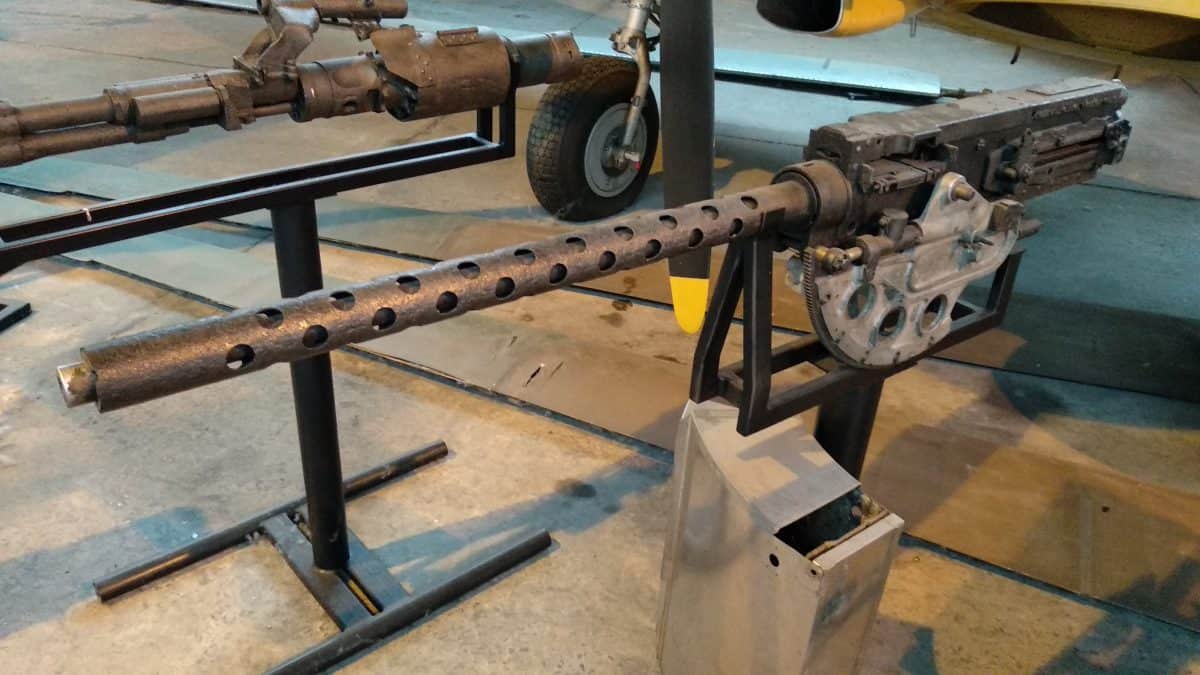
©"Browning M2 MLP 01" by Zala is licensed under BY-SA 4.0. – Original / License
There have been attempts to replace the venerable M2 Browning, a 1933 heavy machine gun, over the last few decades. It’s a testament to this legendary firearm that it has yet to be replaced, all while retaining the same core design features seen in its original configuration. Chambered in .50 BMG, the M2 was developed in the direct aftermath of the First World War, with American war planners recognizing the need for a more powerful machine gun to directly engage thin-skinned armored vehicles, aircraft, and fortified positions at ranges where the standard .30-06 wouldn’t suffice.
The final result was a weapon that has served since World War 2 in a variety of configurations. During the Second World War, you’d see it attached to tanks, affixed to the wings of aircraft like the P-51 Mustang, and serving right alongside the anti-aircraft cannons on naval vessels. It would see use throughout the Korean and Vietnam Wars, mounted on helicopters and armored personnel carriers. Even today, it’s seen on the cutting-edge MRAPs and battle tanks that make up America’s military forces.
What you get is a weapon that generations upon generations of soldiers have trained on. This is owed to its straightforward design. Despite the technological leaps that have taken place in the 93 years since its introduction, the M2 still does the job when considering its weight, cost, and logistical footprint. It’s unlikely to go anywhere for the foreseeable future, as even projects like the General Dynamics LWMG fell well short of providing a suitable alternative to the M2.
Lee-Enfield
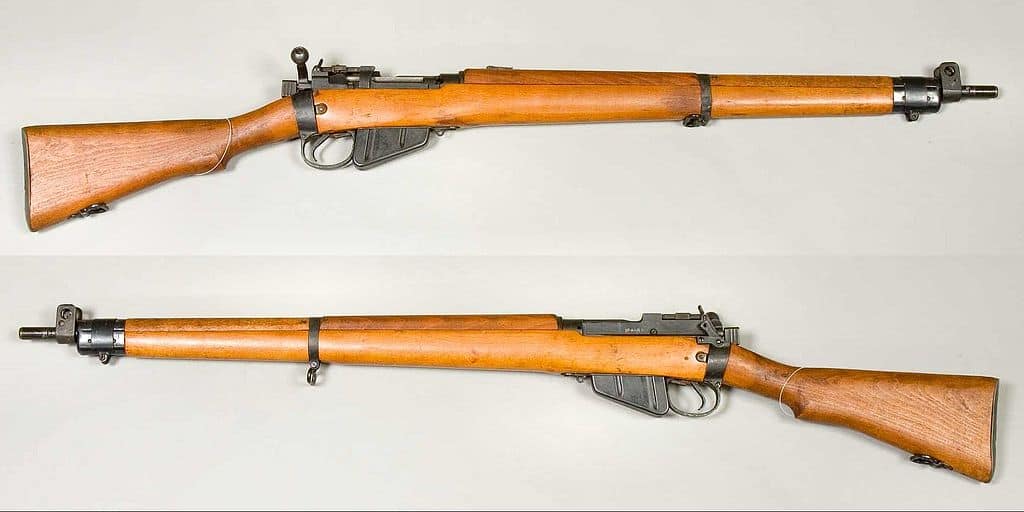
For all intents and purposes, the Lee-Enfield’s country of origin has largely seen the venerable bolt-action become obsolete. It served the British Empire through both World Wars,l providing a level of firepower that was akin to machine guns when considering the regimented drilling instilled in basic riflemen. The .303 British it was chambered in was plenty potent for its time, competing with the likes of 8mm Lebel and 8mm Mauser when considering raw kinetic energy. With a service history lasting from 1895 until 1957, the British Empire was well-equipped when the Lee-Enfield was a standard piece of kit.
After the end of the Second World War, as the Cold War reached across the very corners of the globe, material was shipped to client states all over to bolster their fledgling armed forces. The Lee-Enfield still remains in active use across countries like Afghanistan and Pakistan, where its robust design and a fitting surplus of .303 British ammunition make it a popular choice.
It still saw use in the Canadian Rangers until 2015. The robust action of the firearm made it well-suited for patrols in the Arctic regions of Canada, where a normal semi-automatic or select-fire assault rifle might fall short. The Lee-Enfield might not have been intended to operate in such extremes, but it proved to be a highly capable weapon when considering sub-zero temperatures while maintaining an accurate base of fire. The Tikka T3 CTR has largely replaced the Lee-Enfield in use with the Rangers, but it’s reported that there was a brief period of mourning for the beloved service rifle.
Conclusion
The legendary firearms we’ve covered today all have common attributes we can trace. Reliability is a chief concern among these weapons, with ease of use and simplistic designs being a plus. Further, they’re designed with enough flexibility to succeed in roles that planners and designers might not even consider at the time of their inception. At the core of it, these weapons weren’t designed for anything else but to work when needed, and they do that with gusto.
The image featured at the top of this post is ©Roo72, Public Domain, Wikimedia Commons – License / Original