
Historically, we often view the Second World War as a time of great strife, as it remains humanity’s deadliest war to date. However, beneath the bloodshed, there is no denying the great amount of innovation and ingenuity at play from engineers all over the world as they began looking for any possible advantage. Some of the weapons and platforms developed would act as a prediction of things to come, but might have appeared too late to make any sort of substantial difference. With that in mind, we’re looking at some of the most technologically advanced weapons of the Second World War and how they influenced future developments.
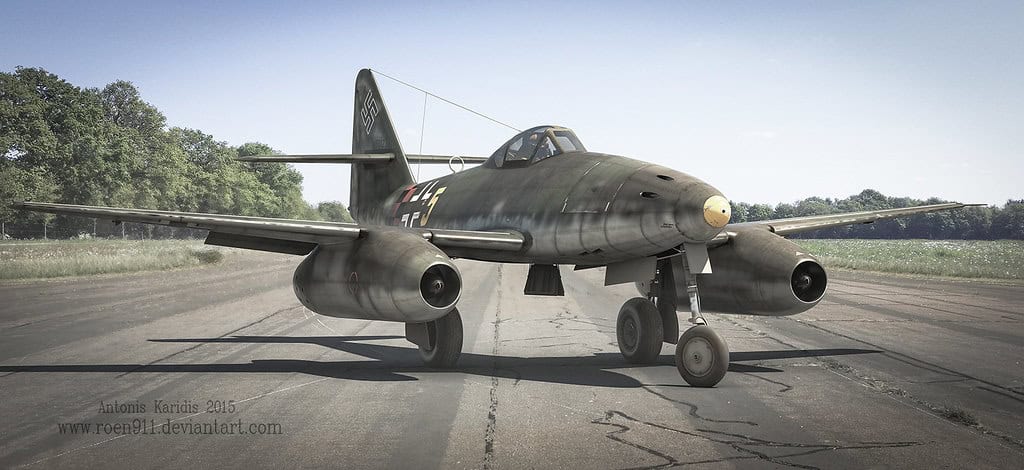
Messerschmitt Me 262

©"Messerschmitt ME-262 'Schwalbe'" by bkaree1 is licensed under BY 2.0. – Original / License
Arriving late in the war, and amid production and material problems, the world’s first true jet-powered aircraft took flight. The Me 262 made use of a pair of Junkers Jumo 004 turbojet engines, giving it a maximum speed of around 100 to 150 miles per hour faster than any comparable Allied piston-engine fighter. By the time the Luftwaffe took hold of the Me 262, the war was essentially lost. Germany had minimal fuel supplies, production bottlenecks hindered delivery, and Hitler insisted that what precious few they had available were converted into bombers.
Further, by 1944 and 1945, Germany’s more seasoned pilots were in short supply. This technologically advanced fighter was relegated to use by green pilots, who weren’t capable of leveraging its full capabilities. It did score some victories, but not enough to make a definite impact on the Third Reich’s fortunes by the end of the war. Everything was too little, too late, which is going to be a repeated theme as we look at the rest of these German wonder weapons.
Armament-wise, the Me 262 was well-suited for hunting strategic bombing craft. Heavy cannons made short work of any Allied craft, and it could boom and zoom with the best of them. If it had perhaps arrived earlier in the war, or the materials were readily available, it might have been a different story. As it sits, it remains a fascinating hypothetical of what could’ve been had the war dragged on another year or two.
Horten Ho 229 Flying Wing
Of all the weapons and platforms we’ll cover today, few demonstrate just how advanced German engineering was like the Ho 229 Flying Wing. The prototype jet was very ahead of its time, with a silhouette more in line with modern airframes rather than something from 80 years ago. A lot of the specs for the Ho 229 are largely hypothetical, as the Flying Wing never saw full-scale production.
We do know that Horten engineers intended for it to have a flight ceiling of 49,000 feet, with a maximum speed of 600 miles per hour, placing it well ahead of even the P-51 Mustang. This was in part thanks to its flying wing design, which did away with the conventional fuselage and tail seen on piston-driven aircraft of the time.
The war’s end didn’t bode well for the Ho 229’s production, nor did its complex design. Allied observers and museum evaluations confirmed it could very well have outpaced Allied fighters, soaring to altitudes that most planes of the era could only dream of. Like the Me 262, it’s a case of what could’ve been. Many of these wonder weapons came about from a drive to get a substantial edge, without focusing on what precious resources were left as the war dragged on.
Fritz X

©"Fritz X Guided Bomb" by Sanjay Acharya is licensed under BY-SA 4.0. – Original / License
You’ll get some heads to turn when you mention facts like they were testing unmanned aerial vehicles as early as the First World War. The Second World War saw its fair share of leaps forward, as the first helicopters and rockets were tested and utilized, paving the way for what the proxy wars of the Cold War would look like. The Fritz X was something else entirely, being the first truly viable guided munition to see combat use throughout the war.
It lacked the sophistication of something like a JDAM, but for the time period, it was well beyond what anyone expected. The Fritz X relied on a radio control link that was controlled by the bombardier after the munition was released. It successfully sank the Italian battleship Roma in 1943, while damaging other Allied vessels in the Mediterranean.
It did have some significant shortcomings, however, as it was susceptible to jamming, making it a fairly expensive dumb bomb. The systems themselves were quite complex, resulting in a degree of difficulty in effectively utilizing them in combat. Ultimately, they had little tactical impact, being more of a curiosity at a time when the German war machine was starting to feel the pressure of a two-front war.
V-3 Supergun
You do have to hand it to the Germans throughout both World Wars; they did love a massive gun to try and handle things. The V-3 Supergun was unlike anything the world had seen, making use of a 150mm projectile to strike targets as far as 103 miles away. Two massive prototype cannons were built at the Fortress of Mimoyecques in northern France, with the intended strike target to be London. They were ultimately destroyed without firing a single shell during Allied bombing raids.
What makes the V-3 unique isn’t so much the concept, as long-range cannons were experimented with during the First World War and the Paris Gun. Instead, it was more the technology at play with the shells the cannon fired. Each shell made use of a multi-charge propulsion system, with the idea being to boost muzzle velocity and extend the range.
Rather than making use of explosive charges like most larger cannons, the Supergun made use of solid-fuel rocket boosters. A smaller iteration of the V-3 was successfully used in Luxembourg, being dubbed the “half-barrel” variant. Two gun installations were installed, firing 183 rounds with 44 confirmed hits. Coincidentally, the sole use of the cannon coincided with the Battle of the Bulge, where German resources were more sorely needed.
Goliath Tracked Mine

©"Goliath Tracked Mine with manual control WW2 Weekend" by Henrysz is licensed under BY 4.0. – Original / License
I mentioned unmanned vehicles earlier, and they saw a more refined return during the Second World War. Rather than taking to the air, these were intended for the ground, with the intent being to disable tanks and demolish tanks rather than bombing targets. Around 7,000 Goliath tracked mines were produced, but they’re fairly primitive when compared to modern unmanned ground vehicles. They made use of a joystick and a cable to control, giving a weak point for the operators to lose control under heavy combat.
More importantly, they were rather thin-skinned in terms of armor to keep weight down. When coupled with the slow operational speeds, this resulted in a platform that was relatively easy for Allied troops to spot and disable, with the Goliath even being easily dispatched with standard rifle fire. The promise was certainly there, but the execution left something to be desired.
Ultimately, the Goliath proved to be more of a liability than any sort of boon. For the intent of destroying structures and dispatching tanks, a sapper or anti-tank gunner hiding out of sight was far more effective and less likely to get spotted right away.
Fliegerfaust
The last of the wonder weapons we’re covering is rather forward-thinking. The Fliegerfaust was an experimental man-portable air defense rocket with a multi-barreled launcher enabling infantry to engage low-flying aircraft effectively. It was a failure in testing, as poor accuracy and limited range ensured only a handful were tested before the project itself was shelved. You can’t help but imagine how the war would’ve changed with more effective means of repelling dive bombers and strafing runs.
Realistically, the German war machine should’ve been focused on capitalizing on what scant resources it had. As the war wore on, and the Soviets pushed back in the wake of Barbarossa, the use of wonder weapons proved to be more and more tenuous. If they had stuck with just producing what worked, they likely could’ve stuck it out another year or so before the combined might of the Allies came crashing down on them.
Why Did These Weapons Fail?
There is quite a bit of scholarship on Germany’s war effort during the Second World War and its failings. As such, I won’t dive too in-depth on what went wrong, but will touch on some of the broader talking points. Firstly, the timing of many of these weapons came too late in the war, with the most advanced appearing in 1944 and 1945, right as the Soviets and Western Allies were knocking on Germany’s front door. As such, there wasn’t ample time to shift the needle in terms of strategic dynamics.
Speaking of the late war, you can’t ignore the failing German production capacity in the late war. As formerly conquered territories were liberated, resources started dwindling, and German factories were strained both by the lack of material and subsequent Allied bombing raids that left them in ruins. Many of the weapons covered also lacked the requisite training and support infrastructure that any system requires for effective use. It’s easy to play armchair general, but logistics and support win wars, and German support for these newer platforms simply wasn’t there.
Finally, I’ve touched on this a handful of times, but wonder weapons diverted valuable resources. Germany was in constant short supply of vital materials like rubber, steel, and fuel throughout the war, hindering just how effective some of these platforms could be. When compared to an Allied nation like the United States or the Soviet Union, which focused on what was good enough, these wonder weapons were forward-thinking, but not the right fit for the matter at hand. Germany was going to lose the war regardless, but the focus on expensive, complicated systems simply lacked the personnel, resources, and production capabilities to be truly effective.
Conclusion
These weapons and platforms weren’t without their legacies by any means. The Korean War would see the first truly viable jet fighters taking flight in MiG Alley, with the Soviets and Americans making use of their own takes on the design. Precision-guided munitions have been rather standard fare since the late 20th century, with JDAMs being able to land within fairly confined spaces to devastating effect.
Unmanned systems started being perfected in the late 20th and early 21st century, showing that the concept certainly was viable. It was simply a lack of technological advances holding back their effective use. We see unmanned systems conducting aerial reconnaissance, performing sentry duty, and even conducting naval patrols in the modern era. The Third Reich was looking forward, but this was in spite of hindering itself from fighting the war that was right in front of it.
The image featured at the top of this post is ©"Messerschmitt Me 262" by aeroman3 is licensed under PDM 1.0. – License / Original