
Few aspects of warfare are quite as harrowing and devastating as the siege. These defy the sudden violence and swift resolution of pitched battles. Instead, they’re a train crash in slow motion, making use of mechanical, psychological, and biological means of grinding a population into submission. For much of recorded history, sieges have been a contest of wills, where the primary weapons aren’t the likes of swords and spears, but rather time, hunger, and disease.
The great walls that encased the major cities of history served as both a shield and a tomb, an interesting paradox when considering the standard fortification measures for centuries. Today, we’re taking a closer look at some of the worst sieges in recorded history. They stand out for their sheer brutality, along with the lasting effects they’ve had on the shape of history.
Siege of Tyre
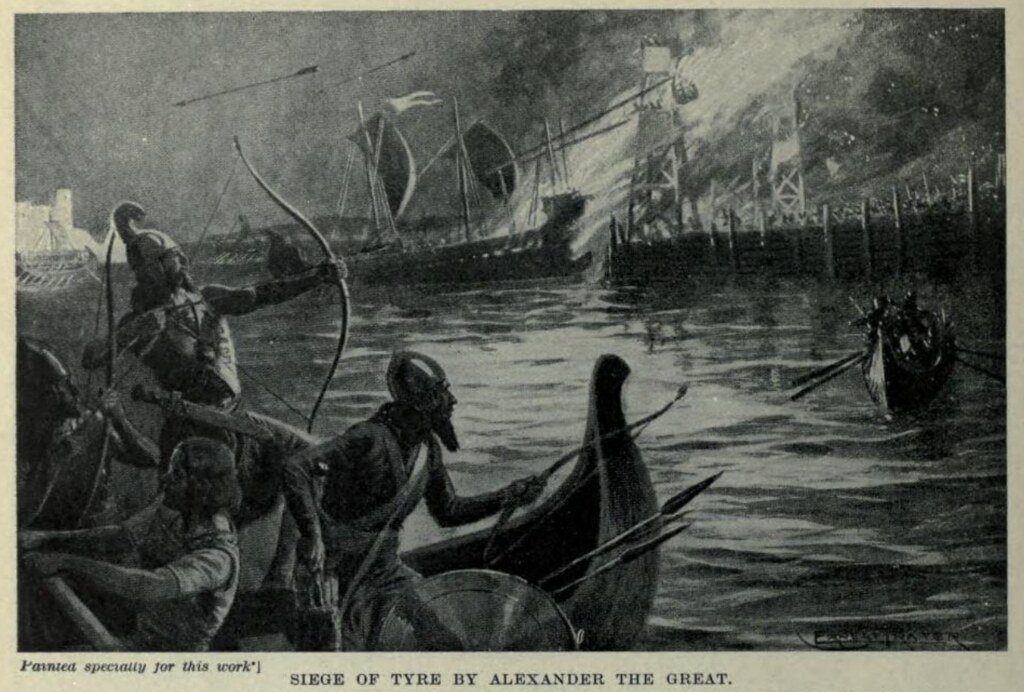
©"Greece – Siege of Tyre by Alexander" by History Maps is licensed under BY 2.0. – Original / License
As Alexander the Great made his march to Egypt, the island city of Tyre proved to be a sizable thorn in his side. The island city was surrounded by massive walls and a half-mile of seawater that would make any siege a seemingly impossible task. The Tyrians mocked Alexander and his army, believing themselves to be untouchable.
Alexander was undeterred, and his solution was a piece of military engineering that still stands in place, centuries later. The Macedonians got to work on a mole, or a giant stone causeway, which led from the shore straight to the island. For seven grueling months, the Tyrians fought back against the progress of the Macedonians with fire ships and by pouring burning sand on them.
By the time the walls fell, Alexander’s patience had worn thin. The massacre of Tyre’s citizens was systematic. Around 8,000 Tyrians were killed in the immediate aftermath of the city’s fall. Another 2,000 young men were crucified along the shores of the city, serving as a gruesome reminder of their fates if they defied Alexander. 30,000 citizens were sold into slavery, effectively ending the city of Tyre. Tyre itself was erased from the map, and the causeway Alexander built stands to this day. The siege has turned it into a permanent peninsula.
Siege of Jerusalem
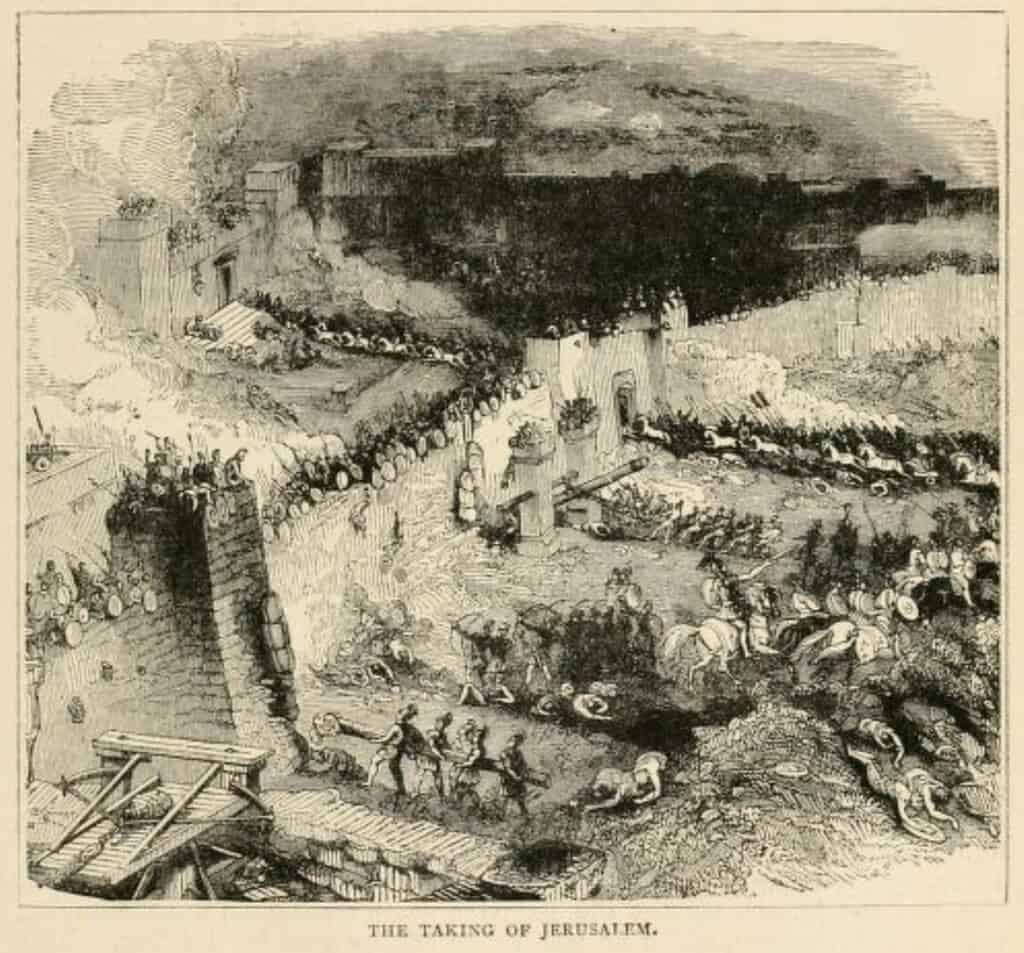
©"Hebrews – Siege of Jerusalem" by History Maps is licensed under BY 2.0. – Original / License
Not many of the sieges we’re covering are going to have the sort of impact where we can still feel the aftershocks nearly 2,000 years later. The First Jewish-Roman War came to a close with one of the most brutal sieges in all of recorded history, something that eyewitnesses struggled to come to grips with or even attempt to describe. Titus, who would be the emperor of Rome, encircled the city of Jerusalem with four legions. The city was effectively cut off from all outsiders, curbing the flow of supplies as its numbers swelled for Passover.
Starvation was the primary killer in Jerusalem, with the famine reaching extremes in no time. Factional infighting led to the burning of their food stores, only exacerbating the famine. Around 1.1 million would die in the wake of the encirclement, mostly from starvation and disease. Roman-Jewish historian Josephus noted incidents of cannibalism within the city walls as the famine wore on.
As citizens attempted to flee, the Romans were swift to make them serve as a reminder of what would happen and to break the will of Jerusalem psychologically. Around 500 people were crucified daily, a practice which continued until the Romans ran out of wood to build the crosses. The siege ended with the destruction of the Second Temple and the forced diaspora of the Jewish people, something we’re still seeing nearly 2,000 years later.
Siege of Baghdad
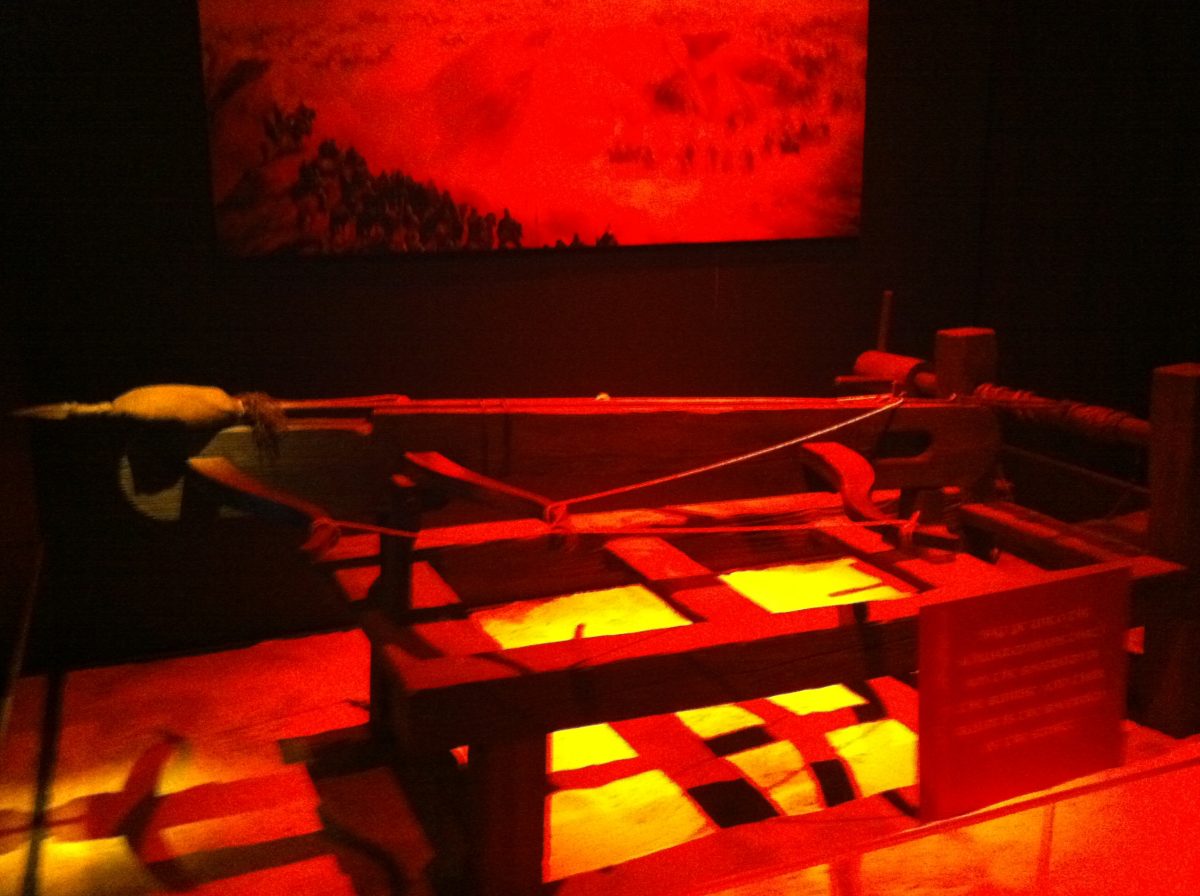
©"Triple-Bow Siege Crossbow, Genghis Khan Exhibit, Tech Museum San Jose, 2010" by Bill Taroli is licensed under BY 2.0. – Original / License
In the 13th century, the great city of Baghdad was seen as the Islamic world’s foremost place of knowledge and learning. When Hulagu Khan, grandson of the famed Genghis Khan, arrived at the gates of Baghdad, he had the biggest Mongol army ever assembled. Like his grandfather, the mandate was simple: surrender or face the consequences. The caliph, Al-Musta’sim, refused the offer. The caliph was under the mistaken notion that the rest of the Muslim world would come rushing to his aid.
He was proven horribly wrong in short order. The siege itself was relatively swift, not lasting for months or years like many we’ve seen in history. What makes this one of the most brutal sieges in history is the immediate aftermath when the Mongols seized the city, however. Siege engineers breached the walls, and the Mongols came rushing in. The caliph was executed in a notably cruel fashion. He was rolled into a rug and trampled to death by horses.
The Grand Library of Baghdad was emptied, its works tossed into the Tigris River. Legend has it that the waters of the Tigris flowed black with the ink of countless manuscripts before running red from the blood of Baghdad’s great minds. Numbers vary on just how many were slain in the immediate aftermath, with numbers ranging from 200,000 to 800,000 citizens being massacred by the Mongols. That said, the effect on the region was profound as irrigation systems were destroyed, and the knowledge hub of the Muslim world turned into a wasteland for generations to come.
Siege of Leningrad
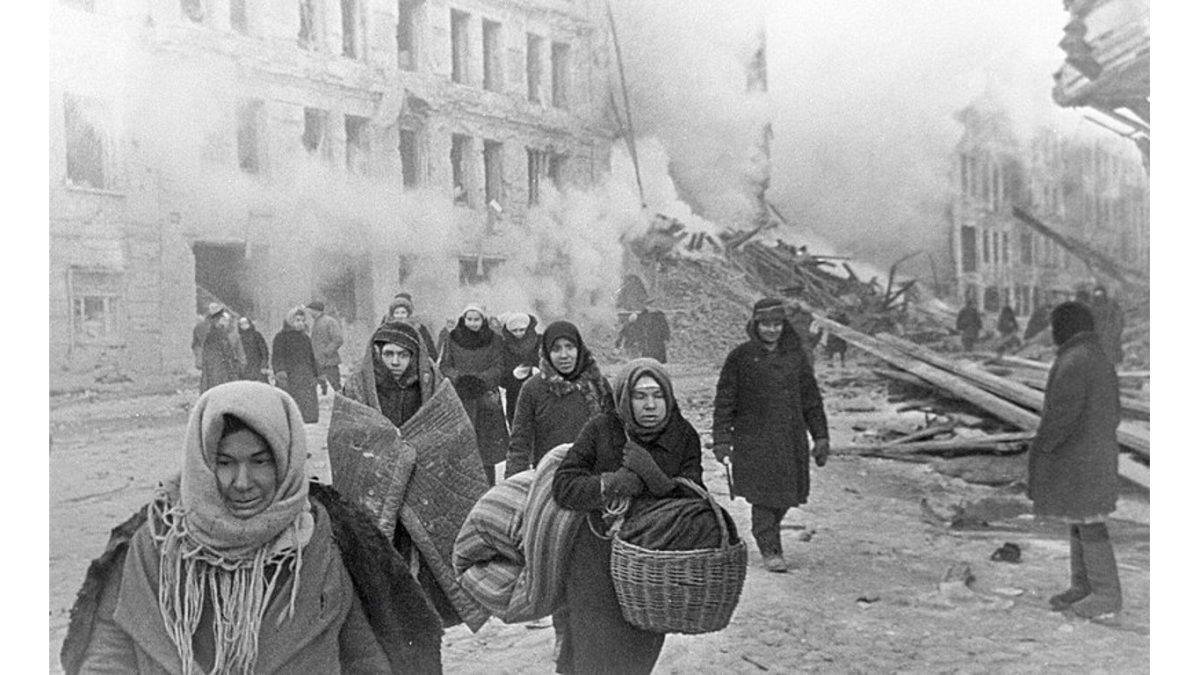
Modern history isn’t littered with sieges, but the few present are among some of the most horrific ever waged. From 1941 to 1944, the city of Leningrad, or St. Petersburg today, was subject to one of the most brutal sieges ever committed. Adolf Hitler didn’t want to capture the city. He wanted to wipe it from the face of the Earth. The primary weapon of the siege wasn’t the great mechanized forces of the Third Reich, but rather starvation.
The citizens of Leningrad were subjected to a grueling 872 days of starvation, completely cut off from the rest of the Soviet Union. Residents made use of makeshift bread, made from a mix of sawdust, cellulose, and flour. When those stores ran out, they resorted to eating things like pets, wallpaper paste, and other shoe leather. Finally, some resorted to cannibalism, desperately trying to cling to life.
An estimated 1.5 million died during the Siege of Leningrad, with 1 million succumbing to hunger and the extreme winter conditions. Compare that to the pre-war population of 3.2 million people, and it serves as a horrifying reminder of just how devastating modern warfare can be. Still, in the face of undaunting cruelty, Leningrad persisted. In the end, the Soviets prevailed and won a hard-fought victory, forcing the Germans from their lines and relieving the besieged city in January of 1944.
Siege of Sarajevo
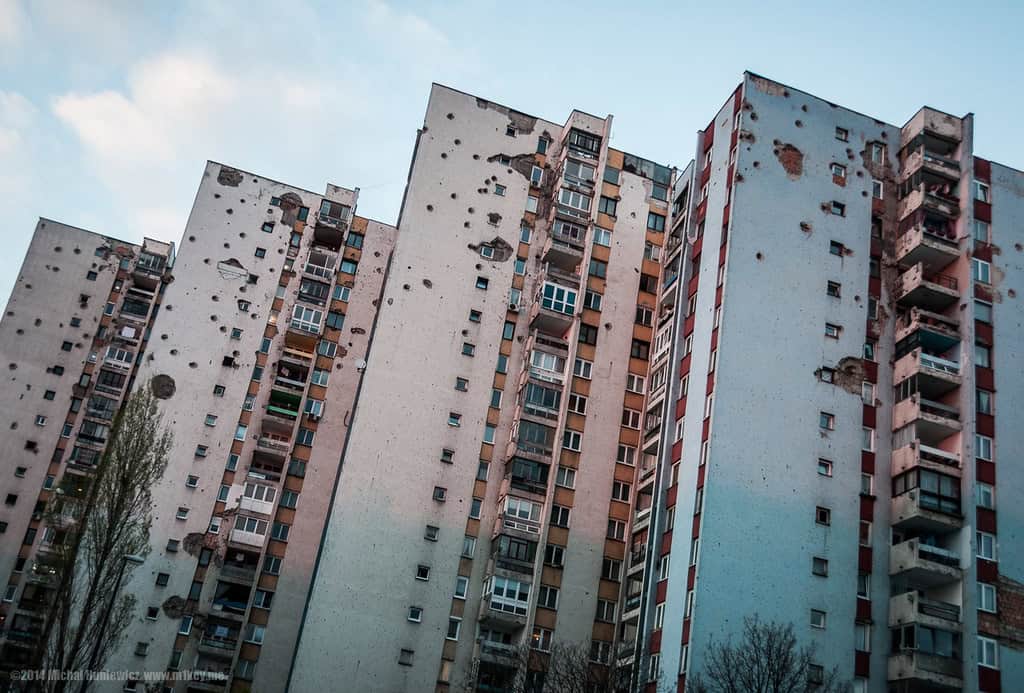
©"War damage on Sarajevo buildings" by M1key.me is licensed under BY 2.0. – Original / License
Leningrad is the deadliest siege in all of history, even when accounting for the likes of Baghdad and Tyre. Few of these brutal sieges can stack up to what happened in Sarajevo, at least in terms of pure duration. For 1,425 days, or nearly 4 years, Sarajevo was under constant attack. This wasn’t a siege dictated by the use of siegecraft and fortifications, but rather the horrors that modern warfare could bring. Snipers and artillery strikes were a common occurrence. Civilians were shot indiscriminately, with Sniper Alley making international news.
Bosnian Serbs encircled the city, with the high ground provided by the mountains allowing them to target anything that moved. The city itself was deprived of all modern amenities, being stripped of water, electricity, and heating. The citizens of Sarajevo’s only lifeline to the outside world was a tunnel they had dug by hand, which measured nearly a kilometer, under the runway of the nearby airport.
The National and University Library of Bosnia and Herzegovina, a longstanding institution and center of the city’s heritage, was deliberately targeted. Countless volumes of archival works, which served as a reminder of the life and culture of the people, were destroyed under directed shelling in 1992, the first year of the siege. Unlike many of the brutal sieges we’ve covered today, Sarajevo is a different beast. In an age of international news and the nascent growth of the internet, a major European city was starved, terrorized, and shelled for nearly 4 years while the world watched on.
Conclusion
The siege is often the final resort in warfare, and a breakdown of the conventions and rules of conflict. It is no longer a battle between combatants, but a desperate struggle where the city can serve as both a defender and a grave for those inside. If anything, the modern era has proven just how horrifying a siege can be. It might not be set upon by the likes of catapults and other weapons, but rather the use of drones, guided artillery, and concentrated bombing campaigns.
What we can learn from these sieges is that the cost when diplomacy breaks down is often paid in blood. Sadly, it isn’t the blood of the combatants spilled in the wake of the siege, but rather a city’s people.
The image featured at the top of this post is ©Al'fred/Shutterstock.com