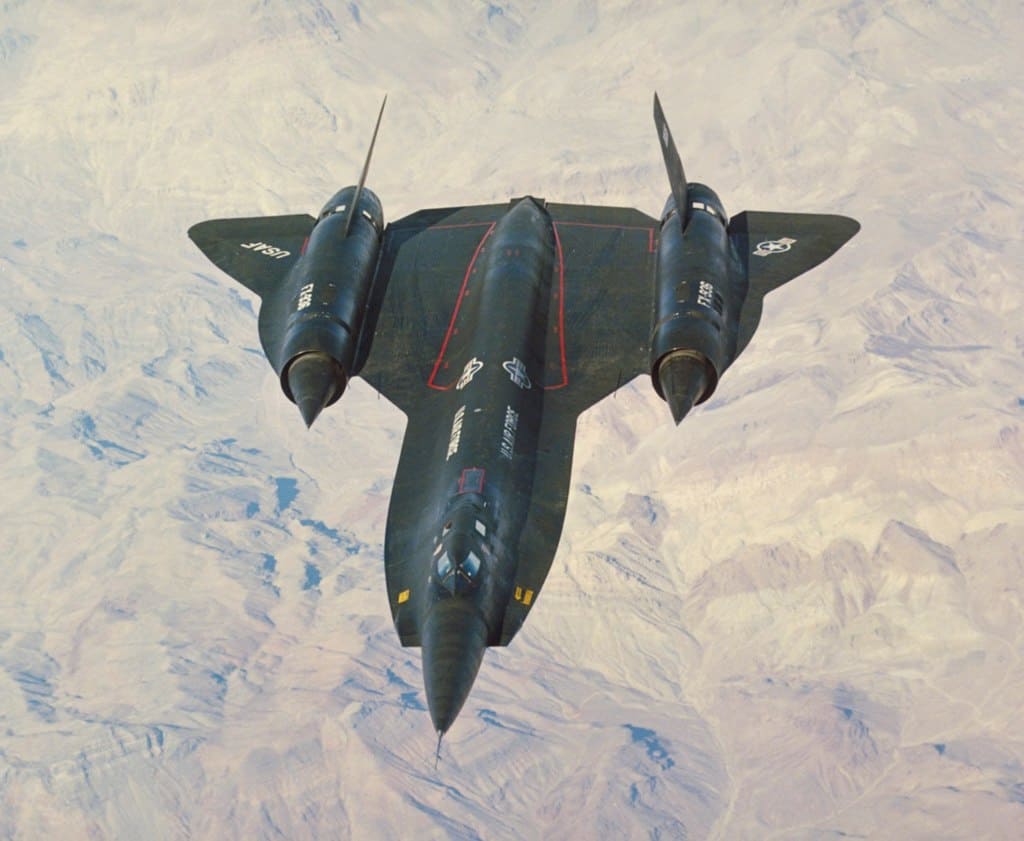

Throughout much of military aviation history, aircraft fit within the confines of what is technologically possible for the time. Occasionally, however, you’ll see military aircraft that burst out of the limits set by technology, often transcending what was thought possible to achieve. If anything, these aircraft seem to come from decades ahead of time, peering into the future while their contemporaries stick with conventional thinking for the era.
Some of the military aircraft we’re covering were so advanced that the means to manufacture them barely existed. Others would introduce ideas that the rest of the world wouldn’t catch up to for decades. Without further ado, let’s take a look at some extraordinary examples of military aircraft that were genuinely well ahead of their time.
de Havilland Mosquito
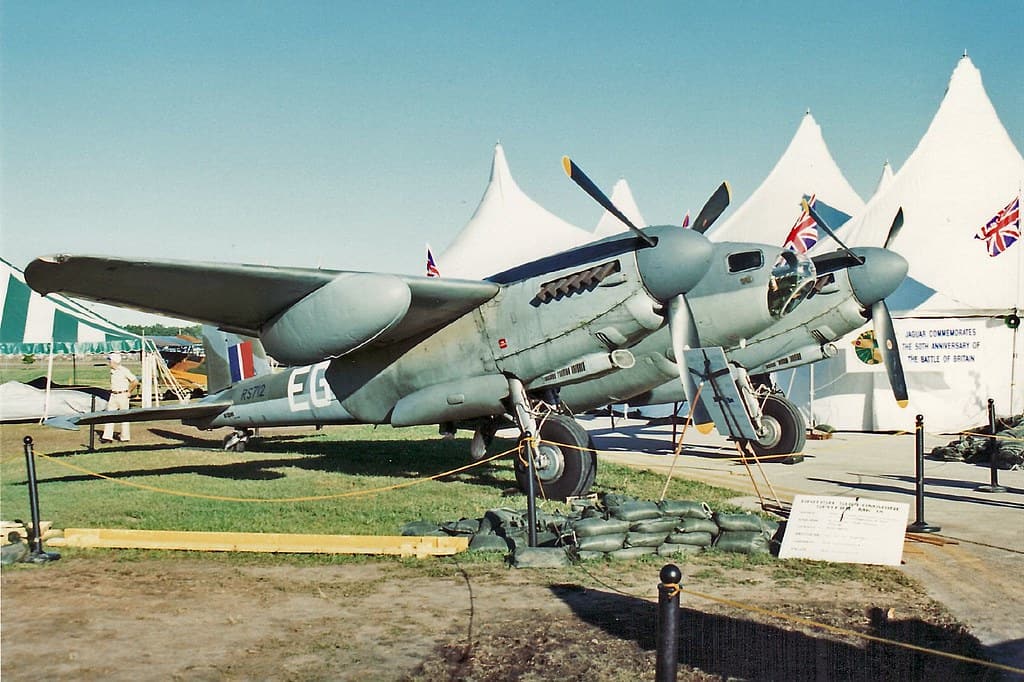
©"de Havilland Mosquito TT.35" by Armchair Aviator is licensed under BY 2.0. – Original / License
The de Havilland design team was a bold sort, especially in the tenuous interwar years leading into the Second World War. By the time the war loomed on the horizon, they proposed a strange aircraft, a light, fast bomber made out of wood. The British Air Ministry was skeptical, as the switch to fuselages and hulls made of metal was the norm, especially for fighter craft like the Hurricane and Spitfire that would come to win the fight during the Battle of Britain. That said, this admittedly strange take on a military aircraft was rather prescient for trends on the whole.
The de Havilland Mosquito was constructed with a balsa and birch plywood sandwich, keeping it somewhat sturdy but remarkably light for the era. The result was a twin-engine bomber that was faster than most single-engine fighters of its day. Bombers were sitting ducks during the war, something that held well until V-E and V-J Day. The Mosquito wasn’t bristling with defensive turrets, but relied entirely on speed to outrun anti-air measures. As we’ll see with later entries, this line of thinking proved to be forward-thinking, as you can’t hit something faster than the targeting technology of the time.
The Mosquito further pushed boundaries by being one of the first truly multi-role aircraft fielded. It worked as a bomber, reconnaissance craft, night fighter, and a precision strike platform. The idea that a single airframe could accomplish all of these tasks wasn’t mainstream doctrine during the Second World War. In fact, it wasn’t until the heights of the Cold War that we’d see the use of single airframes for multi-role missions. The Mosquito was doing it well before it was the norm, all with a wooden frame and a pair of piston engines.
Messerschmitt Me 262

©"Messerschmitt ME-262 'Schwalbe'" by bkaree1 is licensed under BY 2.0. – Original / License
The first jet-powered fighter to take to the skies wasn’t some conversion of a piston-driven craft, but rather a wholly new design that resembled something from the Cold War. It came with a bold swept wing design, twin turbojet engines, and a sleek aerodynamic fuselage that was a complete departure from the more common fighters seen throughout the war. The Me 262 first took flight in 1944, and was well beyond the capabilities of most Allied military aircraft of its era.
In terms of raw performance, the Me 262 was simply that much better. It outsped Allied fighters, and was capable of agile feats that other military aircraft couldn’t match. Allied pilots who encountered it in the sky likened it to something from science fiction, as they simply couldn’t easily draw a bead on the craft as it darted around.
It wasn’t all roses, as the late-war production capacity of Nazi Germany would show. The Me 262 had serious issues, thanks in part to just how futuristic the design was. The twin engines were unreliable, needing constant maintenance to remain airworthy. Going by later norms established by later jet aircraft, its acceleration was sluggish, making it vulnerable to strikes when landing and taking off. The underlying concept was sound, as a fast swept-wing military aircraft would be the blueprint for numerous interceptors during the Cold War. The Me 262 set the tempo for fighter jets for the next 40 years.
Lockheed U-2
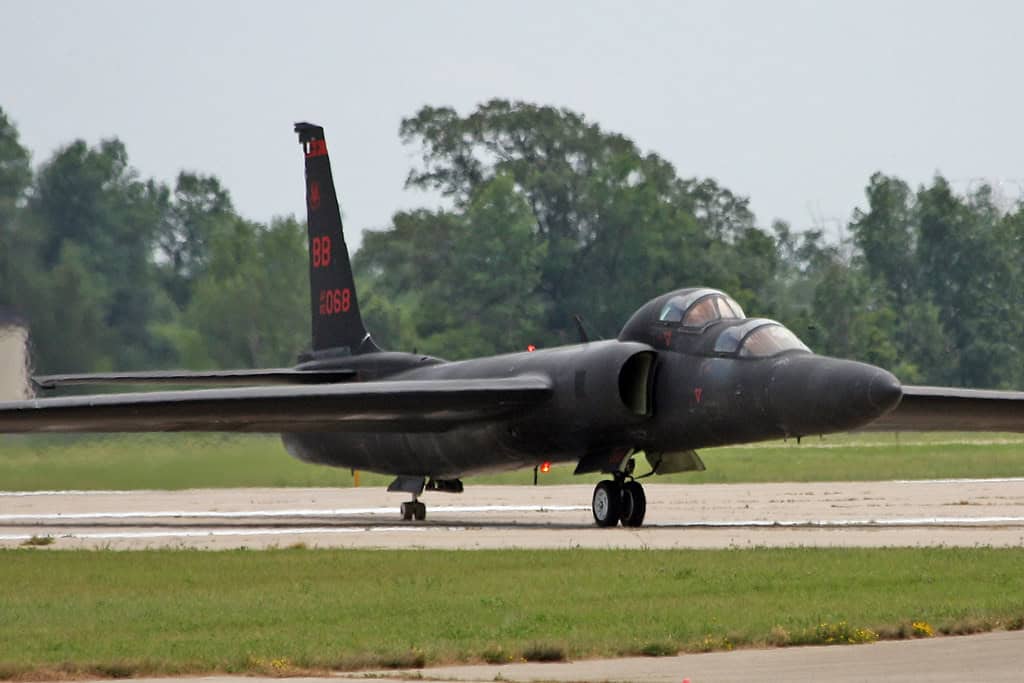
©"Lockheed U-2" by Armchair Aviator is licensed under BY 2.0. – Original / License
By 1955, the era of gunfights in the sky had long since passed. Missiles, guided by radar and heat seekers alike, were the way forward in terms of defeating air assets. This came in the form of both aircraft-mounted and surface-to-air missiles, which were both highly deadly for any pilot operating above enemy airspace. Lockheed decided to take a bold step forward and manufacture a reconnaissance aircraft that was untouchable by any missile platform. The end result was the U-2, which could cruise at altitudes above 70,000 feet to take photographs of enemy territory at will.
When the U-2 first took flight in 1955, it went well above the conventional operational ceilings of the time. Flying at 70,000 feet placed it much higher than commercial airliners and, more importantly, Soviet interceptors. This came about from a rather bizarre design philosophy. Structurally, the U-2 was a supercharged glider, with an enormous wingspan-to-weight ratio. The fragile, minimalist design made for an exceptionally difficult military aircraft to fly. Given that it operated at extremes, pilots were forced to wear pressurized suits, not unlike those worn by astronauts.
The U-2 is an enduring design, serving for over 70 years with the United States Air Force. Its deployment is far more limited these days, only being operated by a handful of detachments like the 9th Reconnaissance Wing and 380th Air Expeditionary Wing. That said, you won’t find many military aircraft that were so ahead of their time that they’re still fulfilling the same sorts of mission over multiple generations of pilots.
SR-71 Blackbird
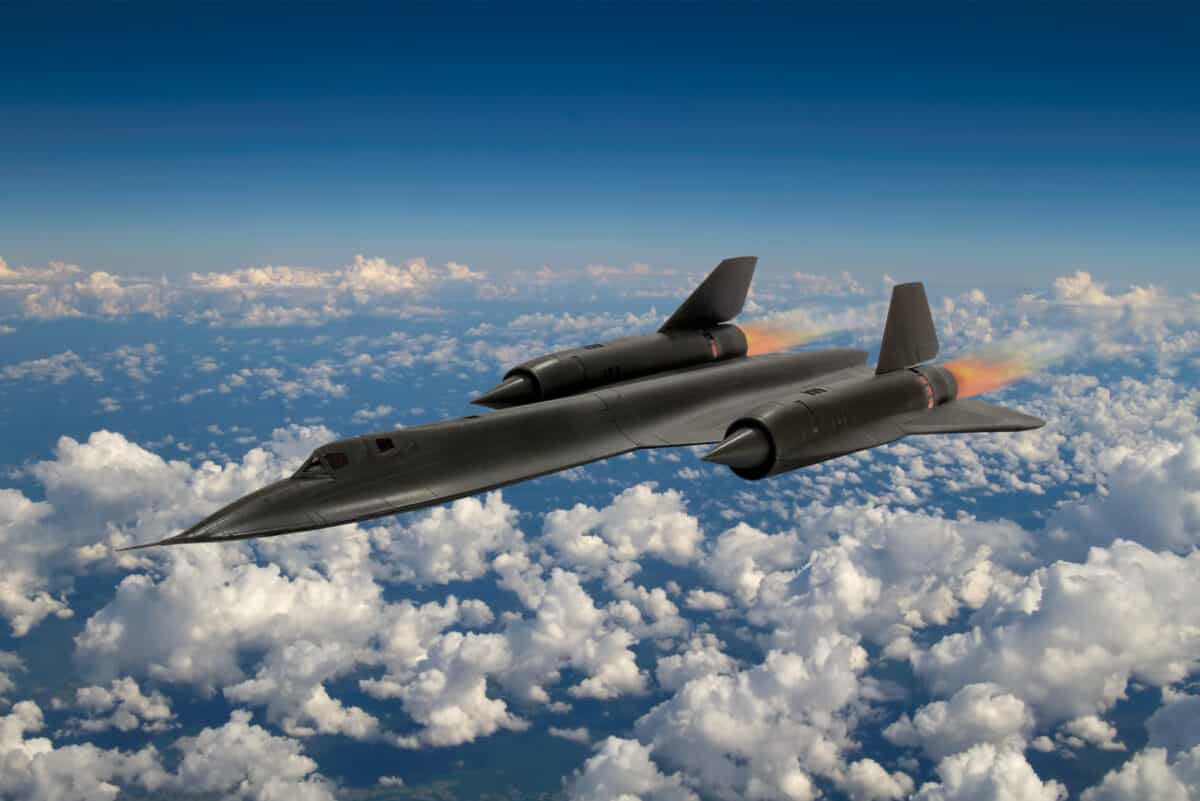
©Keith Tarrier/Shutterstock.com
If the U-2 was decades ahead of its time, the SR-71 Blackbird was from another planet. It was the brainchild of Lockheed’s legendary Skunk Works division, led by Kelly Johnson. When it first took flight in 1964, there was nothing like it, and at the time of this writing, it has yet to be surpassed. The Blackbird is the fastest air-breathing aircraft ever built, achieving speeds of Mach 3.2, over 2,000 miles per hour, at altitudes exceeding 85,000 feet. At that sort of speed, even a lightweight metal like aluminum would tear apart under the heat generated by the friction. As such, Lockheed had to develop entirely new manufacturing techniques.
The Blackbird is mostly constructed of titanium, a difficult metal to work with. It paid off tenfold, however, as the lightly armored Blackbird had shockingly simple defensive measures of its own to use. Upon the launch of a Soviet missile, the Blackbird simply hit the throttle. There was no need for chaff, jammers, or evasive maneuvers. It worked astoundingly well, as not one Blackbird was shot down while in operation.
The Blackbird is a military aircraft so ahead of its time that it is still being studied today. If anything, we’ve yet to fully catch up to where the aircraft is in terms of capability. It makes for a rare, astounding piece of military technology that, even 62 years after its first flight, nothing comparable has been developed.
F-117 Nighthawk
©Arthur Eugene Preston/Shutterstock.com
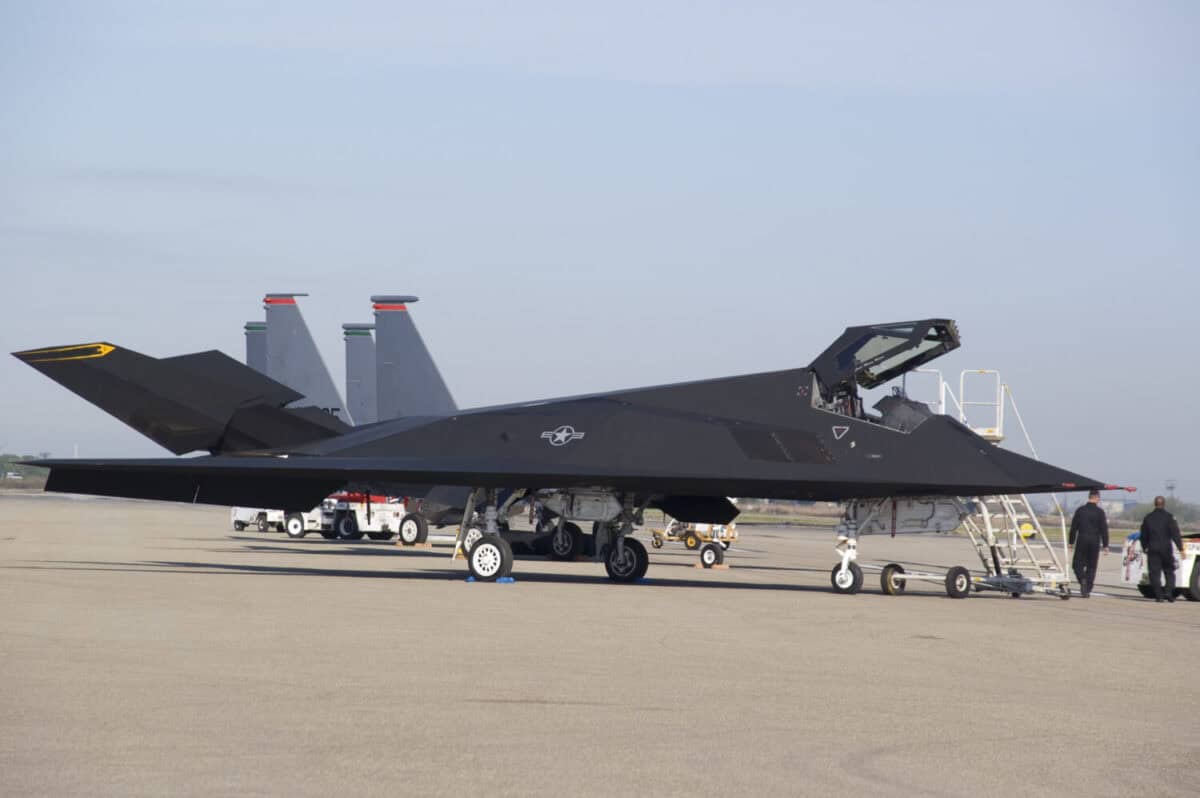
The concept behind stealth aircraft was something that had been theorized upon for decades. Coatings and the shaping of the airframe were intended to minimize its radar signature. This concept wasn’t acted upon for decades, until 1983. The F-117 Nighthawk is the culmination of years of research and development, and when it was revealed to the public in 1988, it was unlike anything the world had seen.
The exterior has a faceted, angular surface. These flat faces were placed at deliberate intervals to disrupt or deflect radar waves, rather than bouncing them back for a positive signature. It even extended to the rest of its construction, as the military aircraft had radar-absorbent materials applied to its surface. Despite being a full-sized aircraft, the F-117 had a radar signature the size of a solid steel ball bearing.
The Nighthawk was decades ahead of its time, something that we’re seeing more fully now with the development of aircraft like the F-22 Raptor and F-35 Lightning. An aircraft’s survivability is being defined less by its speed and agility, and more by the ability to fool even the most advanced radar systems. While the Nighthawk was crude compared to contemporary designs, stealth is a central design consideration for every major military aircraft developed by the world’s militaries. The F-117 established the paradigm, flying combat missions years before the world knew it existed.
Conclusion
There is a common thread between the military aircraft we’ve covered today: the willingness to cast aside conventional thinking and go well outside the box. The designers and engineering teams behind each of the airframes we’ve looked at didn’t ask how to build a better version of something. Instead, they chose to go for what was technically and theoretically possible and build from there. Their designs arrived well outside conventional thinking for the time, and, in some cases, remain so to this day.
The image featured at the top of this post is ©User Rlandmann on en.wikipedia, Public domain, via Wikimedia Commons – License / Original