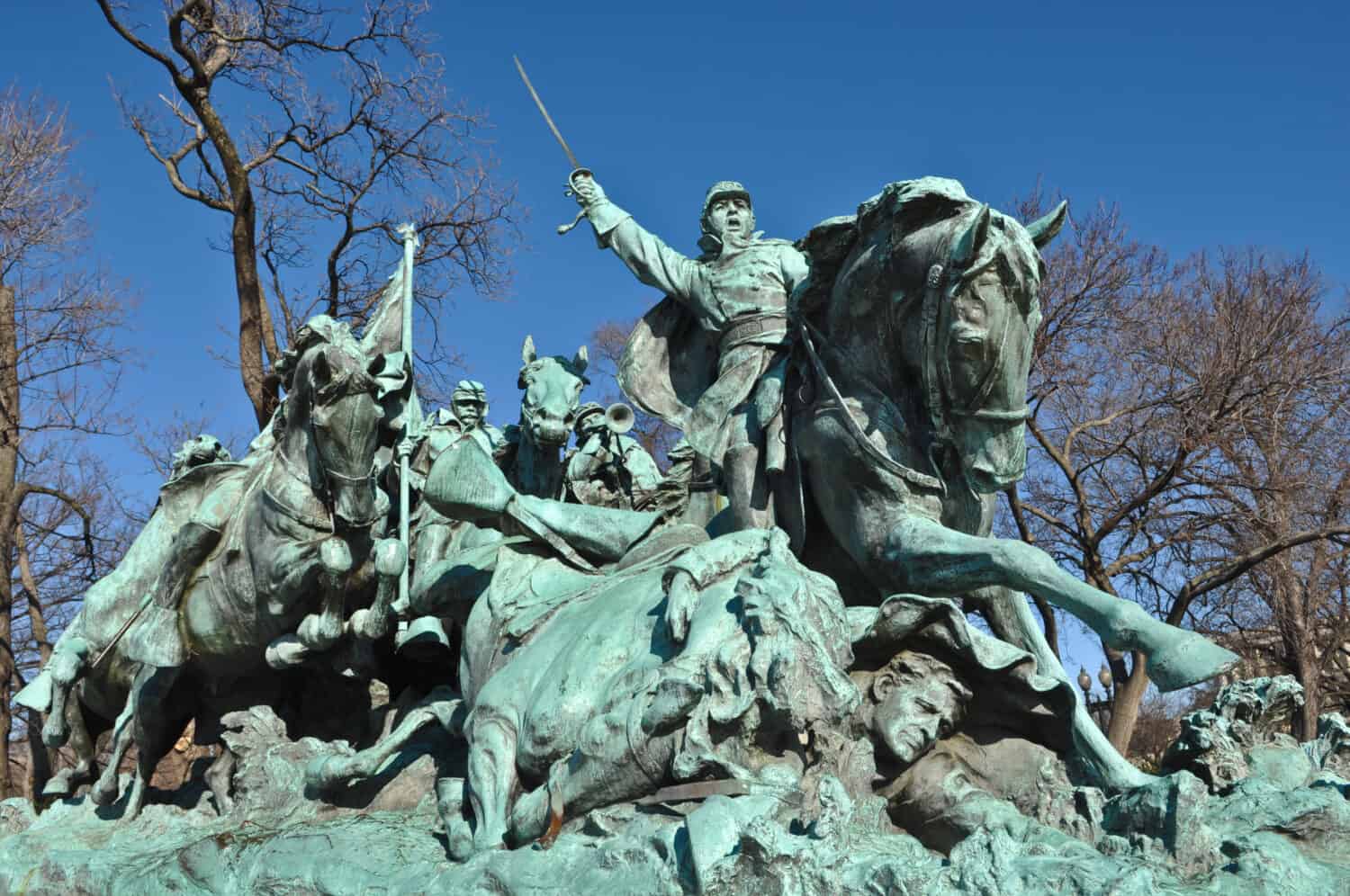

The United States is a relatively young country, speaking in the grander scope of things. That said, it is a nation that has been shaped and molded by conflict. Whether it is wars of colonialism and warring with indigenous peoples, or a horrific civil war. The United States bears the scars of its conflict for all to see. Today, we’re taking a closer look at some of the notable battles to take place on American soil throughout the history of the nation, dating back to well before it even sought independence and ending up somewhere in the 20th century. We’ll be examining key engagements, along with taking a closer look at the impacts of these battles on how the nation was shaped.
Early Conflicts

©"French and Indian War Reenactment" by melissa_rae_dale is licensed under BY 2.0. – Original / License
Long before the signing of the Declaration of Independence or the final battles of the American Revolution, the continent itself was contested by the native population, colonial settlers, and European powers an ocean away. One such example is the Battle of Fort Necessity in 1754, which took place during the French and Indian War. While relatively small in scale, the battle serves as something of a prelude to a much larger conflict in the Seven Years’ War. One young officer, a rather notable figure later on in George Washington, took charge of the British colonial forces against the French in what is now the state of Pennsylvania. The battle itself ended in a British defeat, showing just how fragile the European power’s grasp was on its colonial holdings.
Going back further, we can see King Phillip’s War, waged between 1675 and 1676, in New England. This was a brutal conflict that marked one of many consequential battles between European settlers and the indigenous people of North America. The colonists were besieged by a confederation of Native Americans, led by the aforementioned King Phillip. Entire towns were laid to waste, razed to the very ground they rested on, and while the native people were displaced or killed on a cataclysmic scale.
While these conflicts often don’t come up in the same breath as the American Revolution, it does go to show just how pivotal some of these conflicts were to the shape of the nation itself. Long before any statecraft began, and decades ahead of the forging of the United States, its fate was being shaped by the battles fought on its soil.
The American Revolution

©Hulton Archive / Hulton Archive via Getty Images
Arguably, the most famous example of noteworthy battles on American soil is going to come from the Revolutionary War. What started as colonial unrest from unfair taxation and a lack of representation in Parliament turned into a full-blown rebellion, engaging interest and material aid from the French and other British enemies. As such, several notable battles took place on American soil throughout the Revolution, given the very nature of the conflict.
The war’s opening engagement is recognized as the Battles of Lexington and Concord in 1775. These battles were relatively minor in the grander scheme of the conflict, but marked the first time American and British forces clashed on the battlefield. The Americans were a ragtag force, primarily militiamen armed with whatever spare arms they could muster. Conversely, the British forces were among the upper echelon of the European powers, being a small but relatively powerful force capable of projecting force across the world. The battle was relatively limited in scope, but it proved to be a major touchstone for the national identity of the United States. Men were willing to lay down their lives to protect their independence.
The Battle of Bunker Hill in the same year merely reinforced this notion. It stands as a British victory, but the heavy casualties inflicted upon the Redcoats showed that this wouldn’t be a walk in the park. While the American irregulars lacked regimented training like their European contemporaries, they were more than capable of resisting one of Europe’s premier forces. A major turning point came in 1777, during the Battles of Saratoga. It was here that the French officially allied itself with the fledgling United States, turning a colonial uprising into an international war, and subsequently sealing victory for American forces. Without the French help in both training, material, and other vital means, the Revolution might not have been able to sustain itself, collapsing after all means were spent.
The war itself came to an end in 1781, with the Siege of Yorktown in Virginia. This effectively marked the end of all major land engagements in North America, with the combined American and French forces encircling the British forces led by General Cornwallis. The war didn’t officially end with the British surrender. That would come later with the Treaty of Paris in 1783. However, the British public, and the ruling class by extension, no longer had the will to see the conflict through.
The War of 1812

©Kean Collection / Archive Photos via Getty Images
Despite securing its independence, the very existence of the United States still proved to be rather tenuous on the whole. The War of 1812 would see the nation brought to the very brink of destruction, serving as something of a continuation and reprisal of the American Revolution. It was sparked by the United States and Britain clashing over land, maritime rights, and a general recognition of sovereignty.
The Burning of Washington in 1814 showed just how tenuous independence was at this point in the nation’s life. British forces marched on the nation’s capital, setting both the White House and the Capitol building aflame. The battle itself was rather limited in scope, but the symbolic intent of the act cannot be denied. Independence didn’t equate to security, and it would take more bloodshed to even prove the nation had earned the right to exist.
The Battle of New Orleans in 1815 serves as the inverse of the Burning of Washington, at least in terms of overall morale. General Andrew Jackson took a motley force of American regulars, militiamen, freed Black soldiers, Native American allies, and pirates to a decisive victory against a seasoned and hardened British force. Curiously, the battle itself took place after the signing of the Treaty of Ghent in 1814, but news had yet to reach British forces in North America, or the American combatants still fighting.
The American Civil War

©bpperry / iStock via Getty Images
Civil wars have a way of reshaping the fate of nations. As the South seceded from the rest of the Union at the start of the American Civil War in 1861, it was thought that the war would be a short-run affair, barely last a few months. 4 years of grueling, bloody warfare took place, remaining one of the costliest wars to be waged by the United States in history. We can see some fundamental differences in how the war was viewed early on, however. Take, for example, the First Battle of Bull Run in 1861. Spectators traveled from all over to come see the fighting, viewing it more as a sporting occasion rather than the horrors that awaited. The first Confederate victory of the war showed that it wasn’t going to be a short or polite affair by the time everything was over.
That pales in comparison to the Battle of Antietam in 1862, which remains the bloodiest single day of combat in American history. Nearly 20,000 casualties were a direct result of the battle, and the Union paid dearly for every inch of ground gained. It served as something of a turning point, with Antietam’s bloody engagement halting the Confederate invasion of the Eastern Seaboard.
The most infamous battle of the war would have to be the Battle of Gettysburg in 1863, fought over three days in Pennsylvania. The Confederate attempts to take things on the offensive were halted, despite horrific casualties on both sides. It was at Gettysburg that the popular framing of the war shifted from one to reunite the States to ushering in a new era of freedom with the end of slavery.
By the end of the American Civil War, more than 600,000 troops lay dead, vital infrastructure was destroyed, and cities were razed to the ground. The scars of the conflict are still felt to this day, with regional memories and monuments bearing witness to all that came to pass.
Battles of the 19th Century

©Everett Collection/Shutterstock.com
The American Civil War was far from the only set of battles fought on American soil throughout the 19th century. The aforementioned War of 1812 was one of the pivotal conflicts of the era, but we’d be remiss not to mention the Indian Wars, which were waged for decades throughout the 19th century. One of the most infamous examples of these conflicts is the Battle of the Little Bighorn in 1876, where the 7th Cavalry was killed to the last man by an alliance of Lakota, Northern Cheyenne, and Arapaho warriors. It served as a galvanizing point in these campaigns. Despite it being an overwhelming victory for the Native Americans, it would only serve to intensify military pressure in the coming years as new campaigns and brutality were mounted.
This came to a head at the Wounded Knee Massacre in 1890. Hundreds of Lakota men, women, and children were killed in an attempt to suppress the armed resistance posed by the Lakota. It was part of the larger Pine Ridge Campaign. It came about as an attempt to disrupt a Lakota ritual, the Ghost Dance, and the subsequent fallout would see things reach a fever pitch.
The very soil the nation was built upon wasn’t just up for contention by the settlers who came to reside here and the European powers that controlled it, but also between those who remained and the native peoples who once called this land home.
World War 2

Many of the wars of the late 19th and 20th centuries were fought abroad. Not much is made of the Spanish-American War, the First World War, and others, as they didn’t affect the population left at home. However, World War 2 marked a stark change in this. For the first time in 80 years, the fighting had reached American soil. The Japanese attack on Pearl Harbor might not have happened in the contiguous United States, but Hawaii was an American territory at the time. The surprise attack, targeting the US Pacific Fleet, saw over 2,000 American personnel dead, and brought the nation fully into the Second World War.
Curiously, the Aleutian Island Campaign marks the last time in American history that an aggressor was able to land and take part in any sort of maneuvers. The campaign itself was a relative blip when compared to the whole of the Pacific Theater. However, the occupation of the Attu and Kiska Islands was a wake-up call for the American public. The continent wasn’t insulated from the war. It had the potential to be right at the forefront.
Conclusion
The United States has a history forged in the crucible of warfare. Whether it be colonial skirmishing or the hellish conditions of the American Civil War, conflict has had a way of shaping the fate of the nation from the very start. Further, it has shaped the nation politically and culturally, molding whole communities and people in the aftermath of these battles. Understanding and recognizing these battles isn’t just for the armchair military history buffs, but a fundamental part of comprehending the state of the nation today.
The image featured at the top of this post is ©Brandon Bourdages/Shutterstock.com