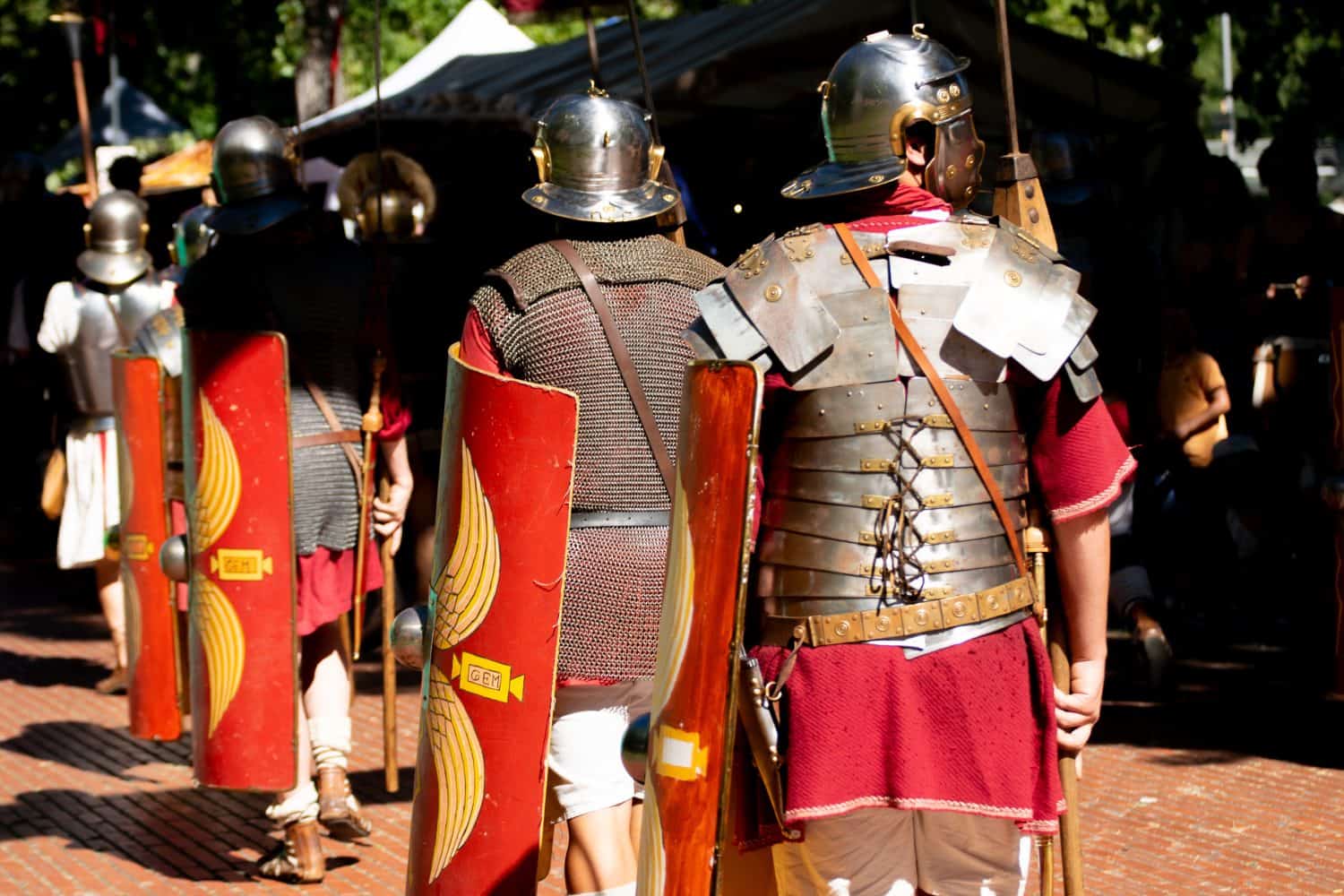

History remembers the broad strokes of ancient warfare. We’ll never forget things like gunpowder, the phalanx, and war elephants. This is understandable, as these drive the imagination and help steer discourse when talking about military history. That said, it’s a singular focus on the big and bold that ignores technologies and innovations that were groundbreaking for their time. With that in mind, we’re focusing on the forgotten chapters of military history and explaining why they were so innovative.
Musculus

©"Musculus of Roman army for the siege of Massilia in 49BC" by Linguae is licensed under BY-SA 4.0. – Original / License
Roman siege engineering is one of the most admired facets of ancient warfare. The Romans, regardless if you’re speaking about the Republic or Empire, were masters of science and engineering, and applied it liberally to their campaigns of expansion. We see this many times throughout history, like the dual lines of fortification at the Siege of Alesia or the siege craft climbing the ramp at the Battle of Masada during the First Roman-Jewish War.
Mechanical ingenuity came easily to the Romans, and they readily showed this with siege craft like the musculus. Essentially a roofed, timber corridor, the musculus was covered with raw animal hides and wet clay to resist fire and arrows. The intent behind it was to push forward toward enemy walls while workers inside dug under foundations and compromised the stonework from below.
What makes this remarkable isn’t just being a siege craft, but having a temporary weapon built on-site repurposed into temporary infrastructure. The musculus resisted burning pitch and flaming logs rolled down from the walls of Massalia, eventually gaining access to the city itself. It remains a testament to Rome’s ingenuity and acts as a demonstration of their mastery of the siege.
Byzantine Caltrops

©"Iron caltrops Scandinavian style 17th or 18th century" by R. Henrik Nilsson is licensed under BY 4.0. – Original / License
The caltrop is a rather basic device, comprising four metal iron spikes arranged so that one is always pointing upwards when thrown at the ground. It is a masterstroke of design, having roots across multiple theaters of ancient warfare, ranging from Rome to Warring States-era China. The Byzantine Empire, the successor state to the Western Roman Empire, is where the weapon truly shone. Byzantine use of the caltrop was systematic, and one of the earliest examples of sophisticated area denial you’ll find.
Byzantine commanders deployed caltrops not just as a physical obstacle, but to manage the terrain. You can find manuals from the height of the Byzantine Empire describing how to best use the weapon to hinder enemy approach routes, setting the flow of an engagement on your terms. This was often down while conducting a retreat, meaning that enemy forces never saw the area seeded with caltrops.
This is a starkly modern concept, predating the use of things like landmines for area denial. The physical threat of caltrops posed potential injuries, but changed the psychological response of Byzantium’s enemies. The primary sources we have depicting the use of these caltrops are so precise and tactically driven that you’d be mistaken in thinking it was a 20th-century doctrine.
Zend-hapet and the Sassanids
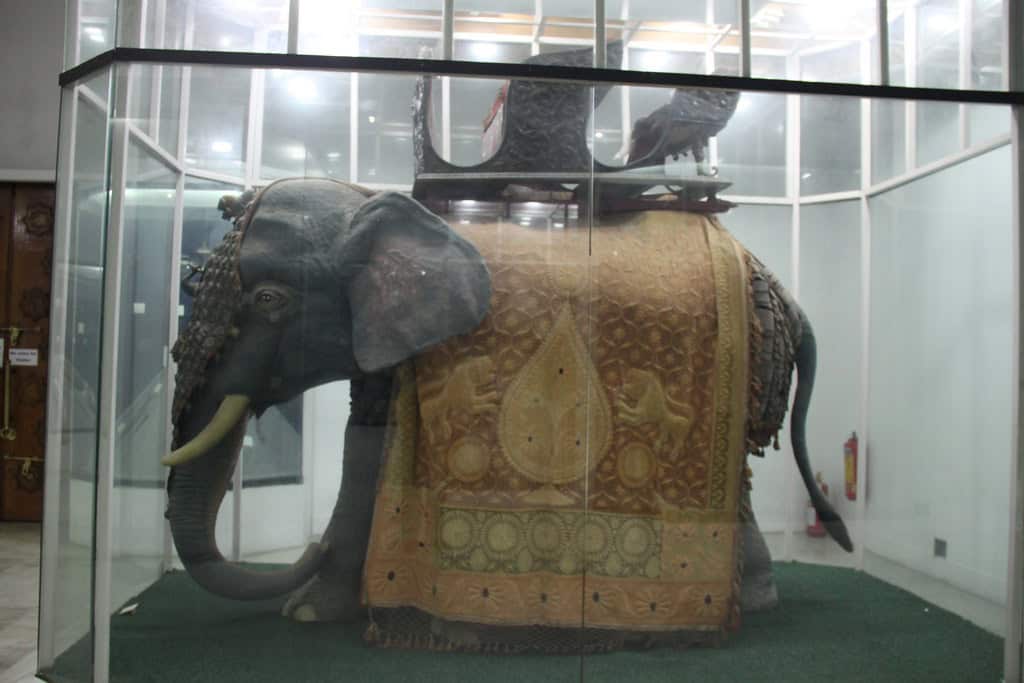
©"Indian Arms: War Elephant" by Gary Lee Todd, Ph.D. is licensed under CC0 1.0. – Original / License
War elephants were a primary weapon during the early Sasanian period, primarily used as a psychological weapon to sow terror and discord on the battlefield. This quickly developed into an operational role, as war elephants served in a logistical role and for surveyed battles sometimes. Centralized command over all war elephants fell to the Zend-hapet, or Commander of the Indians, signifying the elephants’ and handlers’ place of origin.
This logistical role is important, with the war elephants ranking well above Persian infantry and cavalry. There were some challenges in using war elephants, as a panicked or wounded pachyderm is just as dangerous to friendly forces as it is to the enemy. Historians frequently document this throughout the Sasanian period, as seen in the Battle of al-Qaddisyah. Managing a herd of war elephants required a specialized touch, but there were some noted benefits to their use.
Skilled handlers enabled them to serve as a vital means of prolonging and conducting sieges. War elephants under the Sassanids served as mobile artillery platforms, carrying siege towers and howdahs to bombard enemy cities freely. Curiously, war elephants primarily served in the rear of Persian armies, unlike the conventions set by their counterparts in Carthage. The Sassanids recognized just how big an institutional and logistical investment these animals were, especially when it came time to wage a siege.
Pyrphoros

We often think of early incendiary weapons as things like burning pitch, flame arrows, and blazing logs. Their use in naval warfare receives undue focus because of Greek Fire, which the Byzantines famously used. Long before the Byzantines rose to prominence, the masters of the Mediterranean Sea were the Rhodians, and they forged a fearsome reputation from their use of the pyrphoros. Naval incendiary weapons throughout ancient warfare posed just as much danger to their operators as they did to their targets.
The pyrphoros was a ship-mounted flame projector, which solved the more immediate issues surrounding the danger of operating such a weapon. The device comprised a long pole, with a funnel-shaped container filled with combustible material at its end. When an enemy ship came into range, they angled the pole and yanked a chain attached to the container, which sent flames all over the vessel.
This requires a keen understanding of engineering to use effectively . Previous attempts at naval incendiary weapons required getting within boarding distance, but the pyrphoros quickly delivered fire in the blink of an eye. Rhodian naval squadrons engaged much larger forces with confidence, as few of Rhodes’ enemies could match their potency.
Boeotian Flame Projector
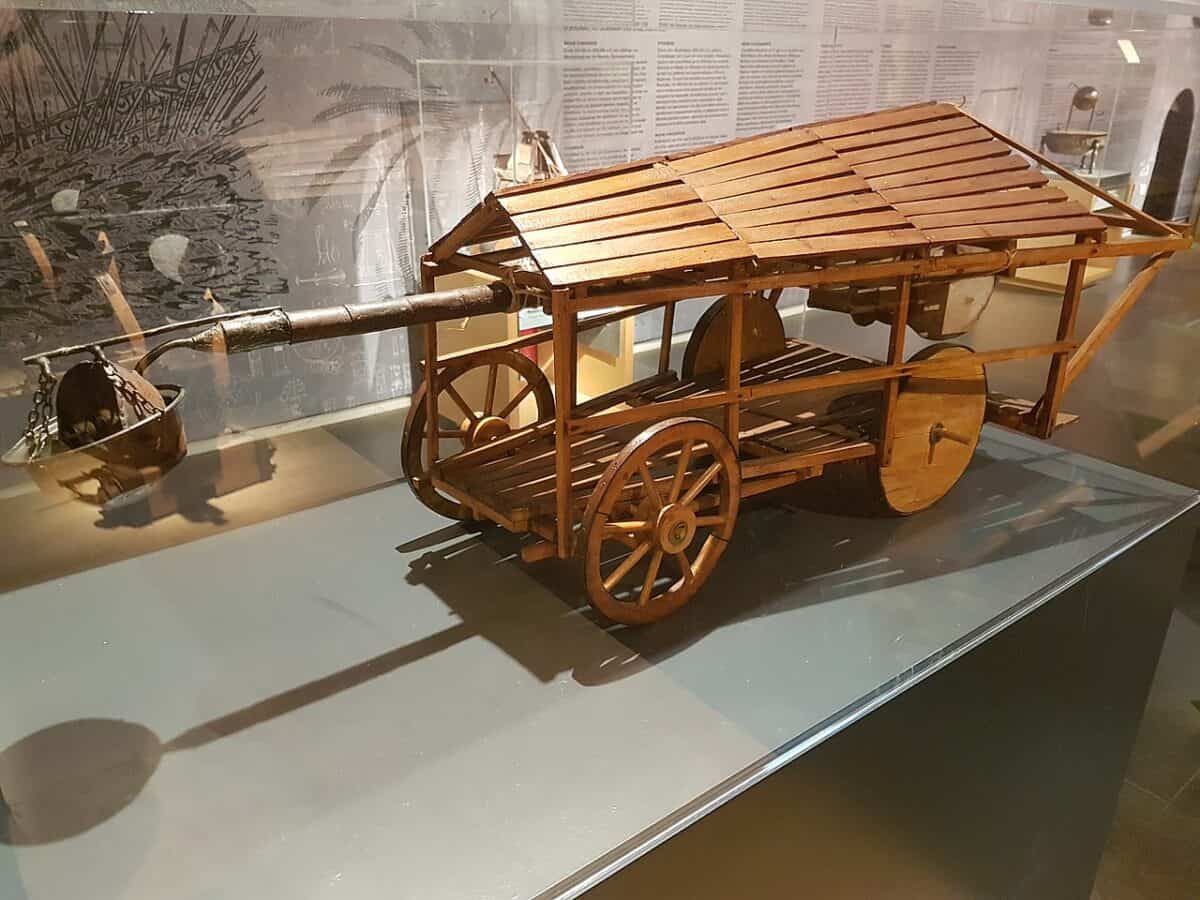
In 424 BC, we’ve got possibly the earliest known example of an incendiary weapon. Thucydides, a rather divisive historian, documented this event during the Siege of Delium in the Peloponnesian War. Thucydides, known for embellishing and aggrandizing his claims, took care to document the device and its function.
It was made of a large beam of wood, sawn in half lengthwise. This was hollowed out, then fitted back together to make a sealed pipe. On one end of the wooden pipe rested a cauldron, suspended over an iron nozzle. The whole of the contraption was covered in iron plates and then wheeled against the Athenian fortifications at Delium. The Boeotians loaded the cauldron with charcoal, sulfur, and pitch, which were affixed to a set of bellows to blow the mixture at the wooden fortifications.
Delium fell shortly after, as the jet of flame produced by the rush of air sent the defenders scrambling from the walls. What makes this rather striking when talking about ancient warfare is who made it. The Boeotians were a known quantity to the Athenians, and were regarded as a culturally inferior people. Their use of an offensive siege weapon the Athenians couldn’t defend against, put that notion to rest.
Conclusion
When looking over any of these innovations, you can see why they are forgotten in the larger backdrop of ancient warfare. These were largely solutions designed for a single operational problem, with few returns to the same line of thinking when empires fell. They exhibit genuine innovation, often predating thinking that wouldn’t become common for centuries. That said, they aren’t necessarily unworthy of memory. It’s just that more banal and typical means of conquest and defense ruled the day.
For every example of something like the Boeotian flame projector, you have many sieges where an enemy simply sat outside the walls and ran down every runner that left a city. History records the more common examples of ancient warfare, with more unusual solutions often being left as footnotes at the bottom of a textbook page.
The image featured at the top of this post is ©VicVa/Shutterstock.com