
The history of small arms engineering is a push and pull between wild imaginations and the harsher realities of what people are looking for in a given firearm. We look back on history-defining rifles like the AK-47, M1 Garand, and Gewehr 88 with some degree of fondness, celebrating their innovations and the lasting legacies they’ve left. However, for every success story, history has a litter of failures waiting in the wings. In some cases, this isn’t simply about where a design was simply too good to be true, but rather a stark reminder of things like technological limitations and the requirements of the average infantryman. Today, we’re looking back at those forgotten, experimental weapons that simply never made the grade, and seeing why they failed.
Mars Automatic
©"MarsAutomaticPistol" by Horst Held is licensed under BY-SA 3.0. – Original / License
The turn of the 20th century saw firearms development as a time of rather wild experimentation. Mere decades before, new technologies like the bolt-action rifle and viable revolvers were developed. Even the machine gun, the defining weapon of the Great War, was a late 19th-century innovation. The next true breakthrough would come in the form of self-loading pistols, or semi-automatics as we know them today. Historically, we can point to designs like the Mauser C96 or Luger P08 as the first true viable designs to be adopted by a military. Colt would have their own take on the concept in the early 20th century, championed by legendary designer John M. Browning. For one designer, these early designs lacked the power needed to be true manstoppers.
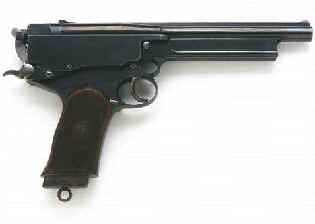
Hugh Gabbett-Fairfax’s Mars Automatic was a handcannon in an era well before the development of true magnum handgun rounds. It was chambered in .45 Mars, one of the more potent handgun calibers of the early 20th century, far outstripping its contemporaries like 9mm Parabellum, .32 ACP, and even the beloved .45 ACP that Colt M1911 would use. On paper, the .45 Mars was a magnificent achievement, generating around 950 joules of energy at the muzzle and achieving an impressive 1,200 feet per second in terms of raw speed.
However, the limitations of the Mars Automatic’s design were quickly evident. The feeding mechanism was a unique design, as the locking block configuration later developed for the Browning Hi-Power had yet to be standardized. The handgun itself was massive, heavy, and absolutely punishing to shoot for any extended period of time. It proved to be a flop with British testers, who didn’t care for the pistol. Further, the complex mechanism driving the pistol was susceptible to fouling, especially when considering field conditions in the age of industrialized warfare. Only around 80 of the Mars Automatic pistols were developed from 1897 to 1907, becoming a prized collector’s item.
Gyrojet
©"File:Gyrojet at National Firearms Museum (460776909).jpg" by Joe Loong from Reston, USA is licensed under BY-SA 2.0. – Original / License
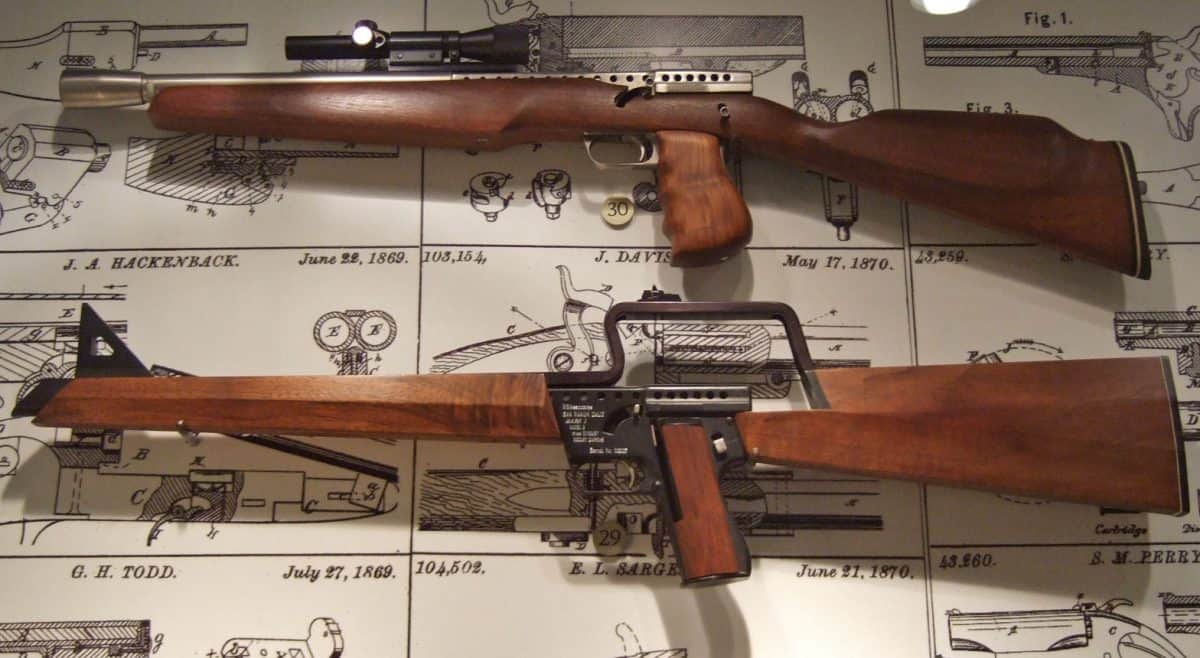
You certainly can’t blame designers for trying to get in on the hype of the Space Race in the 1960s. IT is one of the pivotal turning points of the Cold War, and one of the most enduring events in American history. MB Associates decided that sort of space-age technology was just the sort of thing that was needed, especially for the wars of tomorrow. The Gyrojet wasn’t like a conventional small arm by any means. It made use of solid fuel rockets as its primary ammunition source, foregoing more of the traditional elements of a pistol or rifle, like a locking breech or steel barrel. On paper, it sounds like a dream come true for many soldiers, as the light weight of both the ammunition and the pistols and carbines themselves made for easy carrying. Plus, you could count on the weapon producing no recoil, given its nature as a solid-state rocket.
The Gyrojet failed primarily due to the physics around the concept. A standard bullet is at its fastest when it leaves the barrel, generating enough force and pressure to exit the muzzle and impart its energy on a given target. The rockets fired by the Gyrojet needed time and space to ignite, meaning you could reasonably stop the gun from firing simply by putting your finger in the muzzle like an old cartoon gag. The tiny exhaust ports on the rockets were also a sticking point, as they could readily clog due to their small size. Accuracy was nothing to write home about, with some testing showing them to veer off course wildly before striking their target.
When you consider that the weapon only truly entered its effective range after the projectile had traveled about 30 feet or so, you don’t have a winning recipe. During the 1960s, it was a resounding failure, with Gyrojet managing to sell around 2,000 firearms before it closed up shop in 1975. Like the Mars Automatic, this experimental weapon remains a favorite of collectors, with unfired ammunition fetching a princely sum at auctions.
H&K G11
©Marcus Burns, CC BY 3.0 , via Wikimedia Commons – Original / License
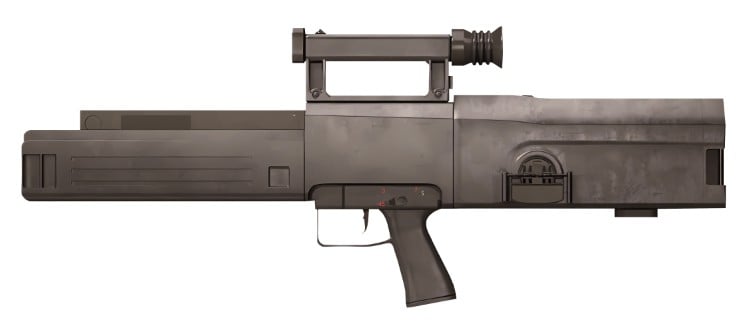
If anything, the G11 is perhaps the closest a design we’re covering today has met with widespread adoption. Famed German arms manufacturer Heckler & Koch sought to solve the weight problem present with any modern firearm. Ammunition can weigh quite a bit, especially for a soldier looking to carry a full combat load in the field. This is partly down to the design of the modern rifle cartridge, with a metal jacket being the best possible solution for containing pressure when the round is loaded into the breech.
The G11 made use of caseless ammunition, meaning the bullet was fully encased in its propellant. This cut down on weight significantly, and allowed for a radically different design when it came to the G11’s inner workings. Internally, H&K’s design resembled a finely manufactured watch when compared to contemporaries like the M16’s direct impingement system. It could achieve astonishing rates of fire as well, with the 3-round burst mode maintaining 2,000 rounds per minute.
What killed the platform wasn’t so much the constraints or limitations of the weapon, although field stripping it for basic cleaning was a difficult proposition at the best of times. The death knell of the G11 came about in the form of the political climate surrounding West Germany in the late 1980s and early 1990s. The once divided country reunified, bringing a significant number of problems to the fore. H&K’s wonder rifle was shelved, as the last thing the German government needed was a massive expenditure to retool logistics chains and ammunition stores.
Dardick
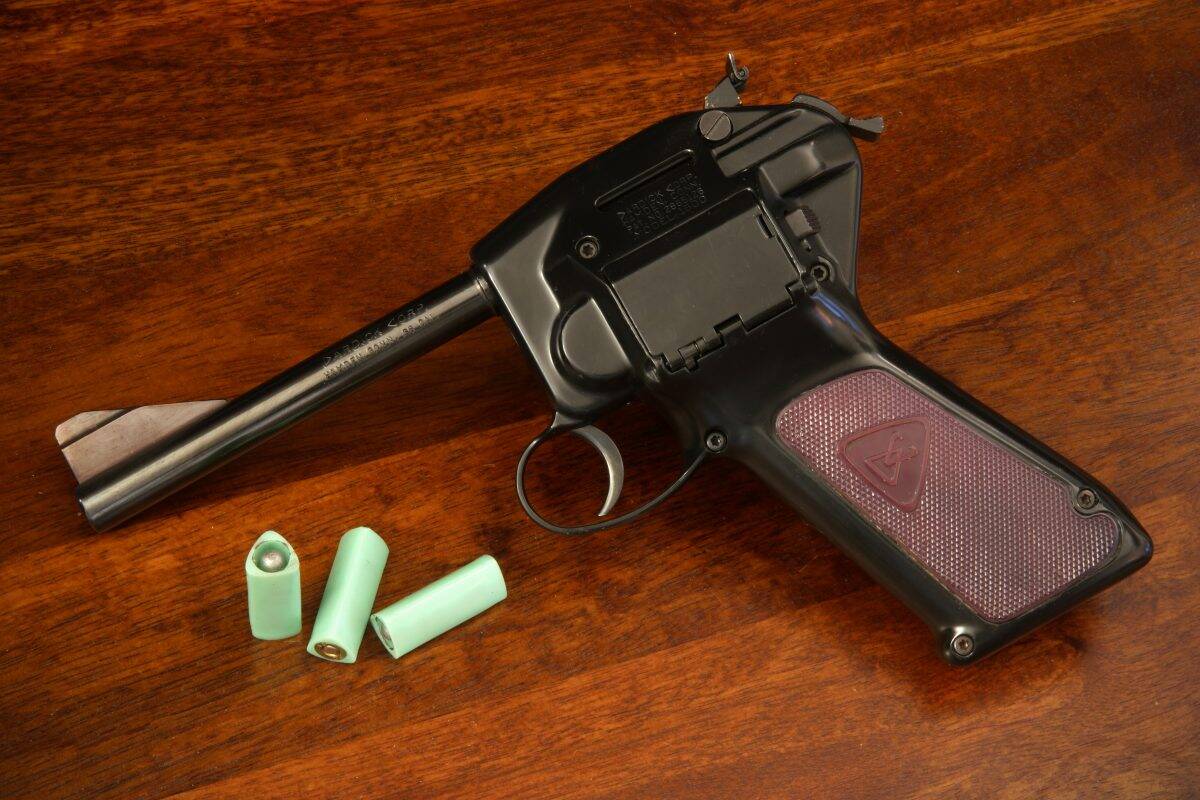
©"Dardick 1500 with trounds (29432934078)" by lifesizepotato from San Antonio, TX is licensed under CC0 1.0. – Original / License
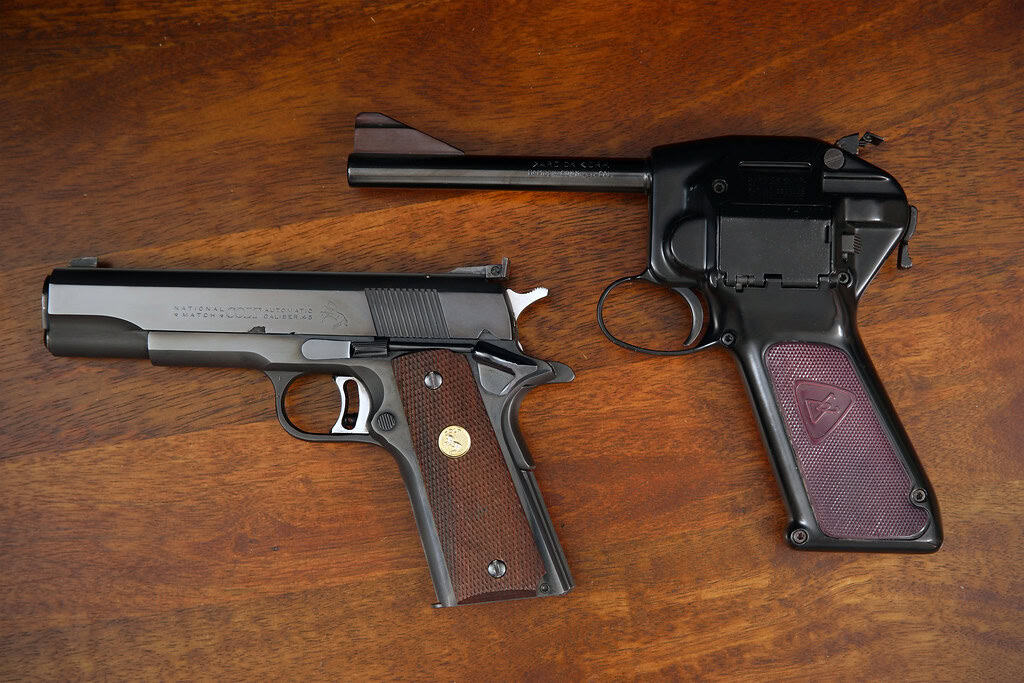
Many of the conventional elements we’ve grown accustomed to with small arms are the result of many failed experiments. Spitzer bullets, rounded metal cases, and more have come about thanks to decades of testing, iteration, and refinement. Inventor David Dardick wasn’t satisfied with the state of handguns, getting to work on a rather unusual design for an open-chamber pistol starting in the late 1940s. By 1958, he had patented the first element of an admittedly off-kilter revolver design. Dardick was operating off the idea that triangular cases allowed for more efficient use of space, something the United States Military had experimented with in the 1950s before ultimately shelving it.
The Dardick pistols were magazine-fed revolvers, and yes, you are reading that correctly. Rather than the enclosed cylinders seen in just about every revolver manufactured over the last 200 years or so, the Dardick made use of open cylinders, with triangular rounds, or trounds, being stripped from the magazine and loaded with each pull of the trigger. Theoretically, the reasoning was sound, as you could readily get quite a bit of ammunition in a magazine. The smallest of Dardick’s designs could hold 10-rounds, with capacities going up to 20-rounds.
While the potential for fewer moving parts and more compact dimensions is appealing, the Dardick never caught on. Third-party support for a gimmicky ammunition type never manifested, and the pistols were discontinued in 1962. A handful of these weapons were tested by the United States Military, but were ultimately passed on.
Conclusion
The world of small arms design isn’t so much about pushing boundaries forward, but that does certainly play a role. Instead, when it comes to meeting the needs of soldiers, it comes down to what is good enough. The failures we’ve looked at today could’ve been workable designs with time, investment, and support. However, the kinks in the overall designs were never addressed, and they’ve ultimately been left to the sands of time as a result. If ain’t broke, don’t fix it, or so the saying goes.
The image featured at the top of this post is ©"Dardick 1500 vs Colt 1911" by lifesizepotato is licensed under CC0 1.0. – License / Original