
American history has been largely forged in conflict, starting from the very first days when the Revolution’s first volleys were fired. Suffice it to say, firearms are an integral part of the social fabric of the United States, playing a key role in politics, expansion, industry, and shaping the culture for centuries at this point. American firearms have ranged from European-pattern muskets to the modern assault rifles used by today’s military.
Beyond just the mere mechanical designs, these weapons have a profound impact on the shape and course of the American people. Today, we’re looking at the weapons that won wars, settled frontiers, redefined entire military paradigms, and fuel debates even to this day about the role they play in American society. Having a keen understanding of these firearms is integral to gaining any sort of insight into America today.
Muskets
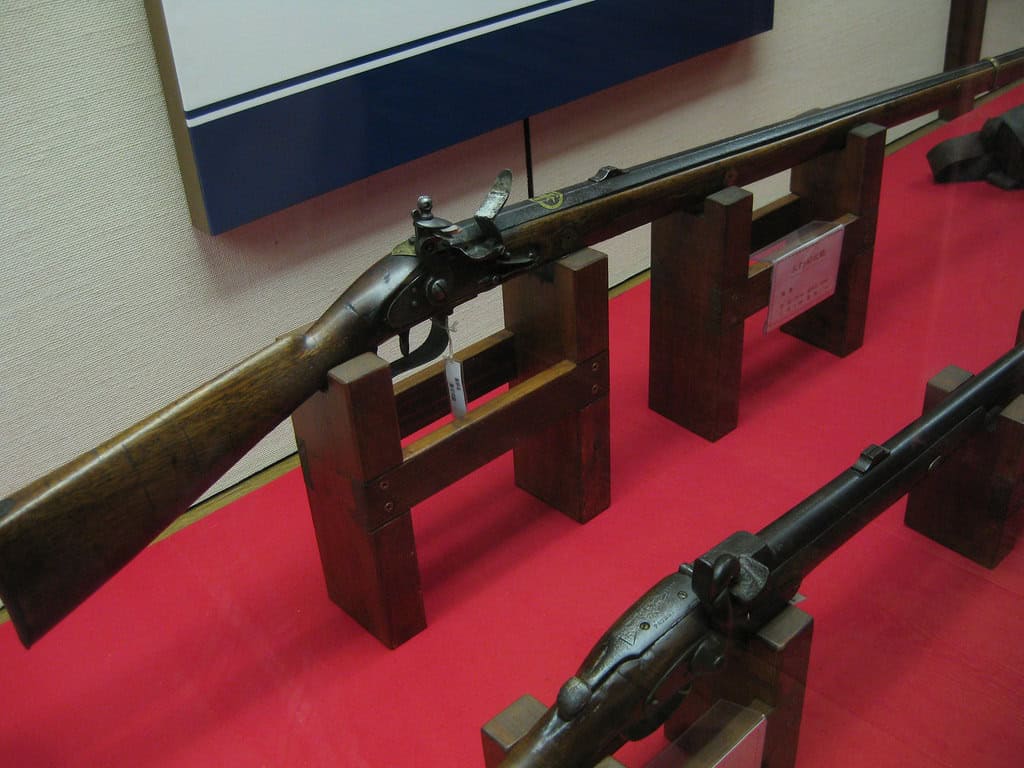
©"Flintlock musket" by ryochiji is licensed under BY 2.0. – Original / License
The earliest firearms in American history weren’t too dissimilar to those used in mainland Europe. American settlers arrived on the continent toting matchlock muskets, eventually transitioning to flintlock muskets around the late 17th and early 18th centuries. When flintlocks became the norm, these were Brown Bess-pattern muskets, typically used by British forces for over a century. These were typical flintlocks, being muzzle loaders with a smoothbore barrel. By modern standards, these were inaccurate in the best of conditions. When used en masse, they could shine, as the volume of fire far outweighed their shortcomings.
In colonial America, the musket saw many uses. Primarily, they were tools of survival, being used for hunting and bringing game to the dinner table. This was a decidedly less settled America, at least by European standards, and the threat of attacks from hostile forces meant that able-bodied men were likely to be trained in basic maneuvers in formations. The bedrock of an armed citizenry was established well before the Constitution was drafted. With firearms being part and parcel of early American life, you can start to see how guns became so intertwined with the notions of basic rights.
Pennsylvania Rifle
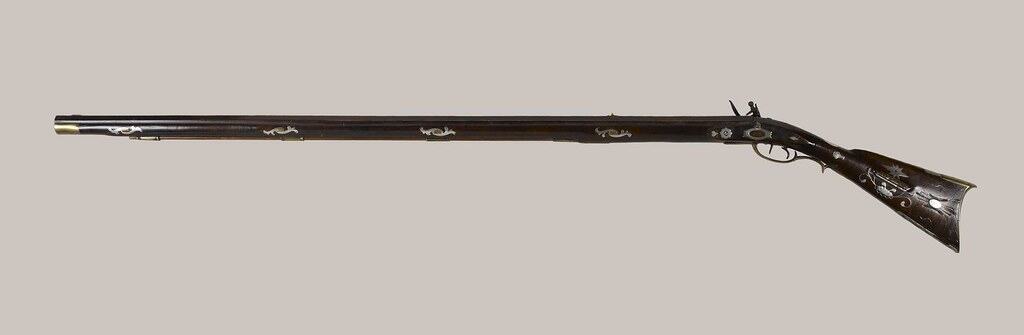
©"Kentucky Rifle ca. 1810" by museado is licensed under CC0 1.0. – Original / License
By the time the first rounds were fired at the Battles of Lexington and Concord, the American service rifle had changed. While smoothbore muskets were still fairly common, the Pennsylvania Rifle, or Kentucky Rifle, started seeing frequent use. This was a rifle in the truest sense, with grooves in the barrel to impart spin on the round as it left the muzzle. Rifled muzzleloaders were more difficult to reload under pressure, and arguably less effective when affixing bayonets for close quarters.
However, the Pennsylvania rifle had the advantage of range over the typical smoothbore muskets in use by British forces. Sharpshooters could effectively engage officers and artillery crews at distances where traditional muskets would be ineffective. Irregular warfare gave American forces a chance against the superior expeditionary forces of the United Kingdom, at least when considering the strength of arms, numerical superiority, and professional discipline.
Colt Paterson

©"Colt Paterson No 5" by Hmaag is licensed under BY-SA 3.0. – Original / License
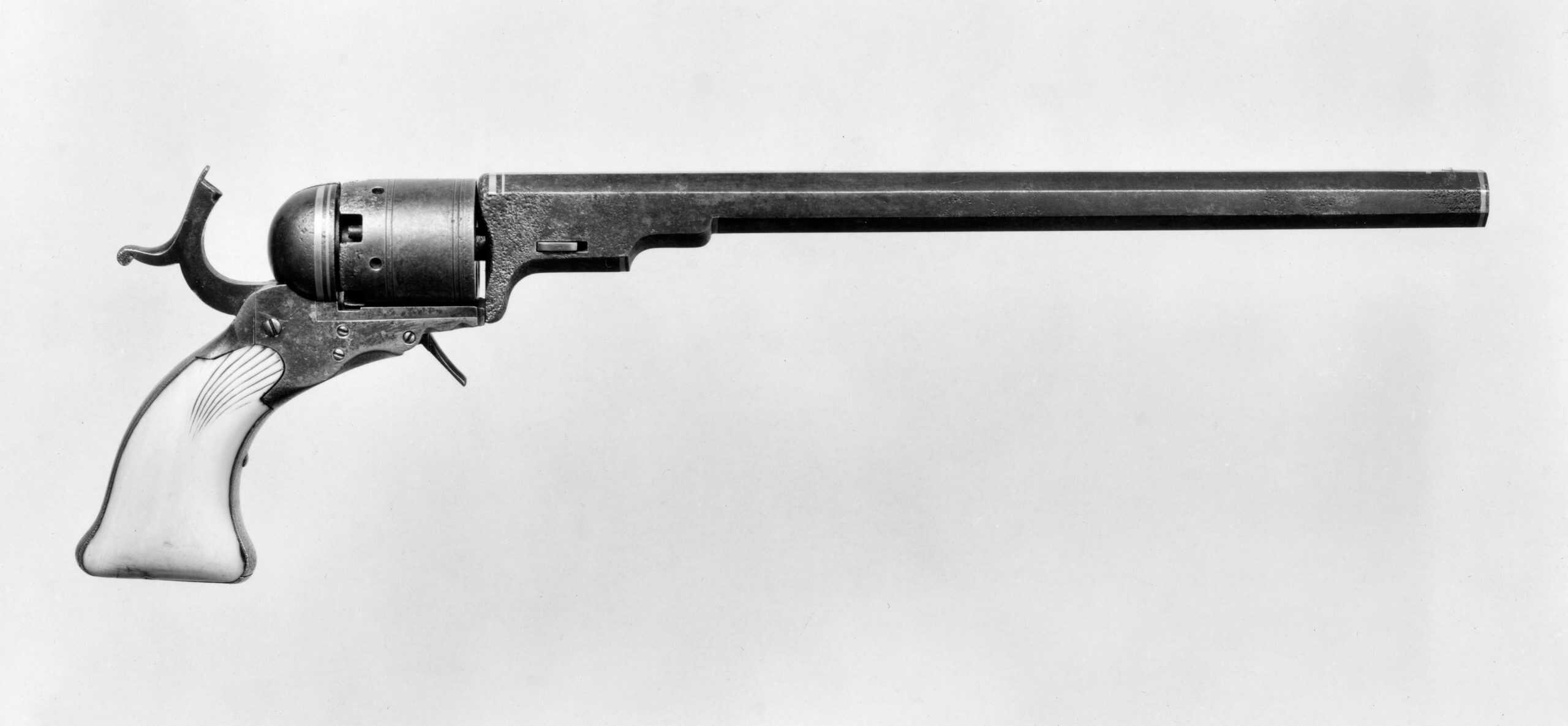
The 19th century saw the rise of true repeating firearms. Weapons that were able to fire more than one round without needing to reload weren’t uncommon by any means, but they were often mechanically complex, fragile, and inherently dangerous due to certain design flaws. Samuel Colt’s 1830s Paterson revolver changed things considerably, being the first truly viable revolver to be sold on the wider market. The Paterson did have reliability issues, but given its debut in 1836, few pistols could offer the same sort of advantages.
Colt got hard at work on its successor designs, refining the concept into the later Colt Walker and 1851 Navy. The foundation for the later 1873 Single Action Army was set, and repeating pistols changed things considerably. It wasn’t uncommon for people to carry single-shot pistols as a means of personal protection, but having multiple rounds without needing to reload was a massive boon.
The revolver is a decidedly American refinement, and the popularity of the Paterson and its successors had a profound effect on the psyche of the United States. No longer was the open frontier being mastered by brute force and sheer numbers, but instead could be ostensibly tackled by singular men.
Springfield Model 1861

©The Smithsonian Institute / Public Domain – Original / License
You can make your arguments about the first truly industrialized war. For the United States, it would be the American Civil War, waged between 1861 and 1865. Weapons and materials were mass-produced, moved by rail, and firearms carried a whole new degree of lethality. This is best exemplified by the 1861 Springfield, which was a rifled musket making use of the cutting-edge Minie ball. Rifled firearms were already a massive advantage for any forces, but the use of the Minie ball allowed for even greater accuracy and range.
Infantry tactics largely hadn’t changed by the mid-19th century, with massed formations being the norm. The devastating effects of rifled firearms were seen in the opening battles of the American Civil War, where thousands died in droves as wave after wave of volleys were fired. Soldiers could effectively engage far beyond just 100 yards or so. More importantly, they were far more effective, inflicting horrific casualties.
The use of rifled muskets like the Model 1861 Springfield and its equivalent in use by the Confederate States led to a massive shift in infantry tactics. The old way of fighting would no longer work, a lesson that many European nations would have to learn the hard way as the Great War grew closer.
Winchester Model 1873

©"Winchester Model 1873" by Hmaag is licensed under BY-SA 4.0. – Original / License
Lever-action rifles never saw mass adoption across the world. Their mechanisms were prone to fouling, and the later development of Spitzer bullets meant that they simply weren’t viable for the rapid pace of firearms technology in the late 19th century. The Model 1873 lever action developed by Winchester has a reputation all of its own, and one deeply enmeshed with the American frontier. The 1873 is best known by its appellation, “The Gun That Won the West”, which certainly has some credence to it.
The 1873 and its successors saw frequent use both in combat, ranching, hunting, and general peacekeeping. Lawmen, outlaws, and Native Americans alike were fond of the weapon, although the use of the Model 1873’s use by indigenous peoples is a bit overblown. That said, by the time films grew in popularity, the 1873 had become iconic, and part of the mythology of the Wild West.
While it might not have been the defining rifle of the 19th century, which arguably will go top the Gewehr 88 and its successors, few rifles are so closely associated with a time and a place like this lever-action.
M1903 Springfield

©"M1903 Springfield – USA – 30-06 – Armémuseum noBG" by Armémuseum (The Swedish Army Museum) through the Digital Museum (http://www.digitaltmuseum.se). is licensed under BY-SA 3.0. – Original / License
Speaking of the Gewehr 88, the Mauser bolt-action has been the norm for well over a century, with many bolt actions building upon the foundation set by Paul Mauser in the late 19th century. By the turn of the century, many nations were making use of their own take on the action, just like the United States’ M1903 Springfield. It saw use across the last of the battles across the American frontier, and was the primary service rifle throughout the First World War and the opening stages of the Second World War.
It isn’t hard to see why it was such an enduring design, either, as the potent .30-06 chambering, proven action, and ease of use made it a winner when it came to the trenches of the First World War. Well before the establishment of dedicated sniper schools in the United States Armed Forces, the 1903 Springfield was a prized battle implement for sharpshooters. If anything, the M1903 marks the transition from the United States being a nation still undergoing massive changes to its evolution as a world power.
M1 Garand
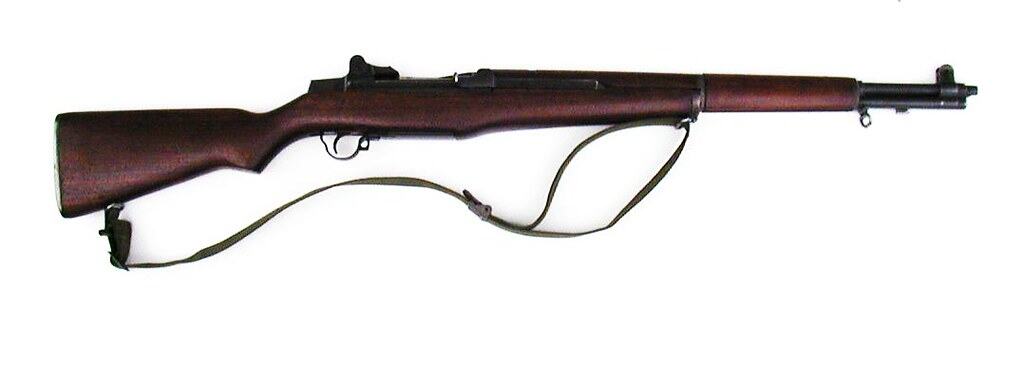
©"M1 Garand" by simonov is licensed under BY-SA 2.0. – Original / License
General George Patton once dubbed the M1 Garand “the greatest battle implement ever devised,” and it’s a bit of praise that is well-earned. Adopted in 1936, the M1 Garand marked the first true semi-automatic to be adopted on a larger scale by a world power. Chambered in the same .30-06 utilized by its predecessor, the M1 Garand’s 8-round internal magazine gave a substantial amount of firepower without any lag time.
When it came to combat, the M1 Garand had a significant edge against the Arisaka rifles of Japan and the Karabiner 98ks utilized by Nazi Germany. Few nations would field semi-automatic rifles as the war wore on, but the United States famously made use of them. America would enter the war as an industrial powerhouse, seen best by issuing millions of these over the course of the weapon’s service life.
Further, it demonstrated the technological innovation at the core of the American experience, as it was a proven, tested design that entered combat and acquitted itself quite ably.
Colt M1911
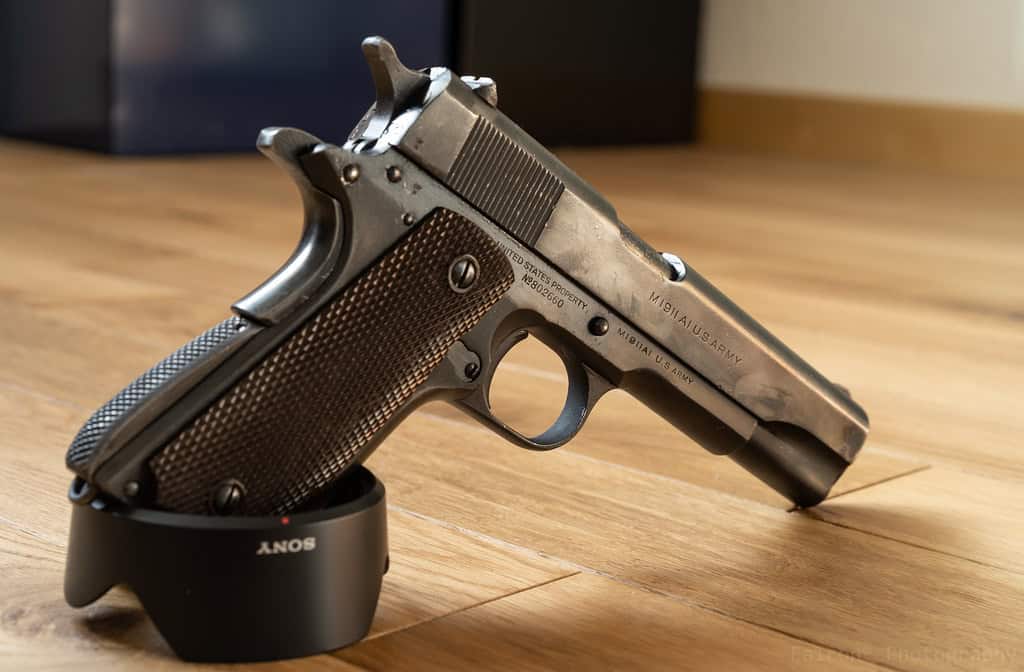
©"Colt M1911A1" by Falcon_33 is licensed under BY-SA 2.0. – Original / License
Adopted shortly before the First World War, the Colt M1911, often regarded as the magnum opus of firearms designer John Moses Browning, has the distinction of being one of the longest-serving sidearms in American history. It saw combat in the First World War, Second World War, Korean War, and Vietnam, with some limited use in the decades since it was effectively replaced by the M9 and M17 service pistols.
It isn’t hard to see why, as the M1911 is a masterstroke of design work. Ease of use, user comfort, and potency made it a popular choice for close-quarters combat when a rifle or carbine might’ve proven to be too unwieldy. Despite no longer being a common service weapon, it remains a popular choice for civilians, who use it for sport and self-defense purposes.
AR-15

©Colt AR-15 Sporter Lightweight rifle – upper lower break (8378298627) by Steve Rainwater from Irving, US / BY-SA 2.0 (https://creativecommons.org/licenses/by-sa/2.0/) – Original / License
Designed originally in the late 1950s and later adapted into the M16, no firearm has been quite as contentious as the AR-15. In military service, it marked a significant shift in combat tactics, with the focus moving toward smaller-caliber, high-velocity cartridges. It was controllable in automatic fire and surprisingly effective against soft targets.
As the platform aged, future revisions made it a highly customizable, modular platform. However, it serves as something of a firebrand when it comes to American political discourse. The AR-15’s popularity and near ubiquitous nature in the civilian market have sparked debates over gun rights, public safety, and the nature of the Second Amendment itself. It has become far more than just a weapon, but a symbol of the times, illustrating just how deeply entrenched firearms are in the American identity.
Conclusion
From the humble, crude matchlock muskets well into the modern era, firearms have shaped the destiny of the United States. They’ve shaped how the American military fights, how the frontier was settled, and how Americans view their individual rights within the wider context of the Constitution. These aren’t mere tools of violence, but reflections of American progress, social change, and national values. By studying them and their impact, we have a far keener understanding of how we’ve ended up where we are today.
The image featured at the top of this post is ©"